I haven't been able to get to it until now. As I noted before in the earlier posting, I like Shaw. He seems harmless enough to me in 2017, but that obviously cannot be true, since all authors worth reading must be dangerous in some way. Arms and the Man spoofs romanticism, or the romantic mindset, but in a fun rather than seething or contemptuous way, I think. Here is a note I wrote about it in 2001, Lincoln's birthday to be precise, which was a later reading after my initial one, dated March 5, 1999:
--Much more impressed with the play the second time around, the conflict between ideality and "reality" is quite clear really, I'm not sure why I wasn't "struck" by it before. I think it seems apparent that Shaw is skeptical of the idealists, though I think he understands the need for these feelings--in his society I believe he felt their aims--and people's energies--were often misplaced.--
That doesn't say much. One ought to be able to say something intelligent about a work one likes--the point of the exercise is otherwise lost. I like that all of the characters in this, as well as in other Shaw plays, are willful and individualized protagonists whose personas impose upon each other (with the possible exception of the servile Nicola, who is however so aggressively dedicated to his servility that it achieves a kind of force in itself).
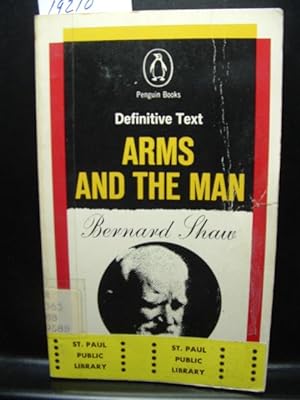
My edition is a Penguin paperback proclaiming itself "the Definitive Text". It contains just the single play though it seems to belong to a broader set of "The Penguin Shaw". The last copyright date is 1958, but it looks to be of a much later date than that, 80s or even possibly early 90s. The publisher's price was $3.50. Probably not the 90s then. I noted that I bought it in Concord. The used book store we used to have in town must still have been open then, though it did not last much longer.
This is my edition, but not my book. Someday soon I hope to have the technological capacity to take and post my own photos again.
A few favorite quotes to mark the occasion:
RAINA: ...But they don't know that it was in this house you took refuge. If Sergius knew, he would challenge you and kill you in a duel.
BLUNTSCHLI: Bless me! then don't tell him.
SERGIUS: You have deceived me. You are my rival. I brook no rivals. At six o'clock I shall be in the drilling-ground on the Klissoura Road, alone, on horseback, with my sabre. Do you understand?
BLUNTSCHLI: ...Oh, thank you: that's a cavalry man's proposal. I'm in the artillery; and I have the choice of weapons. If I go, I shall take a machine gun.
PETKOFF: We should be most happy, Bluntschli, if it were only a question of your position; but hang it, you know, Raina is accustomed to a very comfortable establishment. Sergius keeps twenty horses.
BLUNTSCHLI: But who wants twenty horses? We're not going to keep a circus.
Bluntschli is obviously, like Caesar in Caesar and Cleopatra, the Shavian alter ego in this play.
I am picking my way through the Mencken pretty slowly. It has its usefulness, I guess, although most of the various approaches to the subject of language which are described in the book are probably outdated, haphazard and imprecise by the standards of modern scholarship. There are a lot of illustrative anecdotes and tidbits about American life from colonial times up to the 1930s which serve the purpose of filling out further one's perception of what the country has been through time. For example, I had not known that the American custom of giving policemen and even railroad conductors military titles (captain, sergeant, etc) is not done in England and was considered strange in that country. Mencken's famed ability for lacerating the pretensions and ill-conceived ideas of the weaker-minded is not on full display here though one occasionally comes across a mildly amusing sentence:
"Nor is the title (Dr.) frequent among pedagogues, for the Ph.D is an uncommon degree in England, and it is seldom if ever given to persons trained in the congeries of quackeries which passes, in the American universities, under the name of 'education'."
If you are wondering where Phileas Fogg and Passepartout are in Around the World in Eighty Days, they are in Nebraska after the attack on the train by the band of Sioux warriors, being carried by sledge from Fort Kearney to Omaha, where they hope to catch a train that will get them back to New York in time to catch the steamer back to England that is the last leg of the trip. I assume Fogg is going to make it within the eighty days and win the bet, but as I am not familiar with any version of the story I am not absolutely certain.
For the most part I think the second Knausgaard book is better than the first, although most of the material in the first volume is more interesting to me, the second volume mainly being concerned with his domestic life as a thirty-something man with children living in an apartment in Stockholm, which does not come off as a particularly thrilling or vital city to live in, though I'm sure I would like it there. Perhaps I am more used to him now. Also I suspect he must have more control over his style and the effect he wants to have, since fairly banal recitations of changing diapers or the preparation of yuppie meals will often be a set up for some more interesting part. However I still haven't figured out whether the banal descriptions of everyday life are really necessary from the literary point of view. He does refer a lot to an idea which I sometimes touch on as well, that at least some people in future times will want to know what life in this time period was really like, and there will not be near enough books (there never are) that will convey that sense, which does have a power of its own when done well.
This is going to be a hurried report, as I want to post before I leave on a trip so I can take my next book with me. If, unlikely though it is, I have some time with the computer one evening while I am on that trip, I may write a supplement to this post.
The first appearance of Shaw in the program. He will appear many more times, five by my reckoning, which is not as many as Eugene O'Neill will have, but I think it safely puts him ahead of every other playwright besides Shakespeare.
As I grow older I find Shaw more amusing. His plays tend to follow similar patterns, mostly arranged around puncturing bourgeois pieties and other aspects of the collective mentality of those classes, but he is quite funny and his writing is clear and fairly unique, to me, I don't think anyone else really writes like him (maybe Wilde has some similarities) or they would be just as celebrated.
I read this back in March, 1999, both before I had children and when I was a very earnest note-taker and marker up of books in the full expectation of developing into a literary man myself. I am not going to claim that my notes revealed any accurate insights, but I am astounded by how much I noticed, or tried to notice and how attentive I was to word choices and trying to articulate the intent of gestures and actions...
OK, I am not going to be able to finish this tonight. There will be a supplement forthcoming with the rest of the post. This is kind of cheating on my self-imposed rules, but I don't want to put off starting the next book for almost two weeks....
The Challenge
1. Iron Man 3 (movie)...........................................................................................................3,663
2. Kate Andersen Brower--The Residence: Inside the Private World of the White House...1,955
3. Kelly Link--Get in Trouble..................................................................................................125
4. Sarah Morgan Dawson--A Confederate Girl's Diary............................................................80
5. Ocean Vuong--Night Sky With Exit Wounds.........................................................................51
6. Sarah Bradford--Lucretia Borgia..........................................................................................50
7. Natalie Diaz--When My Brother Was an Aztec.....................................................................37
8. Flash Fiction Forward (eds. Thomas and Shepard)..............................................................28
9. Best of Lady Churchill's Rosebleed Wristlet (eds. Link and Grant)........................................4
10. Camille Rankine--Incorrect Merciful Impulses.....................................................................3
11. Salil Tripathi--The Colonel Who Would Not Repent: The Bangladesh War and its..............3
12. Danez Smith--Insert Boy........................................................................................................2
13. Ron Davis--Forbidden Fruit: Indecent Relations..................................................................1
14. Xao Seffcheque--Ja-Nein-Viellicht Kommt Sehr Gut (record)...............................................0
15. Solmaz Sharif--Look...............................................................................................................0
16. Juan Martinez--Best Worst American.....................................................................................0
Round of 16
#1 Iron Man 3 over #16 Martinez
No library recognition for Martinez's book which did just come out a month ago.
#15 Sharif over #2 Brower
A somewhat stunning upset. Sharif's short poetry book is actually at my library. Incredible.
#3 Link over #14 Seffcheque
Seffcheque is undoubtedly an obscure figure, especially in the English-speaking world, but what was he all about?
According to 3 of the 11 comments on this video, this song was big in Montreal in the early 80s.
#4 Dawson over #13 Davis
#5 Vuong over #12 Smith
#6 Bradford over #11 Tripathi
#7 Diaz over #10 Rankine
#8 Flash Fiction, etc over #9 Lady Churchill's, etc
In all of these instances the winning book had received the imprimatur of having been acquired by a library--in numerous instances just one--while the loser had not.
Round of 8
#15 Sharif over #2 Iron Man 3
#8 Flash Fiction over #3 Link
#7 Diaz over #4 Dawson
#5 Vuong over #6 Bradford
I had really wanted to have a battle of the Sarahs, but it wasn't meant to be.
Final Four
#15 Sharif over #4 Vuong
Vuong's poetry offering is even shorter than Sharif's, but he is only available in Dover, while Sharif
has been embraced by four libraries, including my own public one.
#7 Diaz over #8 Flash Fiction
Championship
#15 Sharif over #7 Diaz
Diaz's book was a shorty too, but was only available in one college library in-state (Southern New Hampshire University).
This Challenge was notable for the number of diverse authors and modern books, what everyone is counting on to be the future of literature. I suspect that if Shaw were around today, he would be something of a multiculturalist champion, at the snooty upper end of the scale anyway. It seems to me that if someone (the new person rising from a traditional outgroup) had the stuff to pierce urbanely through conventionalities and other nonsense, he (Shaw) respected them well enough, though not everyone saw him in such an enlightened light.
(The italicized notes I have added to the post because the last sentence made no sense to me for several minutes when I read over it again. Also the real Shaw in his time probably would have been no more of a multiculturalist than the general run of his kind, though if raised in ours he might have been adaptable. I do believe he had had to have some respect for (other) iconoclasts, provided they were clever.)
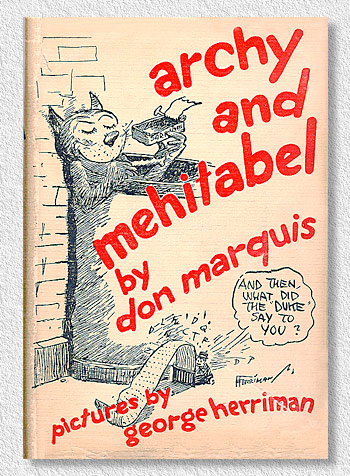
This may be the closest thing to a comic book on the IWE list. archy was a cockroach who in a previous life had been a free verse human poet. He banged out poems, all in lower case letters due to his not being able to reach the shift key, at night on a typewriter in what I took to be a newspaper office in New York City, though evidently it was in an apartment. mehitabel was a street cat of shockingly loose morals by the standard of literary anthropomorphized animals who appeared to live in the apartment in the earlier poems though after the beginning she was out living the hardscrabble city life most of the time. The poems originally appeared in The New York Sun newspaper, often famously accompanied by illustrations by Krazy Kat cartoonist George Herriman. These stories were immensely popular in their day. The himself once much more famous writer Christopher Morley, as recounted on the dust jacket of my edition, called the stories "the wisest collection of American irreverence written in our time" and that "the grandest of all times to have been young and excitable...about 1916 when Don Marquis invented his Vermin Voltaire, archy the roach". Three books were made out of this material, archy and mehitabel, archy's life of mehitabel, and archy does his part, which in turn were collected into the one volume the lives and times of archy and mehitabel in 1934. This was the book that I read, though looking over the summary in the IWE, it stopped at the first volume, which was by far the best, and in truth, I found the second and third books to be disappointments that added little to the first. It became a little repetitious after a while. The first book, however, I did like. Its charms lie in its mixture of absurdity and matter of fact, even blunt concerns about eating and scrapping and other facets of the life of a small urban animal who possesses the instincts of said animal along with a humanlike consciousness and language. archy offers more direct social commentary in the later poems, some of which hits its mark as far as it goes, but it tends to lack the playful anarchic quality of the earlier stories.
I was very lazy about making notes for this book, so I do not have many examples to comment on.
From "quote and only man is vile quote":
"humanitys culture consists
in sitting down in circles
and passing the word around
about how darned smart humanity is
i wish you would tell
the furnace man at your house
to put out some new brand
of roach paste I do not get
any kick any more out of the brand
he has been using the last year"
An 'archygram' about living in a museum
"but it is dull associating
with mummies no
matter how royal their
blood used to be when
they had blood
it is like living in
philadelphia"
From "archy visits washington"
"it is so hot that you can
fry fish on the
sidewalk in any part of
town and many people
are here with fish to fry"
From "the league"--archy seems to have been in the main a liberal, and supportive of the idea at least of organizations dedicated to the promotion of peace, though he was doubtful about their effectiveness.
"incidentally I wonder why europe of today
is always referred to by highbrow writers
as post war europe
they seem to think that the war
which started in nineteen fourteen
is over with whereas there have been
merely a few brief truces"
From 'statesmanship"
"why in the world
says this
insect do you not
go to the country and become
grasshoppers if
living in town and being
cockroaches is getting
too difficult for you...
how i asked him are
cockroaches to become
grasshoppers
that is a mere
detail he said which i
leave to you for
solution i have outlined
the general scheme for your
salvation so do not ask
me to settle the mere
details i trust to you for
that you must do
something for yourself
we philosophers cannot do it all
for you unaided you
must learn self help
but alas i fear that
your inherent stupidity will
balk all efforts
to improve your condition"
Eddie Bracken and Carol Channing made a recording of the 'archy' material, subtitled "a back-alley opera" in 1954.
From "what the ants are saying"
"what man calls civilization
always results in deserts
man is never on the square
he uses up the fat and greenery of the earth
each generation wastes a little more
of the future with greed and lust for riches"
He was quite prescient as far as anticipating some of the attitudes of modern progressives and other cynics of the American system in particular.
mehitabel the cat was a well-conceived and very lively creation, who plays well off of archy's somewhat more constrained and frustrated persona.
The Challenge
1. Ben-Hur (movie).........................................................................................1,918
2. Emma Cline--The Girls...............................................................................1,466
3. Ben Mezrich--Bringing Down the House.......................................................571
4. Mark Helprin--A Soldier of the Great War.....................................................448
5. Thomas Pynchon--Against the Day................................................................111
6. Ray Bradbury--Golden Apples of the Sun.........................................................47
7. Randy Olson--Houston, We Have a Narrative.................................................46
8. Lake/Simmons--Bazaar Style...........................................................................22
9. Lisa Leavitt-Smith--Paris Interiors...................................................................15
10. Rico Austin--In the Shadow of Elvis...............................................................14
11. Mark Thomas--Belching Out the Devil: Global Adventures with Coca-Cola..7
12. Jen George--The Babysitter at Rest...................................................................7
13. Conan/Sorrell--At Home With Pattern..............................................................3
14. Nathalie Leger--Suite For Barbara Loden........................................................2
15. Annette Messager--Word For Word..................................................................1
16. Raymond Carroll--Only Raising Dust on the Road, Part 1...............................0
17. A Series of Unfortunate Events (TV).................................................................0
Play-In Round
#16 Carroll over #17 Unfortunate Events
This version of the Lemony Snicket stories is a streaming-only TV series.
The Sweet Sixteen
#1 Ben-Hur over #16 Carroll
I break my rule of never allowing a book to beat a film when no library has a copy of the book.
#2 Cline over #15 Messager
Cline is shorter and more readily available, and looks as if it might be a real book.
#3 Mezrich over #14 Leger
#4 Helprin over #13 Conan/Sorrell
These two are walkovers.
#5 Pynchon over #12 George
I'm not really ready at this time to read a 1,085 page Pynchon novel (though I know I should be), however I have to retain some integrity for the Challenge and I can't let him be beaten by a babysitter book.
#6 Bradbury over #11 Thomas
I was actually interested in the Coca-Cola book, but it drew a tough matchup here.
#7 Olson over #10 Austin
Despite a combined 60 Amazon reviews for their books, neither author has had a work make its way into a library in the state of New Hampshire.
#8 Lake/Simmons over #9 Leavitt-Smith
Same story here. I believe this is the first time we have ever had chalk in the round of 16.
Elite Eight
#1 Ben-Hur over #8 Lake/Simmons
Ben-Hur will fall when he runs up against a vetted book.
#2 Cline over #7 Olson
#6 Bradbury over #3 Mezrich
Finally, the first lower seed to win.
#4 Helprin over #5 Pynchon
Titanic matchup, obviously. Helprin's book, at 792 pages, is the short one by far here.
Final Four
#6 Bradbury over #1 Ben-Hur
#2 Cline over #4 Helprin
The Cline book is not obviously unserious enough to lose here.
Championship
#6 Bradbury over #2 Cline
Bradbury, along with Thomas, his first opponent, were designated for upsets, but Bradbury never really needed to rely on one as he cruised to the title.
I couldn't find any map or description of neighborhoods with boundaries definitively delineated enough for my purpose, so I have classed my sites here by the Metro station they are nearest to. The reason for the high number of "unknowns" is of course all of the ancient figures on these lists who were native to the city but cannot be identified with any more specific location.
A List: H. L. Mencken--The American Language......................................62/697
B List: Don Marquis--The Lives and Times of Archy and Mehitabel.......396/477
C List: Karl Ove Knausgaard--My Struggle: Volume 2..............................55/592
I suspect that what is considered valuable in the Mencken book could be acceptably covered by the modern reader through pertinent excerpts. Many of the controversies and premises it addresses have been long superseded, or are long lost causes, such as the contention among the British educated classes and their American admirers that American speech was even in its highest forms a brutal degradation of the mother tongue, and the alarm in England in the 1930s when the book was written that the introduction of talking Hollywood movies would sow and spread the linguistic rot among the population there. I was also reminded of the obsession that raged among American educators throughout the first half of the last century with eradicating the word "ain't" and the abominable habits of dropping one's g's from the national vernacular. He has referred in recent pages to a study of local accents in New England that I am hoping he will go back to, as I might find that personally interesting. New England had at this time apparently the greatest diversity of local speech patterns in the United States. I am guessing this is not the case anymore. Even twenty years ago there were still a decent number of older people around with very distinct and unusual, archaic accents, as well as a surprising number of people who spoke (Canadian) French as their first language. But I guess those people must all have died off, since I don't remember encountering anyone fitting these descriptions for some years now.
Having fallen behind on my "C" List, I arranged for a string of very short titles to win my legendary Challenges, and having finished all of them in relatively short order, I decided to take up the second volume (and the longest, seemingly) of Knausgaard. So far Knausgaard has been at the same pre-school birthday party for the entire book. I do like him, and I do look forward to reading my little segment of him each day, but that is because he is like the literary-minded friend of my own generation, which I do not actually have, who is smart but not forbiddingly or inaccessibly so--in the birthday party scene he is a little befuddled by the kinds of parents who have the kinds of awesome 21st century careers that require them to go to Malaysia for conferences on a regular basis. This is about what I get from him.
Before Knausgaard, I read Jesus's Son, the Carveresque short story collection by Denis Johnson that is much praised. It was published in 1992, though most of the stories seem to be set in the 70s. The stories are set primarily in the great expanse between Chicago and Seattle, and feature characters who have a lot of problems with things like drugs, violence, employment, health, the inability to form stable or even functioning relationships with other people. You know, I was going to say something how the country has changed, that people like this used to be seen as having a kind of rawness or authenticity about them, whereas now they seem kind of pathetic. You would have to be a very strong writer to write as if you identified with them without coming off as more than a bit of a fool. I didn't think the author accomplished that here, though that is just my impression as someone who reads a fair amount of books. I would like to think that someone out there trusted my opinion, but I can't expect it. I could go more into this book if anyone was interested, but I need to get my post up for tonight.
This book is about, roughly, eastern Pennsylvania, drinking, country clubs, roadhouses, railroads, cars, state highways, social class, lust/sloppy encounters, fading college memories, and the 1930s. That is, much of what I know, or knew, and think of as normal life. It is one of those snappy books of that era, and it also happened to be set on Christmas Day and the 3 or 4 days afterwards (in 1930), which dates coincided with the time when I was reading it (in 2016), in my old house with my icy windows and crusty snow in the yard. So I got a good deal of pleasure out of it, though how much anyone without as much personal identification with the material would, especially nowadays, I can't say.
This is the only O'Hara book to make the IWE list, even though he was still highly regarded, as well as alive, at the time it was published. The blurb for Appointment in Samarra begins "John O'Hara's qualifications as a novelist are rated higher and higher as the years pass but as to one of them there has never been any doubt". It goes on to praise his ear for American conversation and Appointment's readability and character portrayals, "especially that of Caroline English". It also makes that claim that the town of Gibbsville, where this and many of O'Hara's stories are set, is modeled on Harrisburg, which is a pretty major error, I am almost certain that O'Hara's hometown of Pottsville is what was meant. Characters in the book talk about going to Harrisburg, and especially Reading, which is a dump now, but was evidently prosperous and lively ninety years ago.
In spite of his comparatively high level of success as a writer, which he had already attained by the age of thirty, O'Hara was notorious even in his own lifetime for being cloyingly open about his various social and professional insecurities, such as not having been able to attend Yale (or any other college, for that matter), not being awarded literary prizes, not being considered on the level of Hemingway and Fitzgerald and the other major writers of that generation that preceded him by ten to fifteen years. The preface that he wrote for the Modern Library edition, which came out in the early 1950s, is full of name-dropping as well being surprisingly candid and unironic about his influences, most of whom (Lewis, Galsworthy, Tarkington) were not much in vogue among the edgier writers even then. The whole thing would get anyone who submitted it laughed out of any respectable literary magazine today.
All of the characters in the country club set are introduced with the names of their colleges. Lafayette and Lehigh are as well represented as the Ivy League. There was even a writer for the local newspaper who had graduated from the University of Missouri.
Now it is time for everybody's favorite section of these reports, when I copy my favorite quotations from the books:
p. 17 "She was known on the stag line as a girl who would give you a dance; she was at Smith, and was a good student. She had a lovely figure, especially her breasts, and she was a passionate little thing who wasn't homely but plain and, if she only knew it, didn't look well without her glasses. She was so eager to please that when a young man would cut in on her, he got the full benefit of her breasts and the rest of her body." Oh yes, it's that kind of book. Where were all the eager to please girls (for me) when I was young? Of course, I know where they were, they were elsewhere, eager to please other people. It's a let off steam kind of question. It's still a few years before I'll have time or extra money to try to hash this out with a psychiatric professional.
p.50 "She felt sorry for prostitutes on all occasions; she thought milk for babies ought to be pure; she thought Germany was not altogether responsible for the World War; she did not believe in Prohibition (It does not prohibit," she often said). She smoked cigarettes one right after the other, and did not care who knew it..." Defining characteristics of people in other ages.
p. 125 "That was in the summer of 1926, one of the most unimportant years in the history of the United States..." Is this true? Maybe it was, though I don't think of it as an especially bad or boring year.
Chapter 6 is a very good rendering of a very inebriated but nominally functioning man's thought process, conversation, behavior, etc. Or at least it is very similar to what I have experienced in the same state.
p. 187, English remembering his childhood. "There was a game called Run, Sharpie, Run, and sometimes the gang would play Ku-Klux Klan, after having seen "The Birth of a Nation." I feel like I have some duty to acknowledge this stuff when it turns up in these books, though as with Tarkington the casualness of the references to these things and obliviousness to any sense of moral culpability do give the books an air of authenticity. I understood by this that they played this game among themselves at least and did not go around tormenting actual black people, though perhaps they did. There is quite a bit of very casual anti-Semitism in the book as well, of the sort that could not be unironically published today by any reputable outfit. I don't know that I would call O'Hara an aggressive Jew-hater (doubtless others will have no problem doing so, but I am of a mild disposition, and feel no need to castigate people unless they avow extreme positions) --even in the 30s, 40s and 50s I have to think that would have been an issue in both the New York publishing world and in Hollywood, which frequently adapted his novels at that time--but he certainly seems to regard the Jewish community as a distinct entity that has some characteristics that he finds distasteful and that is also set to some extent in implacable, if not mortal, opposition to his own,
I went to Pottsville, the nominal setting of this story, one day back in September or October of 1989. This was on a hitchhiking trip/adventure I undertook to see America following a trail marked by the birth-cities of the writers on the IWE list. Since I started out from Philadelphia, I made it to Pottsville within the first four or five days of the trip (after, if I remember correctly, Philadelphia, Germantown (in Philadelphia), Burlington, New Jersey and Wilmington, Delaware). I did not even have the wherewithal to seek out monuments or sites related to the authors themselves, but figured the cities had spawned important literary figures, and something in the location must have something stimulating for me to contemplate. Pottsville is about 2 hours northwest of Philadelphia, in mountainous coal country. It was foggy and wet the day I was there, leaves all along the roads leading into town, upon which I walked much of the way from the highway (I-78 I think) near the exit off which I had spent the previous night in a cornfield. These roads, most of the time, ran along the bases of very steep, wet, tree-covered hills with the occasional dilapidated old house clinging to the edge of them. Not much was happening in Pottsville, though the main street was still there at least, had not been converted into strip malls and such, and I hung out at the library for a while, and got something to eat at a diner that was still open. But the population of the town was mostly old people and the single mother/unsocialized young men types that you can probably imagine, and the atmosphere was gloomy, so I decided not to stick around for the night and started on the way to Scranton, which was the next stop on the list. I didn't make it (this was the night some people found a $20 a night motel for me, which I once wrote about on my other blog), but I did get to Scranton the next day, and I enjoyed it there (nice old public buildings to idle in) and I stayed ovenight there in a sheltered basement stairwell of a church. (It's a good thing I am not doing this now though, since Scranton apparently arrests more people per capita for nonsense than anywhere else in the country).
Within a span of about ten pages O'Hara, through his characters, manages to pay homage/suck up to Hemingway and Fitzgerald, who were the rock stars of American literature and about 10 years older (or less) than him when he was a young man breaking in to the business. Hemingway did throw him a bone by praising Appointment when it came out, which O'Hara did not neglect to mention in the preface (and elsewhere, one suspects).
p.158 I was shaken by Al Grecco's fucking of Franny Snyder. "...she wanted a cigarette and accepted a drink and was easily persuaded to go for a short ride. The short ride was short enough: half a mile off the main road between Gibbsville and Collieryville to a boathouse on the Colliery Dam...she must have felt the same way, because if there was ever an easy lay she was it--that day. But she said on the way home: 'If you ever tell anybody this I'll kill you.'" I get shaken by these things of course because nothing of this sort ever happened with me, and I know that other people, the people I have nothing to do in life but dream about being, or having been now...You see, I need to record this and tell it to the psychiatrist when I go. You go there and you can't say exactly what is giving you so much pain and discontent. Of course they can't do anything for you, or make you feel that it should have happened to you, and that you deserved it, and were robbed of experiences that you should have had, or make you feel that you don't need to have them, but I would still feel better if I could talk to someone about the jealousy and rage that has, I won't say ruined my life, but hindered my development.
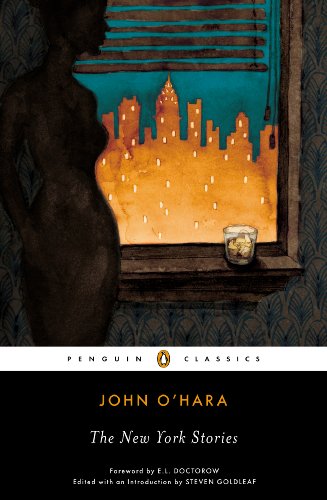
During the Christmas season I happened to go to my local independent bookstore, which is really pretty good, and on a lark I took a look to see if they had any O'Hara books in stock, which I wasn't expecting they would, because I think of him as being very out of fashion, but actually they had 5 titles by him. There was a special Penguin edition of Appointment in Samarra (as noted above, I read the Modern Library edition, which I already had, as I have collected that series for many years), and three other Penguin paperbacks, for Butterfield 8, Ten North Frederick (National Book Award winner for 1955), and an edition of New York Stories, with a stylish cover illustration featuring a tumbler of whiskey on a windowsill with a nighttime view of the Manhattan skyline, somewhat reminiscent of The Lost Weekend. They also had the Library of America volume of his stories, these being considered it seems the most valuable part of his oeuvre now.
Even among the country club set, the aggressive assertions of manliness and especially the amount of physical fighting among the men is shocking to read about in these wussified times of ours.
p.241 "...he did not like to see men driving hatless in closed cars; it was too much like the Jews in New York who ride in their town cars with the dome lights lit." Both of these abominations were lost on me, I am sad to say.
p. 240 In a rundown of one of the characters' humdrum everyday sights, he notes "the trees with the bark knawed away by horses." This is a lost thing now, though apparently it was still a familiar sight in 1930.
p.287 The main character's father was a doctor, and one of those eminently respectable but shallow and emotionally cold pillar of the community types who loomed so large over the literary small towns in 1880-1940 America. He has a professional adversary in town who is Jewish, referred to by Dr English in his own mind (though I don't think publicly) as "the little kike quack". There is tension between them because "Dr English had given a dinner to the County Medical Society and failed to invite Moskowitz. Dr English thought he had good reason: the dinner was at the country club, and Jews were not admitted to the club, so Dr English could not see why he should violate the spirit of the club rule by having a Jew there as his guest." The tension between Wasps (especially--I suppose there must be Catholic country clubs,* but they don't seem to get a lot of attention) and Jews over not allowing the latter into country clubs is famously well documented. I don't know whether this is still an issue or not. My sense is that country clubs in general are in decline anyway because few younger people (younger being under age 55 or so) can afford them, and those who can are not willing or able to devote as much time to golf and drinking as past generations were. I remember in my youth some arguments put forth in, if not defense, justification of these discriminatory policies, not by anyone who actually belonged to such a club (one guy might have been the bartender at one), the main one being that members joined the club to have a place to go and relax, and in those days at least, the presence of Jews apparently made this sought after relaxation more elusive than the members cared for. And yes, I know that by relax is meant, be able to get comfortably drunk and feel at ease to speak the terrible thoughts one has about all of the out-groups of the club. I knew it then, really.
As noted above, this is widely considered O'Hara's best novel now, with his stories still being held in some regard as well. This is a good first novel by a twenty-nine year old, with a lot that is interesting in it, but it is hardly a masterpiece, and if he never improved upon it--and he had a long career--I would have to consider his development to have been a disappointment.
*The club in the book actually has a strong Catholic contingent (O'Hara himself was a Catholic, by origin), which is the source of much of the tension in the book's plot.
The Challenge
1. Dan Brown--Angels and Demons................................................................3,452
2. Stephen King--The Gunslinger....................................................................1,975
16. John O'Hara--Gibbsville, Pa: The Classic Stories..........................................17
A much better challenge this time, I think, though the numbers of movies is a little higher than I would like, three being my preferred maximum. But I take what I get.
The Sweet Sixteen
#16 O'Hara over #1 Brown
A no-brainer, especially with O'Hara not slated to appear again on the set list.
#15 Lee over #2 King
Besides being shorter, the Lee looks as though it may be a literary book.
#14 Gray ovr #3 Raging Bull
#4 The Red Shoes over #13 California Solo
An easy call for the Powell/Pressburger classic.
#5 Proulx over #12 Caro Diario
#6 Johnson over #11 Weigel
Both are short, both look somewhat interesting, neither is available at my library. Weigel is another book about God/religion (albeit the absence of it in this instance), and having read two of those recently I am weary of the subject.
#10 Marsden over #7 Fantastic Beasts, etc
#8 Dylan over #9 Lilley
Normally a book would win over a record, but who is the Nobel Prize winner in this tournament anyway? Not O'Hara, (ironically, given that he openly coveted it despite never being considered a legitimate contender). And against a genre novel?
Elite Eight
#16 O'Hara over #4 Red Shoes
O'Hara marches on
#15 Lee over #5 Proulx
I was sorely tempted to take Proulx, who even graduated from the same high school as I did, and has the stronger reputation as an author, I think. It was very close, and I decided it based on the slightly shorter length of the Lee book. I hope this person is a good writer!
#6 Johnson over #14 Gray
These are both short story books. I am sticking with the Johnson.
#8 Dylan over #10 Marsden
I'll give Dylan another win over a genre book.
Final Four
#6 Johnson over #16 O'Hara
O'Hara goes down in the semis because this collection is a whopping 864 pages.
#15 Lee over #8 Dylan
I believe in Lee.
Championship
#6 Johnson over #15 Lee
In the end I went with Johnson because he is supposed to be a good writer, and ultimately his book is the shortest of the group (133 pages! Hey, he did study under Raymond Carver), and I had no upsets to consider.