Showing posts with label imperial Germany. Show all posts

Wednesday, September 1, 2021

Thomas Mann--Buddenbrooks (1901)

I don't have a grand introduction for Buddenbrooks, the first of Thomas Mann's novels, and there are three or four of them on the list, to come up. We finally get into a long book from the German-speaking world, among people (in this book at least) I find to be quite temperamentally familiar in their emotional drives, romantic pursuits and so on, to the sorts of people I have mostly lived among in the United States, more than the English really, and certainly more than the French and Italians. Even Thomas Buddenbrook's obvious attraction to Catholicism and preference for calling for those in its service to his aid without joining the faith etc////////////

O.K, so I started this post 16 days ago and then I had to do many things and I went on vacation and I forget where I was going with this opening paragraph so I am going to start over. Buddenbrooks seems  to be an exceptionally well respected novel--I can find very little snark or condescension directed at it even on the internet--and it is still on the cusp at least of being modern, perhaps because its author remained a prominent literary figure well into the middle of the last century, yet it is a book that any regular (non-scholarly) person could read easily and maybe even get something out of it, insight or advanced understanding beyond what they were limited to before. It has numerous of the elements that are common in classic European novels, and which I presume are central to their having been a predominant art form over the past 400 years--a long arc of time either literal or implied, families of enough solidity and standing that they are sort of extra-representative of the society being depicted, venerable schools and rituals. Of course not all of the great novels involve these exact themes, but most of them work more or less within these basic parameters. 

Here's the IWE introduction: "Mann's first novel is still ranked among his best. It pictures the high-bourgeois business family of which Germany's commercial cities have had a superabundance for at least a century and it portrays the problems of the monster or mutant of artistic soul born into such a family. The novel is wholly authentic because Thomas Mann was such a person born into such a family."

I'm not sure whether the mutant referred to here is supposed to be Christian or little Johann Buddenbrook--I am assuming it is the boy, since Christian comes off as rather pathetic and Hanno really is the endpoint of the family. Even while he is alive, it is obvious that the continuation of the firm and the family's position is hopeless. I cannot quite believe either of these hapless characters are stand-ins for the vigorous, focused and preternaturally mature author.

I took many notes on this book. I won't use them all but I can't begin to organize them, especially after this lapse of time, so it will just be the snippets again.

p. 70 The grandfather's dying words: "And to Christian: 'Be something worth while!'" At this point in the book Christian was still a young man, so the admonition was humorous.

p. 84 "Contempt was a weakness of Sesemi's--perhaps a pardonable one."

p. 206 "Her strongly developed family sense was instinctively hostile to conceptions of free will and self-development...She had, unconsciously, the feeling that any trait of hers, no matter of what kind, was a family tradition and therefore worthy of respect."

I feel like we are not supposed to think too highly of Tony Buddenbrook, that she is too emotional and shallow and personally undisciplined and thus emblematic of the general rot that has set into the family, but I found her spirit to be attractive. The misfortune of her first marriage, into which she was forced for the sake of the family, was not her fault, but of course it colored the way everyone regarded her forever afterwards.  

p. 264 Christian "'I have gone a great deal to watch concerts,' he said. 'I like to watch how the people behave with their instruments. It is really beautiful to be an artist.'"

There follow two paragraphs about Christian's self-absorption. Pertinent to modern condition, expresses what was formerly considered appropriate mental development in a man.

p. 270 More Christian: "He silently took for granted the pre-eminence of his elder (Thomas), his superior capacity, earnestness, and respectability. But precisely this casual, indiscriminate acknowledgment irritated Thomas, for it had the appearance of setting no value upon superior capacity, earnestness, or respectability."

p. 338 Tony: "And when I am his wife, you'll see...I will take care that he has ambition and gets ahead and makes an effort and is a credit to me and all of us." 

I always note passages like this. The idea holds a fascination for me. 

p. 341 Gerda. "She had a real distaste for expeditions like to-day's especially in summer and most especially on Sunday. She lived in the twilight of her curtained living-rooms, and dreaded the sun, the dust, the crowds of townsfolk in their holiday clothes, the smell of coffee, beer, and tobacco; and above everything else in the world she hated getting hot and upset."

The contrast between "morbid beauty" and "healthy prettiness" (represented by Antonie/Tony, who enjoyed such outings and even drinking beer). The latter is always a little undervalued, even in our time. The frigid, impeccably well-presented Gerda, whose only apparent interest is music, is admired by numerous men in the book as a superior, goddess-like being.  

p. 364 Antonie in Munich during her equally unsuccessful second marriage: "...she breathed the Munich air, the air of a great city, full of artists and citizens who habitually did nothing."

Munich comes off in this book as having a reputation in the German speaking world for being a comparatively lazy city. I wonder whether this is still true. 

I found the style of this book interesting in the use of long passages describing appearances, clothes, furniture in some instances, while entire years, marriages, and other significant life passages are passed over in a couple of paragraphs punctuated with rapid bursts of scenes that settle matters decisively and move the story along.  It works here, but I think it would harder to write in this manner than it looks.
p. 428 Thomas Buddenbrook's "What is success?" speech. Whether or not it is itself central to the theme of the book as the author wishes us to understand it, it is central to the ethos of the society which the book is depicting, and is close to that which prevails in our own, so it seems worth examining.

"What is success? It is an inner, an indescribable force, resourcefulness, power of vision; a consciousness that I am, by my mere existence, exerting pressure on the movement of life around me. It is my belief in the adaptability of life to my own ends. Fortune and success lie with ourselves. We must hold them firmly--deep within us. For as soon as something begins to slip, to relax, to get tired, within us, then everything about us will rebel and struggle to withdraw from our influence. One thing follows another, blow after blow--and the man is finished." 

pp. 447-8. Tony at her daughter's wedding: "...Frau Permaneder, overpowered by the past, the present, and the future, burst into audible sobs: just the unthinking, unembarrassed tears of her childhood."

I was moved by this scene. Best character, I wrote, shrewdest acumen, tightly wound. Yes, I have a soft spot for her, though she certainly would have found me disappointing (though personality-wise I was more like the medical student boyfriend she had that her parents wouldn't let her marry when she was young than any of the other characters. He did work his way to a successful career in adulthood, however). 

p. 485 The torment of Hanno (Thomas's weakling son) when he struggles to recite a hymn in his father's presence, remarks on manliness. Is this how you need to raise boys to be capable adults? Because we don't know. (ed--evidently these methods were not foolproof, since they did not work with Hanno. But my impression is still that discipline and strict, even severe expectations have been essential in many instances of successful development). 

"It was cruel. The Senator (Thomas) was probably aware that he was robbing the boy of the last remnant of his self-control But the boy should not let himself be robbed. He should have more manliness by now." 

 p.498. The great Wagner debate of 1868. We are rather insensitive to its depth and importance now, but at the time it was a matter of world-historical seriousness. 

p. 571 Thomas to Christian during their final blow up: "I have more serious things to think about than your illnesses." My comment was 'I love it when people get real'.

p. 615 More worries about Hanno's inferiority. "Somehow or other a boy must know from the beginning how to gain the confidence and respect of his comrades, upon whose good opinion of him he will be dependent for the rest of his life! There were, on the other hand, the two sons of Consul Hagenstrom (the Hagenstroms were an ascendant rival family), two fine strapping boys, twelve and fourteen years old, strong and full of spirits, who instituted prize-fights in the neighbouring woods, were the best gymnasts in the school, swam like otters, smoked cigars, and were ready for any deviltry. They were popular, feared, and respected." 

These truths cut deep with me. 

p. 616 "But--not to speak of his masters--what must his fellow pupils think of Hanno, who was not only a very mediocre scholar, but a weakling into the bargain; who tried to get out of everything for which a scrap of courage, strength, skill, and energy were needed?"

My comment--'Truly such important concepts that are not impressed upon weak boys forcefully enough. They go to any length to justify their pathetic existences.' I don't think I would joke about this matter, but perhaps I was. 

p. 647 Thomas Buddenbrook's revelation regarding the nature of death as a release, a freeing from the body which prevents one from "being something other and better." I haven't made this leap of consciousness yet. Also it is impressive how well the youthful Mann (age 26 at the time of the book's publication) grasped the sense of impending death, the emotions, etc, that grip a 48 year old. I had no conception of this in my 20s. 

p. 658 "Siegismund Gosch ordered another grog in a tone of voice that was as good as saying, 'What's the use of living?'" Lol.

p. 664 "Among the crowd were settled, grey-bearded, highly respectable citizens, wearing the most irreproachable national-liberal expression on their faces." I think this must have reminded me of the respectable liberals of our own day who are always able without appearing to have any trouble about it to hold the correct position on every litmus test of moral worth that comes, and indeed to have always done so, more or less. 

I wrote a note which says, 'There is a manly way to criticize and contend with the great works of civilizational history bequeathed to us. We aren't adequately doing this.' I think the "We" here refers to people like me who aren't doing anything particularly well or providing much societal leadership, but still think of ourselves as the sort of people who ought to be doing that. 

p. 710 "The ideals of the victorious, united fatherland (we are at about 1875 now) were those of a somewhat rude masculinity."

When 19th century Germans talk about music...

Perhaps I should post all of these little notes and observations as individual Twitter tweets. It would get my post numbers up there and perhaps in the more immediate moment the thoughts would take a fresher and livelier form. What would come of this long project of the book list then? I would have to write in a more essay like format on the blog, which would be desirable, and I hope to do more of that somewhere down the line anyway. But now I scarcely have time to do this. 

I read an old translation of course, by H. T. Lowe-Porter, who upon further research, and admittedly to my surprise, was not only a woman but an American to boot. She was the first English translator of most of Mann's works. Indeed she had the exclusive rights to do so for publication for about 20 years. The new ones all claim naturally to be much better and more accurate, and even to retain more of the original humor, though this last I usually find to be especially debatable, as there seem to be few classes of people with less of a feel for humor than modern scholars and intellectuals.     

The Bourgeois Surrender Challenge

1. Robert T. Kiyosaki--Rich Dad, Poor Dad..................................................................57,450

2. The Devil Wears Prada (movie--2006)......................................................................19,618

3. C. S. Lewis--The Great Divorce..................................................................................3,797

4. Michelle Magorian--Goodnight, Mister Tom..............................................................3,446

5. Richard Thaler & Cass Sunstein--Nudge....................................................................2,233

6. Richard Thaler--Misbehaving......................................................................................1,723

7. Emily Giffin--Heart of the Matter...............................................................................1,136

8. The Egyptian (movie--1954)...........................................................................................353

9. Erica Bauermeister--House Lessons...............................................................................291

10. Erica Ridley--Dawn With a Duke.................................................................................266

11. Eli J. Finkel--The All or Nothing Marriage...................................................................197

12. Buddenbrooks (movie--2008)..........................................................................................96

13. Hector Abad--Oblivion....................................................................................................82

14. Albert O. Hirschman--The Passions and the Interests....................................................47

15. Jordan Reeves & Jen Lee Reeves--Born Just Right........................................................44

16. Thomas Mann--Royal Highness......................................................................................34

A decent field.


Round of 16

#16 Mann over #1 Kiyosaki

I assume Kiyosaki is the rich dad. But he goes down in the first round against Thomas Mann.

#15 Reeves & Reeves over #2 The Devil Wears Prada

#3 Lewis over #14 Hirschman

I feel like Lewis has appeared in the tournament on several previous occasions, without winning. I could look this up, and maybe I will at some point. 

#4 Magorian over #13 Abad

The first somewhat close game. I feel like the Mister Tom book is a minor classic while the Abad concerns politically motivated murders in Colombia. Someday a book like that will probably get through and win, but it isn't going to happen a lot..

#5 Thaler & Sunstein over #12 Buddenbrooks the movie.

I would still like to see the movie, though I am picking up signals that it is not always easy to watch in the United States.

#11 Finkel over #6 Thaler

I would probably rather read Thaler, who is a University of Chicago professor who manages to write popular economics books, which is a class of person I am interested in, but Finkel's book had an upset.

#7 Giffin over #10 Ridley

Romance novel alert.

#9 Bauermeister over #8 The Egyptian

Elite 8

#16 Mann over #3 Lewis

A tough loss for Lewis, who fell victim to the old "IWE authors get advantages in the first two rounds unless there is an upset rule." He's another one who will get another crack at the title someday.

#4 Magorian over #15 Reeves & Reeves

#5 Thaler & Sunstein over #11 Finkel

A competitive game between two books that kind of deal with the similar subject of How to Thrive in Today's Cognitively Demanding Social Environment. I thought Thaler & Sunstein looked more cognitively stimulating overall.

#7 Giffin over #9 Bauermeister

Griffin had an upset. It is a fairly mild one.

Final Four

#4 Magorian over #16 Mann

Mann's second novel (after Buddenbrooks), though not one of his more celebrated efforts. It probably would still have won over a children's book but Magorian has an upset to use.

#5 Thaler & Sunstein over #7 Giffin

I can't quite figure out what kind of book the Giffin is, but it doesn't sound like anything I particularly want to read.

Champonship

#4 Magorian over #5 Thaler & Sunstein

I have a mild curiosity to read both of these books. The Magorian more or less wins on a coin flip and because it seems to be genuinely esteemed by serious book readers. 

Monday, March 18, 2019

Gerhart Hauptmann--Before Dawn (1889)

So it did not take long to get to another Hauptmann play--apart from Shakespeare with his series of Henry and Richard-titled plays, I believe this is the only time we get standalone works back to back by the same author in the entire IWE list. This was Hauptmann's debut, it premiered when he was 27, which is around the typical age when most of these big time writers achieved their first breakthroughs into the public consciousness. I believed myself to have enjoyed reading it more than The Beaver Coat, though it was a more sprawling, less-tightly constructed play. It was also however less opaque, more indulgent of emotion, and more concerned with the travails of younger people, which in general I guess interest me more even now unless the older protagonist is extremely interesting or amusing. When reading these things, especially if I am under the impression that they are supposed to be good, I mostly concern myself with seeking and trying to understand wherein the quality lies, and do not always (though not never either) trust myself to identify the flaws and failures in such works and declare them as such. I had not read the IWE's introduction to this before reading it and was therefore given something of a jolt when I looked it up after finishing it:


"The reception of Hauptmann's first produced play was 'tumultuous', according to Lewisohn; literary historians agree that it was 'sensational'. Today the play reads like an adolescent effort to be impressive by being shockingly different. It protests a bit too much the grievances of labor, the perils of alcohol, and the righteousness of the Icarians (one of a spate of Utopian colonies in America during the mid-19th century). But it was written by Hauptmann and Hauptmann could already write."


Obviously the IWE editor is revealing some of his own biases here, but his criticisms are all, or mostly, things that did mildly occur to me in the course of reading the play, but that I let pass, and did not put together at all to inform my view of the whole. It was all a little over the top, but Hauptmann was something of a genius, and a German genius to boot, so it must have been in the service of a much grander point. Such was my thought process anyway. I do wonder why the IWE people included this on the program while leaving off The Weavers, which today at least seems to be considered Hauptmann's best and most important play (and also, as it is about textile workers made obsolete by industrial technology, topical). I am pretty sure we are done with him altogether after this.


After being too uncertain of my steps to make any notes on The Beaver Coat, I took a few this time.


Dr. Schimmelpfennig, in Act V, perhaps an early example of what continues to be a defining theme of our own age:


"...humankind is in agony and our sort with our narcotics manage to make things more tolerable."


Both the drunken, newly prosperous peasant woman Frau Krause and the anti-establishment Loth character take swipes at Goethe and Schiller, traditionally thought of by me as the unassailable quasi-divinities of German literature. "Schiller an' Goethe (wildly mispronouncing these names)--a couple of useless ninnies if there ever were away," opined the lady, while later on Loth proclaims to the somewhat dim but nice and earthily alluring farmer's daughter that Werther is "a stupid book...it's a book for weak people." With regard to Zola and Ibsen (whom I said Hauptmann reminded me of in the last post), Loth says "They are not writers but necessary evils...I'm not sick, and what Zola and Ibsen offer is medicine."


The insistent belief in the hereditary nature of alcoholism struck me as strange, not because there is not any truth to it, but because it was presented as an inevitable doom for the inheritor. Thinking back to the introduction, the postwar period out of which this list originated was probably the time, certainly in recent history, when skepticism about anti-alcohol crusaders was at its height, the memory of Prohibition being well within the lifetimes of many adults. I do see signs that these kinds of attitudes may be returning, in tandem with the increase as a percentage of the population of people who come from cultures with strong biases or even prohibitions against drinking.


I thought this was leading to a revelation of some kind of rape which word I cannot make out now (paternal?), incest, or secret pregnancies, and the IWE summary does indicate that we are to understand that Helene was "seduced" by her brother-in-law, but the translation I have (in a 1963 Penguin paperback published in England only of "Three German Plays", including The Threepenny Opera and Woyzeck by Georg Buchner) is unclear to me on this point where Dr Schimmelpfennig says that "Things aren't so far gone that he has actually ruined her, but he has certainly ruined her name by now." I could look up the original online if I wanted to and see if I could make more sense of that statement. I don't know German particularly well, but I know it somewhat, and I had gotten to a point in my 20s where I could read some of Kafka's stories only having to look up a handful of words on the page. But I don't have time to do that now. I barely have any time even to read these books.


Hauptmann died in 1946 at the age of 83, remaining in Germany throughout the Nazi period, so I suppose it is worth looking into how he spent those years. He of course would have been an old man then, and in the introduction to the book in which The Beaver Coat was included, it was claimed that he was "too old" to have relocated to another country. According to Wikipedia he signed a loyalty oath of the German Academy of Literature and applied for membership in the Nazi party (and was rejected). This was not mentioned in the other book. Film versions were made, albeit allegedly heavily censored, of the two plays I have written about here. I put a clip from The Beaver Coat on that post and will see if I can find one for this one. He had a novel rejected for publication during the war on the grounds that it depicted a black character, though a 17 volume edition of his works was printed in 1942 and a tetralogy of novels in 1944, which would seem to indicate that he was in fairly good stead with the regime. He was in Dresden during the firebombing of that city, when he was past 80, and wrote that "I stand at the end of my life and envy my dead comrades, who were spared this experience", which I can certainly believe was a sincere statement. This was noted in the 1950 introduction. He lived in Silesia, the southeastern part of Germany that was incorporated into Poland at the end of World War II. In May of 1946, he was informed that all Germans were to be expelled from Poland, without exception. At this point, he finally became very sick and died on June 6, 1946, before being expelled. The 1950 essay (by a German--I don't have that book in front of me so I cannot remember whether he was personally acquainted with Hauptmann himself) referenced some writings published after the war that were anti-Nazis and everything that happened during these last years, though Wikipedia doesn't list or refer to them. On the whole, one could get the idea that Hauptmann would not have missed much if he had died at age 70, though I don't know whether there is considered to be anything of great value in his later writings. While not as infamous perhaps as Knut Hamsun or Marshal Petain in his end of life Nazi associations, he doesn't appear to have covered himself in much glory, either. Not that I would have either, most likely, if I had been there, but everyone who found himself in that situation is held accountable to some degree, especially if he was a prominent figure such as Hauptmann certainly was.


The Challenge


This draw produced a rather wild Challenge. Matchups will be decisive
.
1. Narrative of the Life of Frederick Douglass...............................................................3,116
2. Howard Zinn--A People's History of the United States..............................................3,019
3. Alice Hoffman--The Marriage of Opposites...............................................................2,115
4. Alice Hoffman--The Dovekeepers: A Novel................................................................1,969
5. Karyl McBride--Will I Ever Be Good Enough............................................................1,042
6. Charles Dickens--Little Dorrit........................................................................................328
7. Michael C. Ruppert--Crossing the Rubicon....................................................................281
8. Karl Rove--Courage & Consequence.............................................................................255
9. Roger Kerin--Marketing, 12th Edition............................................................................177
10. Dr. Joanna McMillan--Get Lean, Stay Lean.....................................................................2
11. Marx & Engels--Collected Works, Vol. 38: Letters 1844-51............................................1
12. Highlights: The Tonight Show Starring Jimmy Kimmel, Season 4 (TV Show)................1
13. Alcoholism: Analysis of a Worldwide Problem (ed. Golding)...........................................0
14. Richard Chizmar--The Girl on the Porch..........................................................................0
15. Susan Chair Imbarro (?)--Declarations of Independency..................................................0


1st Round


Frederick Douglass gets to sit this one out with a much-coveted bye.


#2 Zinn over # 15 Imbarro
#3 Hoffman over #14 Chizmar
#4 Hoffman over #13 Alcoholism
#5 McBride over #12 Kimmel
#6 Dickens over #11 Marx/Engels


Little Dorrit is not one of the nine Dickens books selected for the IWE list, so it is eligible for the Challenge.


#7 Ruppert over #10 McMillan
#9 Kerin over #8 Rove


Kerin is a textbook in a subject I have a limited interest in studying, but he has an upset card to play.


Round of 8
#9 Kerin over #1 Douglass


Kerin had an allotment of 2 upsets in this tournament.


#2 Zinn over #7 Ruppert


A battle of 600+ page books. My library has Zinn, it does not have Ruppert, which is the decisive factor in the contest.


#3 Hoffman over #6 Dickens


Dickens too falls victim to an upset.


#4 Hoffman over #5 McBride


A mild upset. McBride was a shorter book, but Hoffman had upset in hand for this book too.


Final 4
#2 Zinn over #9 Kerin
#3 Hoffman over #4 Hoffman


Championship
#3 Hoffman over #2 Zinn


This Hoffman, whom I've never heard of, appears to be an extremely popular writer of some approximately mid-list fiction. I have dipped into Zinn before and I cannot say that I am a fan. His approach struck me as disingenuous and not respectful of any accomplishment in our national history that could not be attributed to some oppressed party resisting or overcoming the rapacity of the devils making up the dominant elements of society. Perhaps there are truths in his version of events, and if you are familiar with the opposing narratives perhaps there is good to be gotten out of reading Zinn, though I am not wholly persuaded of this. If he is your introduction to or main lens through which to understand American history, I feel sorry for you.


Tuesday, March 5, 2019

Gerhart Hauptmann--The Beaver Coat (1893)

I have been writing about wanting to read more German literature on these blogs for some time, so, finally, here we are. Gerhart Hauptmann was a prolific writer in many forms and the 1912 recipient of the Nobel Prize, though he is mainly famous for his dramas of the 1890s. He is reminiscent to me of Ibsen, though in this country his books are hard to find and his plays rarely if ever performed, while Ibsen and his works remain fairly broadly know. The IWE thought highly of Hauptmann, and called The Beaver Coat "a serious play and a major work of literature." It certainly reads like a serious work of literature. There is a fineness in the dialogue and the construction of scenes, a restraint in the revelation of action, that is bracing enough. I wonder, as I do whenever I come upon such books, why I do not devote a much greater portion of my time, especially now, to reading late 19th century continental authors, who seem to me so invariably sure in their language, their images, their people, their themes. I feel to some extent as if I have come home when encountering one of these books.


The Beaver Coat is not so much difficult to understand as it is easy to be led to different expectations as to where it is going. It is unconventional because the conflicts and the climax and the consequences that the plot would seem to be building towards never materialize, the characters occupying the roles of civic authorities are completely unfocused on what would appear to be the driving dramas of the play and miss them entirely (the beaver coat of the title was stolen from a property owner by a washerwoman for a ragged boatman plying the Spree River near Berlin. The crime is given scant attention by the presiding judge and is unrectified at the end).....


Unfortunately I was not able to finish this post before I went on vacation for about nine days. It seems to me that every year at this time when I go away, my reading schedule is the midst of a string of plays instead of one of the many 1,000 page books this list requires me to read, which would be much more convenient. So I don't remember anything else that I especially wanted to say on the subject of The Beaver Coat. I did not make any notes on it. My edition, which I will talk more about further, includes an introduction by the translator, Horst Frenz, timestamped Indiana University, May, 1951. He notes that Hauptmann "likes to make fun of the law and its ministers...it is almost an obsession with him that policemen and judges are of necessity imbeciles or charlatans." His concluding paragraph reads:


"...Hauptmann does not give a definite conclusion to his conflict. More than once, he has pointed out that true drama has no ending and that a decision is often imposed upon a playwright who finds no clear-cut ending in life, who always sees new variations, new possibilities for breaking off the action. All that is closely connected with Hauptmann's belief that man's inner struggle is more important and more dramatic than the outcome of the struggle, his searching after truth more significant than the truth itself. It is because of this fundamentally new approach to the problem of dramatic structure that the modern English-speaking drama can hardly be imagined without the pioneer work of Gerhart Hauptmann."


I admit in reading this that I thought it carried a lot of characteristically German unnecessary pomposity and grandiosity with it, as if it contained such ideas as have never occurred to anyone who did not pass though a top Gymnasium. The play lingers in my mind to the extent than it does because of the cleanness of the construction and dialogue and because works from the Imperial Germany of 1871-1914 period have a haunted quality about them for me, because of the power and wealth and cultural might of a sudden, freshly created nation/empire in the heart of Europe that was destined to be so short-lived, and whose contemporary influence, so pronounced just a century ago, has shriveled to almost nothing, in my life anyway.


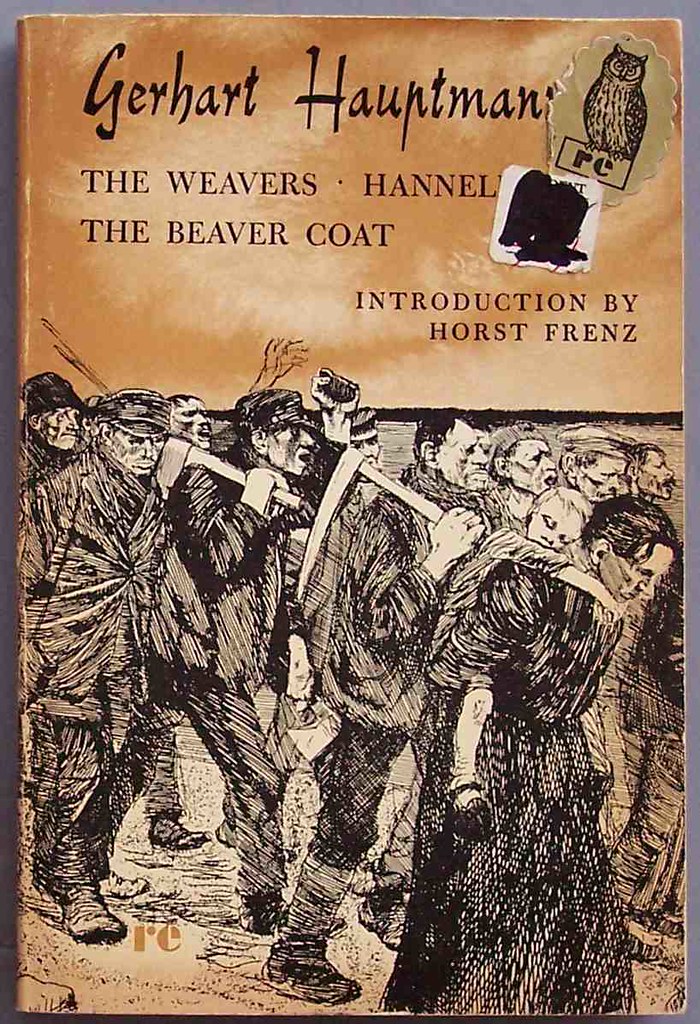
My English copy of this play came in a library bound Rinehart Edition of 3 Hauptmann plays, The Weavers and Hannele also being included, though I don't believe either of these appear on my list. There don't appear to have been many, if any, later editions of this published in the United States. I am well read in the literature published in the Rinehart Editions. Of the specific titles (i.e., not collections) listed in this series, I have read 65 out of 98! For the record, the first five I have not read are The Tatler (Addison and Steele), The Trojan Women (Euripides), The Frogs (Aristophanes), The Menaechni (Plautus), and The Rope (Plautus). Despite the library binding the book is a little wobbly and brittle, but the type and layout, like so many printed series from the immediate postwar years, is ideal for reading.


This is not the only Hauptmann we will encounter on the IWE list, and the wait to become re-acquainted with him will be a brief one.


Challenge Time


This challenge gave us almost nothing to work with.


1. William Kent Krueger--Sulfur Springs............................................344
2. Mo Hayder--Wolf.............................................................................258
3. Rick Perlstein--The Invisible Bridge................................................202
4. Alison Gaylin--If I Die Tonight.........................................................68
5. Joan Wolf--The Counterfeit Marriage.................................................0
6. American Literature to 1900 (ed. Lewis Leary)...................................0
7. Princeton Review--1,027 GRE Practice Questions.............................0
8. T. R. Kenneth--A Room Full of Night..................................................0


Quarterfinals


#1 Krueger over #8 Kenneth


The Kenneth book isn't actually out yet, I don't think. It looks like a genre book, as is the Krueger.


#7 Review over #2 Hayder


I really don't like generic genre novels.


#3 Perlstein over #6 American Literature


Perlstein is a writer of popular histories, which is a genre I actually like. The subject of this book appears to be the transition of the Republican party between the disgrace of the Nixon resignation and the triumph of Ronald Reagan 6 years later, which mirrors almost exactly the first years of my consciousness, though I have no recollection of the Nixon presidency or resignation itself, which happened when I was 4.


#5 Wolf over #4 Gaylin


Wolf's book looks to be a romance novel circa 1980. It qualified for an upset, which I would like to get out of the way here, as I desperately need something readable to win.


Semifinals


#7 Review over #1 Krueger


Did I mention how much I hate genre fiction?


#3 Perlstein over #5 Wolf


Final


#3 Perlstein over #7 Review


This is a big book, clocking in at around 800 pages, but it is really the only choice in this field.