A List: City of God (Augustine)..............................................................................541/867
B List: Between books
C List: Sir Walter Scott--Rob Roy................................................................................7/501
Bonus: Zena Hitz--Lost in Thought.........................................................................126/210
I finally finished Buddenbrooks on 8/4, so I will eventually get up a report on that, though probably not before the last part of August, as there is probably no way I can get it done this week, and next week I am going to be on vacation. The next book on that list is another long one, which will probably take me through all of the rest of August and September, if it ever arrives, which it hasn't yet. So activity on this blog will continue to be light for a while. As to my other one, which I haven't updated since May, I am hoping that when school starts up again, in addition to being able to read a little more, I can get back into something of a more regular writing routine, even if it is just the blogs to start. I want to get in some exercising too, not because I am getting fat, but because I would like to maintain a somewhat healthy look, and as I am getting bored with my social life I would like to keep my options open for having a better one as much as possible--at this point of my life I have to concede that my brains are not enough to get me there on their own. We'll see what happens.
This was not a productive month of reading. My mother came to visit for two weeks in July, and she is even harder to escape from than my regular family. Augustine is coming along slowly. His theme of the two cities (That of Man and that of God) is starting to come into clearer focus. This book is kind of an encyclopedic inventory of such religion and history as was known, or at least regarded as important, up to that point, and I like reading books of that sort from time to time. But I can't read that much of it in any given day.
For the C-List I spent most of the month finishing up Madeline L'Engle's short story collection The Moment of Tenderness. It got mixed reviews but other than one story about the devil which I didn't quite understand I thought it was really good. I guess I don't read that many stories. Maybe they all seem good when a real professional writes them, though I think I have some discernment in these matters. I just started Rob Roy today. It is pretty long for a C-list book, but my discovery of what a good novelist Scott is after not having read him my entire life is one of the modest joys I have had in the past two or three years. The first few pages of Rob Roy possess the same inimitable authorly charm that infused The Heart of Midlothian and especially The Bride of Lammermoor, the two books by this author that I have read in the last year or two.
I am working my way leisurely through my old classmate Zena Hitz's book. She draws on a wide array of liberal learning, much of which, even if I cannot claim to have been already possessed of, is accessible enough to me that I can usually make sense of it. The book has an underlying current (though don't all philosophical books to some extent?) of dismay at the current state of universities and intellectual culture, with the obscene lust for social status and material luxury that has permeated and influenced even the way these realms operate beyond what appeared to be the case in much of the known past, even that known to our generation personally ca. 1990. I feel much of the same general dissatisfaction with the state of public discourse and thinking in comparison with the form I thought, or hoped, these things would take in my mature years back then, so I am receptive to the message of the book.
Pictures. I took shockingly few pictures this month, given that it is summer. The above is obviously Boston. We walked the Freedom Trail, where it is kind of difficult to whip out the phone and take a lot of pictures on the interesting parts, at least if you have children. It had been three or four years since we've walked it, so it was new to the younger ones.
This is a pretty wooded trail in southern New Hampshire, I forget what town. It was near Milford. As you can see we got a lot of rain in July.
This book is about, roughly, eastern Pennsylvania, drinking, country clubs, roadhouses, railroads, cars, state highways, social class, lust/sloppy encounters, fading college memories, and the 1930s. That is, much of what I know, or knew, and think of as normal life. It is one of those snappy books of that era, and it also happened to be set on Christmas Day and the 3 or 4 days afterwards (in 1930), which dates coincided with the time when I was reading it (in 2016), in my old house with my icy windows and crusty snow in the yard. So I got a good deal of pleasure out of it, though how much anyone without as much personal identification with the material would, especially nowadays, I can't say.
This is the only O'Hara book to make the IWE list, even though he was still highly regarded, as well as alive, at the time it was published. The blurb for Appointment in Samarra begins "John O'Hara's qualifications as a novelist are rated higher and higher as the years pass but as to one of them there has never been any doubt". It goes on to praise his ear for American conversation and Appointment's readability and character portrayals, "especially that of Caroline English". It also makes that claim that the town of Gibbsville, where this and many of O'Hara's stories are set, is modeled on Harrisburg, which is a pretty major error, I am almost certain that O'Hara's hometown of Pottsville is what was meant. Characters in the book talk about going to Harrisburg, and especially Reading, which is a dump now, but was evidently prosperous and lively ninety years ago.
In spite of his comparatively high level of success as a writer, which he had already attained by the age of thirty, O'Hara was notorious even in his own lifetime for being cloyingly open about his various social and professional insecurities, such as not having been able to attend Yale (or any other college, for that matter), not being awarded literary prizes, not being considered on the level of Hemingway and Fitzgerald and the other major writers of that generation that preceded him by ten to fifteen years. The preface that he wrote for the Modern Library edition, which came out in the early 1950s, is full of name-dropping as well being surprisingly candid and unironic about his influences, most of whom (Lewis, Galsworthy, Tarkington) were not much in vogue among the edgier writers even then. The whole thing would get anyone who submitted it laughed out of any respectable literary magazine today.
All of the characters in the country club set are introduced with the names of their colleges. Lafayette and Lehigh are as well represented as the Ivy League. There was even a writer for the local newspaper who had graduated from the University of Missouri.
Now it is time for everybody's favorite section of these reports, when I copy my favorite quotations from the books:
p. 17 "She was known on the stag line as a girl who would give you a dance; she was at Smith, and was a good student. She had a lovely figure, especially her breasts, and she was a passionate little thing who wasn't homely but plain and, if she only knew it, didn't look well without her glasses. She was so eager to please that when a young man would cut in on her, he got the full benefit of her breasts and the rest of her body." Oh yes, it's that kind of book. Where were all the eager to please girls (for me) when I was young? Of course, I know where they were, they were elsewhere, eager to please other people. It's a let off steam kind of question. It's still a few years before I'll have time or extra money to try to hash this out with a psychiatric professional.
p.50 "She felt sorry for prostitutes on all occasions; she thought milk for babies ought to be pure; she thought Germany was not altogether responsible for the World War; she did not believe in Prohibition (It does not prohibit," she often said). She smoked cigarettes one right after the other, and did not care who knew it..." Defining characteristics of people in other ages.
p. 125 "That was in the summer of 1926, one of the most unimportant years in the history of the United States..." Is this true? Maybe it was, though I don't think of it as an especially bad or boring year.
Chapter 6 is a very good rendering of a very inebriated but nominally functioning man's thought process, conversation, behavior, etc. Or at least it is very similar to what I have experienced in the same state.
p. 187, English remembering his childhood. "There was a game called Run, Sharpie, Run, and sometimes the gang would play Ku-Klux Klan, after having seen "The Birth of a Nation." I feel like I have some duty to acknowledge this stuff when it turns up in these books, though as with Tarkington the casualness of the references to these things and obliviousness to any sense of moral culpability do give the books an air of authenticity. I understood by this that they played this game among themselves at least and did not go around tormenting actual black people, though perhaps they did. There is quite a bit of very casual anti-Semitism in the book as well, of the sort that could not be unironically published today by any reputable outfit. I don't know that I would call O'Hara an aggressive Jew-hater (doubtless others will have no problem doing so, but I am of a mild disposition, and feel no need to castigate people unless they avow extreme positions) --even in the 30s, 40s and 50s I have to think that would have been an issue in both the New York publishing world and in Hollywood, which frequently adapted his novels at that time--but he certainly seems to regard the Jewish community as a distinct entity that has some characteristics that he finds distasteful and that is also set to some extent in implacable, if not mortal, opposition to his own,
I went to Pottsville, the nominal setting of this story, one day back in September or October of 1989. This was on a hitchhiking trip/adventure I undertook to see America following a trail marked by the birth-cities of the writers on the IWE list. Since I started out from Philadelphia, I made it to Pottsville within the first four or five days of the trip (after, if I remember correctly, Philadelphia, Germantown (in Philadelphia), Burlington, New Jersey and Wilmington, Delaware). I did not even have the wherewithal to seek out monuments or sites related to the authors themselves, but figured the cities had spawned important literary figures, and something in the location must have something stimulating for me to contemplate. Pottsville is about 2 hours northwest of Philadelphia, in mountainous coal country. It was foggy and wet the day I was there, leaves all along the roads leading into town, upon which I walked much of the way from the highway (I-78 I think) near the exit off which I had spent the previous night in a cornfield. These roads, most of the time, ran along the bases of very steep, wet, tree-covered hills with the occasional dilapidated old house clinging to the edge of them. Not much was happening in Pottsville, though the main street was still there at least, had not been converted into strip malls and such, and I hung out at the library for a while, and got something to eat at a diner that was still open. But the population of the town was mostly old people and the single mother/unsocialized young men types that you can probably imagine, and the atmosphere was gloomy, so I decided not to stick around for the night and started on the way to Scranton, which was the next stop on the list. I didn't make it (this was the night some people found a $20 a night motel for me, which I once wrote about on my other blog), but I did get to Scranton the next day, and I enjoyed it there (nice old public buildings to idle in) and I stayed ovenight there in a sheltered basement stairwell of a church. (It's a good thing I am not doing this now though, since Scranton apparently arrests more people per capita for nonsense than anywhere else in the country).
Within a span of about ten pages O'Hara, through his characters, manages to pay homage/suck up to Hemingway and Fitzgerald, who were the rock stars of American literature and about 10 years older (or less) than him when he was a young man breaking in to the business. Hemingway did throw him a bone by praising Appointment when it came out, which O'Hara did not neglect to mention in the preface (and elsewhere, one suspects).
p.158 I was shaken by Al Grecco's fucking of Franny Snyder. "...she wanted a cigarette and accepted a drink and was easily persuaded to go for a short ride. The short ride was short enough: half a mile off the main road between Gibbsville and Collieryville to a boathouse on the Colliery Dam...she must have felt the same way, because if there was ever an easy lay she was it--that day. But she said on the way home: 'If you ever tell anybody this I'll kill you.'" I get shaken by these things of course because nothing of this sort ever happened with me, and I know that other people, the people I have nothing to do in life but dream about being, or having been now...You see, I need to record this and tell it to the psychiatrist when I go. You go there and you can't say exactly what is giving you so much pain and discontent. Of course they can't do anything for you, or make you feel that it should have happened to you, and that you deserved it, and were robbed of experiences that you should have had, or make you feel that you don't need to have them, but I would still feel better if I could talk to someone about the jealousy and rage that has, I won't say ruined my life, but hindered my development.
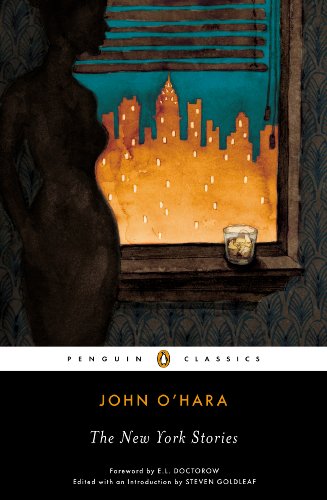
During the Christmas season I happened to go to my local independent bookstore, which is really pretty good, and on a lark I took a look to see if they had any O'Hara books in stock, which I wasn't expecting they would, because I think of him as being very out of fashion, but actually they had 5 titles by him. There was a special Penguin edition of Appointment in Samarra (as noted above, I read the Modern Library edition, which I already had, as I have collected that series for many years), and three other Penguin paperbacks, for Butterfield 8, Ten North Frederick (National Book Award winner for 1955), and an edition of New York Stories, with a stylish cover illustration featuring a tumbler of whiskey on a windowsill with a nighttime view of the Manhattan skyline, somewhat reminiscent of The Lost Weekend. They also had the Library of America volume of his stories, these being considered it seems the most valuable part of his oeuvre now.
Even among the country club set, the aggressive assertions of manliness and especially the amount of physical fighting among the men is shocking to read about in these wussified times of ours.
p.241 "...he did not like to see men driving hatless in closed cars; it was too much like the Jews in New York who ride in their town cars with the dome lights lit." Both of these abominations were lost on me, I am sad to say.
p. 240 In a rundown of one of the characters' humdrum everyday sights, he notes "the trees with the bark knawed away by horses." This is a lost thing now, though apparently it was still a familiar sight in 1930.
p.287 The main character's father was a doctor, and one of those eminently respectable but shallow and emotionally cold pillar of the community types who loomed so large over the literary small towns in 1880-1940 America. He has a professional adversary in town who is Jewish, referred to by Dr English in his own mind (though I don't think publicly) as "the little kike quack". There is tension between them because "Dr English had given a dinner to the County Medical Society and failed to invite Moskowitz. Dr English thought he had good reason: the dinner was at the country club, and Jews were not admitted to the club, so Dr English could not see why he should violate the spirit of the club rule by having a Jew there as his guest." The tension between Wasps (especially--I suppose there must be Catholic country clubs,* but they don't seem to get a lot of attention) and Jews over not allowing the latter into country clubs is famously well documented. I don't know whether this is still an issue or not. My sense is that country clubs in general are in decline anyway because few younger people (younger being under age 55 or so) can afford them, and those who can are not willing or able to devote as much time to golf and drinking as past generations were. I remember in my youth some arguments put forth in, if not defense, justification of these discriminatory policies, not by anyone who actually belonged to such a club (one guy might have been the bartender at one), the main one being that members joined the club to have a place to go and relax, and in those days at least, the presence of Jews apparently made this sought after relaxation more elusive than the members cared for. And yes, I know that by relax is meant, be able to get comfortably drunk and feel at ease to speak the terrible thoughts one has about all of the out-groups of the club. I knew it then, really.
As noted above, this is widely considered O'Hara's best novel now, with his stories still being held in some regard as well. This is a good first novel by a twenty-nine year old, with a lot that is interesting in it, but it is hardly a masterpiece, and if he never improved upon it--and he had a long career--I would have to consider his development to have been a disappointment.
*The club in the book actually has a strong Catholic contingent (O'Hara himself was a Catholic, by origin), which is the source of much of the tension in the book's plot.
The Challenge
1. Dan Brown--Angels and Demons................................................................3,452
2. Stephen King--The Gunslinger....................................................................1,975
16. John O'Hara--Gibbsville, Pa: The Classic Stories..........................................17
A much better challenge this time, I think, though the numbers of movies is a little higher than I would like, three being my preferred maximum. But I take what I get.
The Sweet Sixteen
#16 O'Hara over #1 Brown
A no-brainer, especially with O'Hara not slated to appear again on the set list.
#15 Lee over #2 King
Besides being shorter, the Lee looks as though it may be a literary book.
#14 Gray ovr #3 Raging Bull
#4 The Red Shoes over #13 California Solo
An easy call for the Powell/Pressburger classic.
#5 Proulx over #12 Caro Diario
#6 Johnson over #11 Weigel
Both are short, both look somewhat interesting, neither is available at my library. Weigel is another book about God/religion (albeit the absence of it in this instance), and having read two of those recently I am weary of the subject.
#10 Marsden over #7 Fantastic Beasts, etc
#8 Dylan over #9 Lilley
Normally a book would win over a record, but who is the Nobel Prize winner in this tournament anyway? Not O'Hara, (ironically, given that he openly coveted it despite never being considered a legitimate contender). And against a genre novel?
Elite Eight
#16 O'Hara over #4 Red Shoes
O'Hara marches on
#15 Lee over #5 Proulx
I was sorely tempted to take Proulx, who even graduated from the same high school as I did, and has the stronger reputation as an author, I think. It was very close, and I decided it based on the slightly shorter length of the Lee book. I hope this person is a good writer!
#6 Johnson over #14 Gray
These are both short story books. I am sticking with the Johnson.
#8 Dylan over #10 Marsden
I'll give Dylan another win over a genre book.
Final Four
#6 Johnson over #16 O'Hara
O'Hara goes down in the semis because this collection is a whopping 864 pages.
#15 Lee over #8 Dylan
I believe in Lee.
Championship
#6 Johnson over #15 Lee
In the end I went with Johnson because he is supposed to be a good writer, and ultimately his book is the shortest of the group (133 pages! Hey, he did study under Raymond Carver), and I had no upsets to consider.
A List: Somerset Maugham--Ashenden, or the British Agent..............................282/304
B List: Currently between books.
C List: R. R. Palmer--The Age of the Democratic Revolution: The Challenge...333/528
Late this month. The 6th fell on a Sunday, which is a bad day for me to get any computer time. Obviously any writing time is hard to come by at this point.
The Maugham book is a readable product, ideally consumed, as Ashenden himself would do so, in first class railway carriages and sitting in one's robe and slippers with a glass of sherry by the fire in a Swiss hotel. He (Maugham) does have some literary skills, notably in the area of dialogue that moves the particular episode forward and is somewhat satisfying to the brain at the same time. He is mostly a reassuring kind of writer, the reassurance being that if you are a socially unsophisticated and only modestly smart reader, but find those qualities at a slightly higher, but not dangerous, stage of development attractive in others, he is there for you. As far as this book is concerned, Ashenden is involved in espionage, but it is really more of a travelogue and study of broad and recognizable types than a spy book, Ashenden is never in any physical danger nor is he required to outwit any particularly formidable opponent. The American character is an ignoramus and a bore who is enamored of the sound of his own voice, the Russian ones are fiercely serious and tormented and intellectual. It's that kind of book.
R. R. Palmer (1909-2002) was a historian and college professor, mainly at Princeton, from 1936 to 1977. Several of his publications are considered distinguished, and the two-part Age of the Democratic Revolution is considered his masterpiece. How I came to be reading this large work I will go into more in my next book report when I get around to it. It is a departure from the kind of thing I usually read, which is good, but some sections in it come more alive to me for whatever reason than others. To my surprise, for example, I am finding the account of the anti-aristocratic movement in the Netherlands in the 1780s to be quite interesting. As a smaller country without an internationally famous literature or, in this era, any other art, the texture of its history is not very well understood, by me at least. At the same time I was not as enthralled by the chapter dealing with a similar movement in Ireland during the same period, mainly because the main actors were almost exclusively Anglo-Irish, Catholics being entirely forbidden from the Irish parliament and other offices at that time, which dynamic--the Catholics being as it were on the sideline in the politics of the time--I had a hard time getting a clear vision of. Palmer was a man of his time and his own sympathies and principles seem to be against oligarchy and too great social and economic inequality, for wide participation (by way of voting and representation) in government and so on. His summation of the mood in Europe at the outbreak of the French Revolution resonates a little too closely to that of our own time:
"By a revolutionary situation is here meant one in which confidence in the justice or reasonableness of existing authority is undermined; where old loyalties fade, obligations are felt as impositions, law seems arbitrary, and respect for superiors is felt as a form of humiliation; where existing sources of prestige seem undeserved, hitherto accepted forms of wealth and income seem ill-gained, and government is sensed as distant, apart from the governed and not really 'representing' them. In such a situation the sense of community is lost, and the bond between social classes turns to jealousy and frustration. People of a kind formerly integrated begin to feel as outsiders, or those who have never been integrated begin to feel left out."
He had a good quote on how too extreme inequality really was bad for societies but I can't find it now.
I am in the midst of a stretch of short books for the IWE list. Though it comes under the category of a Victorian novel, Agnes Grey is only 194 pages long (in the recent Modern Library paperback edition) and it feels shorter than that. There is not much to the plot, which is a barely disguised memoir written by a 27 year old about her experiences as a governess in two different houses, and reads at times more like a journal or a record of impressions over time than an unified work of art that is an imitation and embellishment of actual life. In spite of this, and certain other characteristics of the book that I will comment on later, I enjoyed it very much during the few calm moments of the day when I had a chance to read it, as I find I am enjoying most of these older books, whether their reputations have carried down to our own time or not.
Anne Bronte is of course the younger sister of Charlotte and Emily, and while I like her, she is obviously not as good as they are. Nowadays The Tenant of Wildfell Hall is widely considered to be Anne's best and most important book. It has not turned up on any of my lists however, so I have not read it. Still, she had more talent as a writer than at least 96.4% of the people who have ever tried their hand at it, and despite the smallness of the world she inhabits, the by our standards excruciating pace of life and paucity of incident in it, there is enough of interest in the characterization and enough that is familiar and almost comforting, at least to people who have read a lot of Victorian novels, in this pared down and rather unadorned account of that vanished world, to hold the interest and propel one through its brief chapters and story. Her youth and callowness are more noticeable than they are in most novels by people in their 20s that have survived. It was probably fortuitous on her part to stick to a narrow subject with a singular first person point of view. She has a lot of what today would be called snark, and it is her most noticeable shortcoming as a writer, since it is not particularly funny or clever snark. It is quite easy to imagine her as one of those legions of unlikeable young people on the internet taking ugly swipes at people they mistakenly consider to be of a quality far inferior to themselves. Jane Austen of course was pretty snarky--Pride and Prejudice especially is at least in some part of its core a snarkfest from nearly one end of it to the other, which I suspect is why it has remained so popular in our own time. Jane Austen's snark of course is a lot more sophisticated than Anne Bronte's. Bronte/Agnes is not so fastidious about setting her targets up so as to get the optimum effect before she launches into attack, which in nearly every instance is merely the narrator venting to the reader, rather than the much higher incidence of interactive snark, frequently witty and humorous between characters that animates the work and Jane Austen and other more developed writers.
However as I said I am rather fond of Anne, in my person of a sentimental reader of old literature who has been completely exposed by modern life, which is probably not a good advertisement for her book. One thing that happened to Agnes that apparently did not happen to the real-life Anne was the romance (and eventual marriage) to the upright clergyman. The character of Weston who provides Anne's love interest was supposedly modeled on a gentleman who had worked under her father and with whom it was speculated she was in love, though apparently there is no concrete proof of this, and the feminist scholar who edited my edition and wrote the preface at least evidently did not, apart from the one footnote alluding to the source of the Weston character, consider the question otherwise worthy of interest. Anne's writing indicates that at some point she had agreeably sentimental feelings for someone, as her descriptions of Agnes's emotional state at various junctures in her relations with Weston have the ring of unvarnished honesty about them. But Anne died at age 29 without ever having married (As an aside, I have read it plausibly suggested somewhere, perhaps by Somerset Maugham(?), that Emily Bronte was likely a lesbian. I have not read her book since I was very young however, so I wonder whether this would strike me if I should take it up again).
The Challenge
The challenge this time once again turned up very few competitors, resulting in a runaway victory for a book I have never heard of.
1. Still Alice--Lisa Genova..................................................................................................1,628
2. It: How Churches and Leaders Can Get It and Keep It--Craig Groeschel..........................97
3. Gertude Bell, Queen of the Desert, Shaper of Nations--Georgina Howell..........................80
4. The God Who Sees You--Tammy Maltby.............................................................................39
5. Murder & Mayhem: 32 Crimes That Shook Early California--Michael Thomas Barry........2
6. Priestess: Life & Death of Dion Fortune--Alan Richardson..................................................1
The non-scorers this time were a couple of the kind of books that I usually love, but that apparently other people do not read, or at least review, in great numbers: Keymer & Mee's Cambridge Companion to English Literature 1740-1830 & Howitt & Hewitt's Homes and Haunts of the Most Eminent English Poets Volume I.
Even though I said in the last challenge that I was not going to read the winner, God's Problem, by Bart Ehrman, the desire to adhere to the vagaries of the system I had created got the better of me, and I took the book out of the library. There are a few ideas in it regarding the historically/scholarly correct way to read the Bible that I not been exposed to before (such as understanding the figure of Jesus Christ as belonging to the tradition of Jewish apocalypticism), though much of the book seems repetitive and the author, perhaps because he is a college professor (of Religious Studies), often writes as if he anticipates his readership to have the simplistic worldviews and knowledge of eighteen year olds. He was an evangelical Christian, and apparently a strident one, for what appears to be well into his adulthood, when his graduate studies persuaded him that there probably was no God, and if there was, that It certainly had nothing to do with the character referenced as God in the Jewish and Christian Bible. Being by nature a strident fellow, he is now strident in advocating his new discoveries and insights about the nature of the Bible. God's problem, by the way, is that inexplicable suffering, particularly with regard to children and completely innocent people killed by wars and natural disasters, exists, and cannot be adequately explained by Christian theology at least. Being largely incapable of religious feeling myself, I don't really have a dog in this fight, other than the sense I have that the phenomenon of Christianity in Western civilization is so enormous and informs so much of our worldview in such serious matters as most people ever have contact with, that even the most cogent demonstrations of its inconsistencies and the provincial reality, as it were, of its sacred texts, cannot really counterbalance the void in the collective mind and spirit that complete abandonment of Christian wisdom and sensibility would leave, even if reason suggests that such abandonment ought to be executed. The idea of God and what is represented in this idea is, I think, the great invention of the human mind, insofar as it has been across time the bond of civilizations more even than language or blood/racial relations. So it is difficult to put that aside in spite of the obvious scientific or logical objections to it.
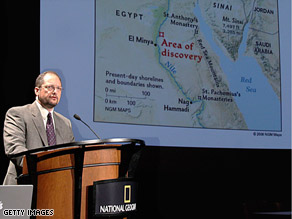
Bart Ehrman delivering the cold hard truth about the Bible.
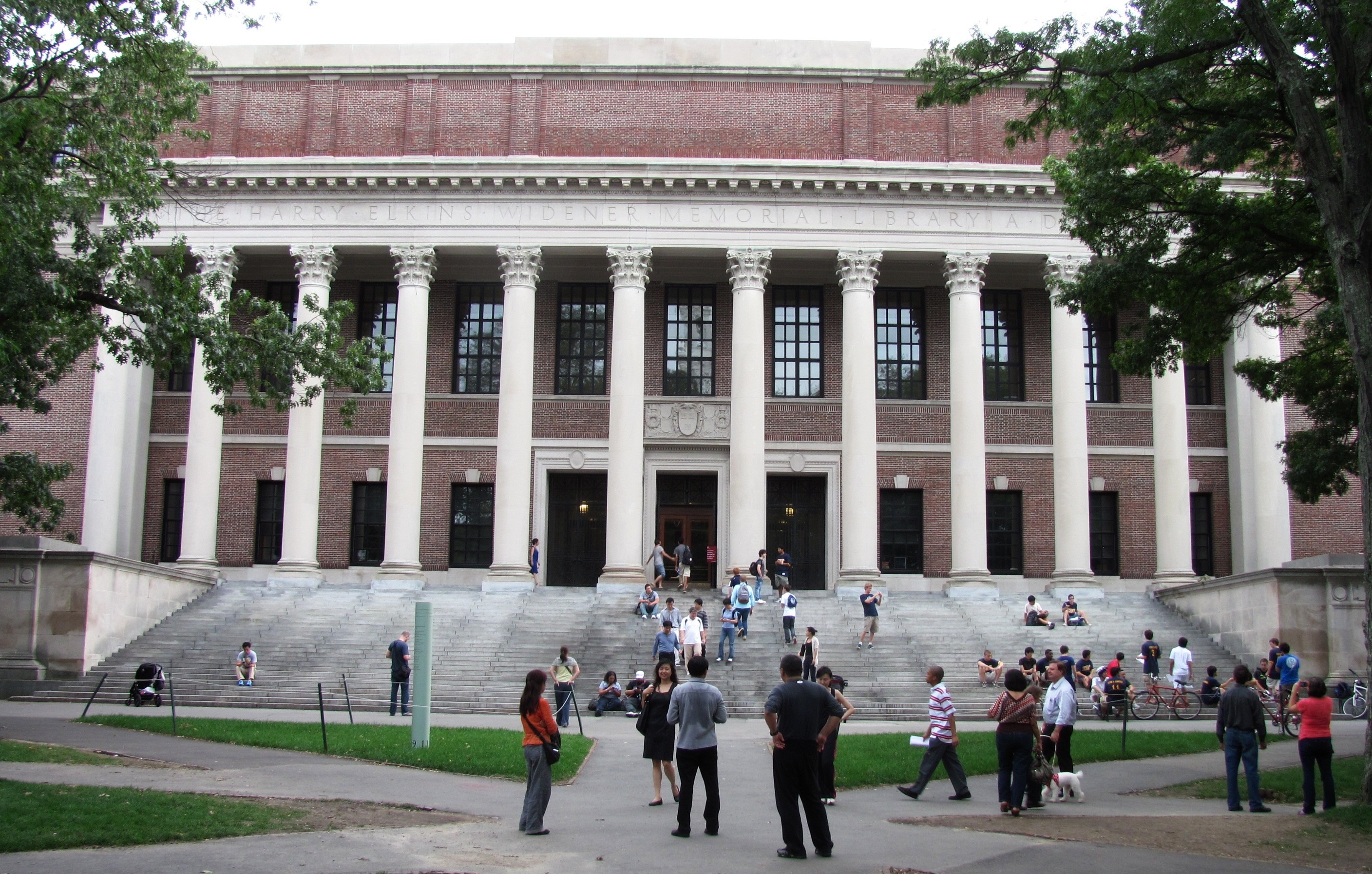
One reason that I bother with reading these kinds of books at all is because I am fascinated with the authentic contemporary professional educated class--the people who who succeeded where I failed. Having spent a substantial part of his life as an evangelical Christian from the midwest, Bart Ehrman is not a perfect specimen of the type, but he has been adapting well enough to have cultivated a suitably annoying authorial personality. He is a made professor at the University of North Carolina at Chapel Hill, which is a place I have always thought of as attractive (in contrast with nearby Duke, which I have always been equal parts terrified of and repelled by). I even sent off an application there when I was high school--at that time it might even have been free to do so, or was $10 at the most, though I had no idea of actually going there unless I did not get in anywhere else. Of course I didn't get in there either. Everybody loves to write about how devastating it is not to get into Harvard and be deprived of an easy route to world influence and a summer house on the Cape, but it isn't exactly light medicine to be told by a good but not terribly exclusive state school that 10,000 people who were better and more desirable than you applied that year alone, but that they are sure you will find an educational option somewhere that suits your requirements (*cough* loser *cough*). In truth I had completely forgotten about this episode in my biography until this Bart Ehrman guy came up; anyway the juxtaposition of the regard the two of us are held in by the University of North Caroline should give some idea of the intellectual gulf that exists between myself and people of this caliber. Yet for most of his book I could not help wondering what was the quality that enabled him to end up at a full professor at one of the nicest colleges in America, while I can barely imagine myself functioning in any kind of contemporary college level class at this point. While his struggles with angst about whether he deserved the steaks and microbrewed beer and Chateneuf-du Pape with which his refrigerator was bursting while 1.2 billion people in the world lacked clean drinking water made for mildly entertaining reading, it did not impress upon me the presence of an intellect of that degree of superiority. He counts many 'brilliant' people, almost all of them academic colleagues, among his friends. His wife is also a 'brilliant intellectual'. (I don't know if I know a single person whom I would feel comfortable referring to as 'brilliant'--if they really were brilliant, I don't think I would have the qualifications to detect wherein their brilliance lay--but I have known a few people whom even I could see were undoubtedly 'bright). ' Outside of these brilliant professional thinkers, however, his society is mostly a wasteland. Most people he meets either have nothing to say when he tells them what his field is or that he is grappling with the subject of suffering, or they offer some trite observation that he quickly pounces on and fires back with some studied rebuttal or follow up question to which they cannot respond (evidently once people are determined to be stupid beyond hope, trying to set them at ease in conversation and drawing out their thoughts is a waste of one's precious time). When he comes to believe something, he believes in it with great certainty and becomes zealous-perhaps a vestige of his evangelical background--that others should be disabused of their own wrong opinions. Past experience of error does not make him shy to assert himself, as might be the case with others. But I am going to stop here.
Still Alice looks to be an even more intense peek into the exalted world of the lives of the cognitive elite in my generation. The author, Lisa Genova, was born in the same year as I was and graduated from Bates College in Maine (where she may have known some old high school classmates/friends of mine, as at least three of them went to school there), before getting a PhD in neuroscience from Harvard. The book is about a brilliant Harvard professor of cognitive pscyhology who gets afflicted with early onset Alzheimer's disease. Unlike in The Plague or The Magic Mountain I don't think the illness is supposed to be a metaphor for the state of contemporary society or Western Civilization. In the acknowledgements the author names 67 people, including 13 doctors, at least eight of whom appear to medical doctors, most affliated with Harvard, who were instrumental in helping the book to get written. One especially curious (to me) acknowledgement was to a couple of doctors "for role-playing as Alice's general practice physician". Really? You can't just make up the dialogue for a doctor's appointment in a novel? I suppose it's possible Camus interviewed a few doctors to avoid egregious blunders ("so you really do lance the boils, right?"), but his doctor characters speak the way he wants them to speak, that is, like philosophers. I was reminded also of Kurt Vonnegut's line about his recurrent Kilgore Trout character ("Like most science fiction writers, Trout knew almost nothing about science"). Our new creative class really likes to get the details right, however.
I don't know how far I am going to make it in this book--these people are hard core meritocrats and they are very proud of themselves. At the beginning at least there is not much in the way of whimsy or humor, or doubt or dubiousness about anything, with the exception of lesser people's abilities. Here are a few quotes by way of example:
"They used to walk together over to Harvard Yard every morning...She savored the relaxed initmacy of these morning walks with him, before the daily demands of their jobs and ambitions rendered them each stressed and exhausted."
"She also loved the adrenaline rush. The bigger the stakes, the more sophisticated or hostile the audience, the more the whole experience thrilled her."
"Her contributions mattered and propelled future discovery."
"One of the big memory burdens for anyone with a serious career in the sciences was knowing the years of published studies, the details of the experiments, and who did them...Most of the senior faculty in her department had this skill at their fingertips. In fact, there existed an unspoken competition among them to see who possessed the most complete, readily accessible mental catalog of their discipline's library."
Lisa Genova is kind of something, though in the battle of Harvard Phds/Professional degree holders and Challenge winners who are about my age I think I like Susan Cain by a hair. I'm not really loving either as a writer. Their resumes are both so awe-inspiring as to be far beyond my capacity to judge them.
"They both wore impressive blue suits, his accessorized with a solid gold tie and hers with a single strand of pearls. They'd been working for a couple of years at the third biggest corporate law firm in Massachusetts, Anna practicing in the area of intellectual property and Charlie working in litigation...She'd been trying without success or secrecy to conceive for six months now. Like everything with Anna, the harder it was to obtain, the more she wanted it...she'd just married Charlie last year, and she worked eighty to ninety hours a week. But Anna countered with the point that every professional woman considering children realized eventually: There's never going to be a good time to do this."
"He was smart, intense, the spitting image of his father, in his third year at Harvard Medical School, and planning on a career as a cardiothoracic surgeon."
"Alice watched her husband and son, both biologists, absorbed in analytical conversation, each trying to impress the other with what he knew."
I'm not sure for what purpose my own family can possibly exist going forward.
The Challenge also produced one video and one musical entry, both seemingly worthy. The search engines rooted out from one set of my Challenge keywords the Bronte connection and (spat?) out the 1967 BBC adaptation of Wuthering Heights. I suspect there will be an overemphasis on certain 60s obsessions (such as the repressed sexuality of women and various forms of hysteria), but I can generally deal with those better than the 21st century obsessions (incest/abuse, homosexuality, outrage at archaic attitudes even when fairly mild in the context of the original source, and so on).
The music was a record album of Bach's Cantatas conducted by Karl Richter, which seems to be available only on vinyl. Needless to say, we should listen to more of this.
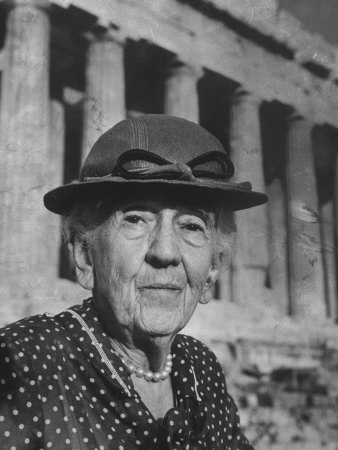
A fine book, from which I derived much pleasure in the reading and looked forward to each daily section. It seems to be considered as an introductory book on the subject for high school students, something I ought to be beyond by this point of my life. However, while most of the figures and stories are familiar to me, I have still failed to commit some of the more important ones to memory, nor have I ever organized the material in my head as neatly as it is done here. I certainly don't think that I would have gotten very much out of this book as a teenager, without any meaningful prior exposure to classical literature. I also appreciated the simple presentations at the beginning of each section regarding the literary sources from which the myths have come down to us. I am weak on Euripides and have never read Ovid, who were major sources, and I was unfamiliar with Appollodorus as well, whom Edith Hamilton disparaged as a dull and inferior writer, though on numerous occasions she opted to base her account of a story on his versions rather than Ovid's, on the basis of their probably being more truthful to the way it was traditionally told.
The book is written in what I kind of think of as the 'conversational learned style' which lasted from the 20s really up to the early 50s. It is a style to which I have always been partial. The tone is not confrontational nor hyperbolic in promoting the breakthrough in human understanding that the author's researches and insights represent, and humorous observations are dropped in (gently) from time to time at some particularly ludicrous or otherwise illogical aspect of a myth. It organizes and conveys information of a high general interest in a concise, understandable way such as it is not usually presented, and that is also pleasant. Our author assumes a mainly northern European-descended audience for her work: in a brief section at the end on the Norse myths, she writes, as a reason for including these in her survey: "By race we are connected with the Norse; our culture goes back to the Greeks." This sense of the homogeneity of the audience probably accounts somewhat for the intimate tone of the book. In the very short forward when she referred to Shakespeare I thought I detected some affectation or self-puffery with regard to her understanding of the greatness of this author and the serious level she occupied in that game; but perhaps I am overly sensitive to any emphasis people make concerning any superiority they possess. I did not find anything off-putting in her writing about the ancients.
Looking at some of the online reviews, someone wrote that they had taken a mythology class in college and the first thing the professor said was "I hope you all haven't been reading junk like Edith Hamilton". This sort of thing is always very obnoxious because it is unnecessary, even in the unlikely event that someone teaching an undergraduate mythology course is really that far advanced compared to Edith Hamilton both in his understanding and his pedagogy. If the students really learn what you are teaching them, they will presumably come to a similar understanding to that of the teacher, and if they are too stupid to do this, mocking such learning as they do have probably is no help to them. I know there is the problem that ignorant people who have read Edith Hamilton in high school think they know something and that they need to be knocked down a peg and the professor needs to establish that when you are in his class you are playing with the big boys and are dealing with a level of intellectual firepower that, especially if you are from a middle class background, you have probably never encountered before, but I don't think it is helpful in most instances to the students. I also believe that any professor doing this nowadays is probably a complete poser. When I was a student you still had some old Europeans to deal with who may well have spoken five languages by the age of thirteen and heard no other music than what was of the highest quality before they were thirty, but any baby boomer, let alone someone of my generation, who grew up in this country and tries to act like they were born with a deeper understanding of literature and mythology than Edith Hamilton attained in the whole of her earnest life is almost certainly full of it.
Jacinto Benavente y Martinez (1866-1954) Bonds of Interest (1907) Born: Madrid, Spain. Buried: Cementerio de Galapagar, Madrid, Spain. Hostal Residencia Universitaria Jacinto Benavente, Avenue Jacinto Benavente 2, Malaga, Andalusia, Spain.
Francoise Sagan (1935-2004) Bonjour Tristesse (1954) Born: Maison Quoirez, Cajarc, Midi-Pyrenees, France. Buried: Seuzac Village Cemetery, Cajarc, Midi-Pyrenees, France.
I had not realized that she had died. I thought she be a candidate for the last person on this list to still be alive. I am aware of at least one author from this group who lives yet. He is coming up in this very post, too.
William Makepeace Thackeray (1811-1863) The Book of Snobs (1846-7), Vanity Fair (1847-8), Henry Esmond (1852) Born: 56B Free School Street (nr Armenian College), Calcutta, India. Buried: Kensal Green Cemetery, Kensal Green, London, England. College: Trinity (Cambridge).
Alexander Pushkin (1799-1837) Boris Gudonov (1825), Eugene Onegin (1831), The Captain's Daughter (1836) Born: Moscow, Russia. Buried: Svyatogorsk Monastery Cemetery, Pushkinskiye Gory, Pskov Oblast, Russia. National Pushkin Museum (http://www.museumpushkin.ru/eng), 12 Moika River Embankment, St Petersburg, Russia. Pushkin Museum of Fine Arts (http://www.arts-museum.ru/index.php?lang=en), Volkhonka Street, Moscow, Russia. State Alexander Pushkin Museum (http://www.moscow.info/museums/state-alexander-pushkin-museum.aspx), Ul Arbat 53, Moscow, Russia. Alexander Pushkin Museum (http://www.vilniausmuziejai.lt/a_puskinas/index.htm), Subaciaus g-24, Vilnius, Lithuania. Mikhailovskoye, State Museum-Preserve of A.S. Pushkin (http://pushkin.elink.ru/english/pushkin/push1.asp), Pushkinskiye Gory, Pskov Obl., Russia. Alexander Pushkin Museum, Chisinau, Moldova. Alexander Pushkin's Museum, Pushkins'ka 13, Odessa, Ukraine. Dacha-Museum, Pushkin, Leningrad, Russia. Catherine Palace, Pushkin, Leningrad, Russia. College: Tsarskoye Selo Lyceum.
Boris Godunov (1551-1605) Born: Vyazma, Smolensk Obl., Russia (?) Buried: Trinity Lavra of St Sergius, Segiyev Posad, Russia. Kremlin, Moscow, Russia.
There is definitely at least one Mussorgsky museum in Russia, and there may be two. Some of the pages identify a museum as being in Karevo, and others in Naumovo, which is about 13 miles away. There are pictures and even videos of one of these places, but I can no definitive information in a brief search as to exactly where it is.
Moliere (1622-1673) Tartuffe (1664), The Misanthrope (1666), The Bourgeois Gentleman (1670) Born: 96 Rue St Honore, 1ere, Paris, France. (There is a second monument claiming to represent Moliere's birthplace, apparently incorrectly, at 31 Rue du Pont-Neuf, 1ere, Paris, France) Buried: Pere Lachaise Cemetery, 20eme, Paris, France. Hotel Moliere (http://www.hotel-moliere-paris-louvre.com/), 21 Rue Moliere, 1ere, Paris, France.
John Maddison Morton (1811-1891) Box and Cox (1847) Born: Pangbourne, Berkshire, England. Buried: Kensal Green Cemetery, Kensal Green, London, England.
Sir Arthur Sullivan (1842-1900) Born: Lambeth, London, England. Buried: St Paul's Cathedral, City, London, England. College: Royal Academy of Music.
W.S. Gilbert (1836-1911) Born: 17 Southhampton Street, Strand, London, England. Buried: Church of St John the Evangelist, Stanmore, Harrow Weald, London, England. College: King's (London).
Francis Burnand (1836-1917) Born: London, England. Buried: St Augustine's Abbey Churchyard, Ramsgate, Kent, England. College: Trinity (Cambridge).
Ignazio Silone (1900-1978) Bread and Wine (1937) Born: Pescina, Abruzzo, Italy. Buried: Pescina, Abruzzo, Italy (exact site apparently unknown, however).
Sir Walter Scott (1771-1832) The Bride of Lammermoor (1819), Ivanhoe (1820), Kenilworth (1821) Born: College Wynd (plaque on 8 Chambers Street), Edinburgh, Midlothian, Scotland. Buried: Dryburgh Abbey, Borders, Scotland. College: Edinburgh. Scott Monument (http://www.edinburghmuseums.org.uk/Venues/Scott-Monument), Princes Street Gardens East, Edinburgh, Midlothian, Scotland. The Writer's Museum (http://www.edinburghmuseums.org.uk/Venues/The-Writers-Museum), Lady Stair's Close, Edinburgh, Midlothian, Scotland. Abbotsford House (http://www.scottsabbotsford.co.uk/), Melrose, Scotland. Sir Walter Scott's Courtroom, Market Place, Selkirk, Selkirkshire, Scotland.
Gaetano Donizetti (1797-1848) Born: 14 Borgo Canale, Bergamo, Lombardy, Italy. Buried: Basilica di Santa Maria Maggiore, Bergamo, Lombardy, Italy. Donizetti Museum, 9 Via Arena, Bergamo, Lombardy, Italy.
Thornton Wilder (1897-1975) The Cabala (1926), The Bridge of San Luis Rey (1927), Our Town (1938) Born: 140 Langdon Street, Madison, Wisconsin. Buried: Mt Carmel Cemetery, Hamden, Connecticut. Miller Memorial Central Library, 2901 Dixwell Avenue, Hamden, Connecticut. College: Yale.
Fyodor Dostoevsky (1821-1881) Crime and Punishment (1866), The Idiot (1869), The Brothers Karamazov (1880) Born: 2 Dostoevsko Street, Moscow, Russia. Buried: Alexander Nevsky Monastery, St Petersburg, Russia. Dostoevsky Museum, Kuznetsky Lane 5/2, St Petersburg, Russia. Omsk State Dostoevsky Museum, Dostoevskaya 1, Omsk, Russia. Hotel Dostoevsky, Vladimirski Prospekt 19, St Petersburg, Russia. Museum, Darovoe, Russia. Museum, 40 Dosoevsky Street, Kuznetsk, Penza Obl., Russia. Museum, Dostoevsky Street 117, Semipalatinsk, Kazakhstan. Museum, Dostoevsky Embankment 42, Staraya Russa, Novgorod Obl., Russia. College: Military Engineering-Technical University (St Petersburg)
I cannot find any evidence that Garnett was buried in the churchyard at Limpsfield in Surrey; however she appeared to have lived in this village for the last fifty years of her life.
Princess Alexandra Kropotkin (1887-1966) Born: Bromley(?) or Harrow(?), London, England.
Thomas Mann (1875-1955) Buddenbrooks (1901), The Magic Mountain (1924), Joseph and His Brothers (1933-44) Born: Lubeck, Schleswig-Holstein, Germany. Buried: Kilchberg Village Cemetery, Kilchberg, Switzerland. Buddenbrookhaus, Mengstrasse 4, Lubeck, Schleswig-Holstein, Germany. Thomas Mann Museum & Cultural Center, 17 Skruzdynes Street, Nerunga (Nida), Lithuania. Thomas Mann Archives, Swiss Federal Institute of Technology, Zurich, Switzerland. B & B Al Pantheon con Thomas Mann, Via del Pantheon 57, Rome, Italy. College: Ludwig Maximilian University of Munich.
O. Henry (1862-1910) Cabbages and Kings (1899) Born: Greensboro, North Carolina. Buried: Riverside Cemetery, Asheville, North Carolina. O. Henry Museum, 409 East 5th Street, Austin, Texas. O Henry House Museum, 601 Dolorosa Street, San Antonio, Texas. O Henry Room, Capital Visitors Center, 112 East 11th Street, Austin, Texas.
Julius Caesar (100-44 B.C.) The Gallic Wars (50 B.C.), The Civil Wars (47 B.C.) Born: Rome, Lazio, Italy. Buried: Temple of Caesar, Forum, Rome, Lazio, Italy. Bust of Caesar, Kunsthistoriches Museum, Vienna, Austria. Murder Site, Largo di Torre Argentina, Rome, Italy.
Herman Wouk (1915- ) The Caine Mutiny (1951) Born: East 167th Street, Bronx, New York. College: Columbia.
At age 98, and with Francoise Sagan already passed, I am pretty certain Herman Wouk is the only author on this list who can still be alive. Here is a Vanity Fair Proust Questionnaire he did last year at 97.
W. Somerset Maugham (1874-1965) Of Human Bondage (1915), The Moon and Sixpence (1919), Cakes and Ale (1930) Born: British Embassy, 35 Rue du Faubourg St Honore, 8eme, Paris, France. Buried: Ashes scattered near Maugham Library, King's School, Canterbury, Kent, England. College: Heidelberg
Jack London (1876-1916) The Call of the Wild (1903) Born: near 3rd & Brannan Streets, San Francisco, California. Buried: Jack London State Historic Park, Glen Ellen, Sonoma, California. Jack London Interpretive Museum, Dawson City, Yukon, Canada. Jack London Square, 466 Water Street, Oakland, Alameda, California. Jack London Inn, 444 Embarcadero West, Oakland, Alameda, California. College: California.
Alexandre Dumas Fils (1824-1895) Camille (The Lady of the Camellias) (1848). Born: 1 Place Boieldieu, 2eme, Paris, France. Buried: Cimitiere de Montmartre, 18eme, Paris, France.
Eleonora Duse (1858-1924) Born: Ni 24/32, Via XX Settembre, Vigevano, Lombardy, Italy. Buried: Cemetery of Sant' Anna, Asolo, Veneto, Italy.
The IWE reports that "The play appeared in 1852 with Eleonora Duse in the title role," but this obviously is wrong, unless there was another, older, Eleonora Duse, who has been completely forgotten by fame. This seems unlikely, however.
7. California (Berkeley).............................4
Humboldt (Berlin).................................4
9. Christ's (Cambridge)..............................3
Columbia................................................3
Glasgow...……………………………...3
Hertford (Oxford)...................................3
Kings (Cambridge).................................3
Kings (London)………………………..3
Leipzig...……………………………….3
Magdalen (Oxford).................................3
Marburg...……………………………...3
Paris (Sorbonne).....................................3
Princeton................................................3
St Petersburg State (Russia)...................3
Trinity (Oxford)………………………..3
Uppsala...................................................3
23. Aberdeen...............................................2
Army.......................................................2
Bern...…………………………………..2
Bonn........................................................2
Bowdoin..................................................2
Brasenose (Oxford).................................2
Chicago...……………………………….2
Christ Church (Oxford)...........................2
Conservatoire de Paris............................2
Cornell.....................................................2
Corpus Christi (Cambridge)....................2
Exeter (Oxford).......................................2
Gottingen...……………………………..2
Jesus (Cambridge)...................................2
Queen's (Oxford).....................................2
Radcliffe...……………………………...2
Royal Academy of Arts (London)……..2
Royal Academy of Dramatic Arts ..........2
St John's (Cambridge).............................2
Trinity Hall (Cambridge).........................2
Union.......................................................2
University (Dublin)..................................2
Washington (Missouri)............................2
46.Algiers.....................................................1
Art Institute of Chicago...……………….1
Bates.........................................................1
Berlin........................................................1
Berlin University of the Arts....................1
Birkbeck (London)...................................1
Bordeaux..................................................1
Brest Naval College..................................1
Brown.......................................................1
Canterbury (Oxford)…………………….1
Carroll (Wisconsin)..................................1
CCNY.......................................................1
Central School of Speech & Drama (UK).1
Christ Church (Cambridge)......................1
College of Charleston...............................1
Conservatorio di Bologna.........................1
Conservatorio di Milano...........................1
Copenhagen..............................................1
Curtis Institute of Music...........................1
Drake.........................................................1
Dublin........................................................1
Ecole Militaire..........................................1
Ecole National des Chartes……………...1
Ecole Normale Superieure (Paris)............1
Ecole Polytechnique..................................1
Erskine (S.C.)............................................1
Escuela de Caminos..................................1
Friedrich Schiller University of Jena........1
Ghent.........................................................1
Grinnell.....................................................1
Halle...…………………………………...1
Haverford...................................................1
Heidelberg.................................................1
Helsinki......................................................1
Imperial (London).....................................1
Imperial (Moscow)....................................1
Johns Hopkins...………………………….1
Lafayette.....................................................1
Lausanne...………………………………..1
Lawrence (Wisconsin)……………………1
Lehigh...…………………………………..1
Ludwig Maximilian University of Munich.1
Lycee Louis-le-Grand.................................1
Magdalene (Cambridge)…………………..1
Merton (Oxford)…………………………..1
Military & Engineering Technical U (St Petersburg)...1
Mississippi...………………………………1
Montpellier..................................................1
Moscow Conservatory...…………………..1
Moscow State (Russia)................................1
Munich.........................................................1
Muskingum..................................................1
National College of Art & Design (Dublin).1
Navy.............................................................1
Nebraska......................................................1
New (Oxford)..............................................1
New England Conservatory...…………….1
Newham (Cambridge).................................1
New York College of Music...…………….1
NYU............................................................1
North Carolina.............................................1
Oklahoma....................................................1
Oriel (Oxford)..............................................1
Oslo..............................................................1
Padua...........................................................1
Pembroke (Cambridge)................................1
Pembroke (Oxford)......................................1
Pittsburgh.....................................................1
Prytanee National Militaire..........................1
Purdue..........................................................1
Randolph-Macon..........................................1
Royal Academy of Music............................1
Royal College of Art (London)....................1
Royal College of Music...............................1
Royal Military College (Sandhurst)............1
Royal Swedish Academy of Fine Arts...…..1
St Andrew's..................................................1
St Catherine's (Oxford)................................1
St John's (Oxford)........................................1
St. Lawrence...……………………………..1
St. Mary Hall (Oxford)…………………….1
St Petersburg Conservatory..........................1
Somerville (Oxford).....................................1
Stanford........................................................1
SUNY-Buffalo..............................................1
Swarthmore...………………………………1
Syracuse........................................................1
Tsarkoye Selo Lyceum.................................1
Tubingen...………………………………….1
University College (London)........................1
University (Oxford).......................................1
Valencia........................................................1
Vanderbilt.....................................................1
Vienna...........................................................1
Vienna Polytechnic.......................................1
Virginia.........................................................1
Wake Forest..................................................1
Warsaw.........................................................1
Washington (Maryland)................................1
Wheaton (Illinois).........................................1
William and Mary.........................................1
Williams........................................................1
Wittenberg.....................................................1
Worcester (Oxford).......................................1