Thought of, doubtless due to the Disney cartoon, primarily as a children's book, the novel Bambi is actually a highly emotional, and in some ways rather brilliant meditation on the arc of life, nothing like I expected. For some reason--probably because I had confused him with Maurice Maeterlinck--I was thinking when I started the book that Felix Salten was Belgian and wrote in French, though in fact he was Jewish and a native of Hapsburg Budapest who wrote in German. Salten was very prominent in intellectual circles in his time as far as activity goes, though most assessments of his raw brainpower in these tough crowds did not accord him a particularly high rank. At least one writer has opined that Bambi can be interpreted as a commentary on the Jewish experience in Europe. I found it to be very sad, though essentially truthful. It really is not a children's book. There is nothing in it of humor or whimsy, despite which I think it is quite good, and well worth the time to read, if you have an intellect and psychological makeup like I do, which admittedly does not seem to be very many people.
p. 20 (I started pretty early with the notes in this book) "These were the earliest days of Bambi's life. He walked behind his mother on a narrow track that ran through the midst of the bushes. How pleasant it was to walk there." The melancholy, wistful tone is established right at the beginning. The English translation by the way was done by Whittaker Chambers, who was a name of some renown in his lifetime, though I don't have a good sense of what specifically he was renowned for.
p. 56 "In a moment Bambi darted after her. Gobo followed him. They flew around in a semi-circle, they turned tail and fell over each other. Then they chased each other up and down. It was glorious."
p. 59 "And Bambi's mother said to him, 'Come, it's time to go.' 'Wait just a little longer,' Faline pleaded eagerly, 'just a little while.' 'Let's stay a little longer, please,' Bambi pleaded, 'it's so nice.' And Gobo repeated timidly, 'It's so nice, just a little longer.'"
See what I mean.
Around this point I made a rather snide note that if a marginalized culture had produced this story, it would probably be held up as so subtly profound and wise as to be inaccessible to us.
pp.70-73 "'It was a bad business', he said, 'a monstrous uproar! You wouldn't believe how scared I was. I hunch myself up as still as a mouse in the corner and hardly dared move. That's the worst of it, having to sit there and move. And all the time you're hoping nothing will happen." This is a squirrel talking. I thought this passage might have been related to the Jewish experience in Europe.
Fall comes for the first time and Chapter VIII is a brief aside featuring the last couple of brown leaves clinging to a branch in complete denial about their future prospects, a real meditation on the reality of death. It hit home with me.
p. 234 I don't know what happened in the middle of the book, I meant to write down some notes but never got around to it. By this time Bambi has come to the point in life where I seem to be: "For his thoughts had grown serious and his heart heavy. He did not know what was happening within him. He did not even think about it. He merely recalled things aimlessly, and his whole life seemed to have become darker."
p. 258 Then he suffers injury and illness: "Not until the fever had entirely left his body did Bambi begin to think over all that had happened to him. Then a great terror awoke in him, and a profound tremor passed through his heart. He could not shake himself free of it. He could not get up and run about as before. He lay still and troubled." Obviously this whole passage would be lost on a child and would have to some extent been lost on the me of ten years ago. The depiction of the emotions of aging, not even out of youth, but really out of the prime years of life is eerily good. Salten, for the record, was 54 when Bambi was published, so he still had a few years on me. Books on these classics lists written by authors older than I am at the time of publication are not quite rare yet, but it has definitely reached the point where the circumstance is worth noting.
p. 268 "But of all his teachings this had been the most important; you must live alone, if you wanted to preserve yourself, if you understood existence, if you wanted to attain wisdom, you had to live alone."
Stolen picture. Since it's getting harder to do this, I'm going to have to start preparing more from my own materials. It shouldn't be hard.
The story meanders a little more in the second half, though it is obviously still an allegory. Though perhaps I should see it again, I think this aspect was completely lost in the Disney adaptation, which Salten apparently liked nonetheless.
I suppose I should at least briefly touch on the question of whether hunting is evil or not. Besides the brutality of humans which are duly noted, many of the animals are obviously predators too. After a heartwarming description of a family of ducks, a fox drags the mother duck out of the water and devours her, the mice live as virtually universal prey, and so forth. While death and inter-species violence are endemic to life, I think Salten would not have us find them lovable or heroic aspects of existence. He has chosen as his hero-animals the deer, who do not attack other animals, after all. I have, of course, never been on a hunt of any kind, unless we count setting mousetraps, the bringing of which latter death I must confess I have never lost any sleep over. I do not avoid hunting for any ideological reason, but merely because I did not grow up among people who ever did those sorts of things. It is a skill, and historically an important one for humans, especially male humans, to have, and I don't have any strong feeling that it was a skill that would better have remained undeveloped, so I have no urge to denounce it. Even the desire to virtue signal in me at this point is not powerful enough to give me any real pause in considering a position.
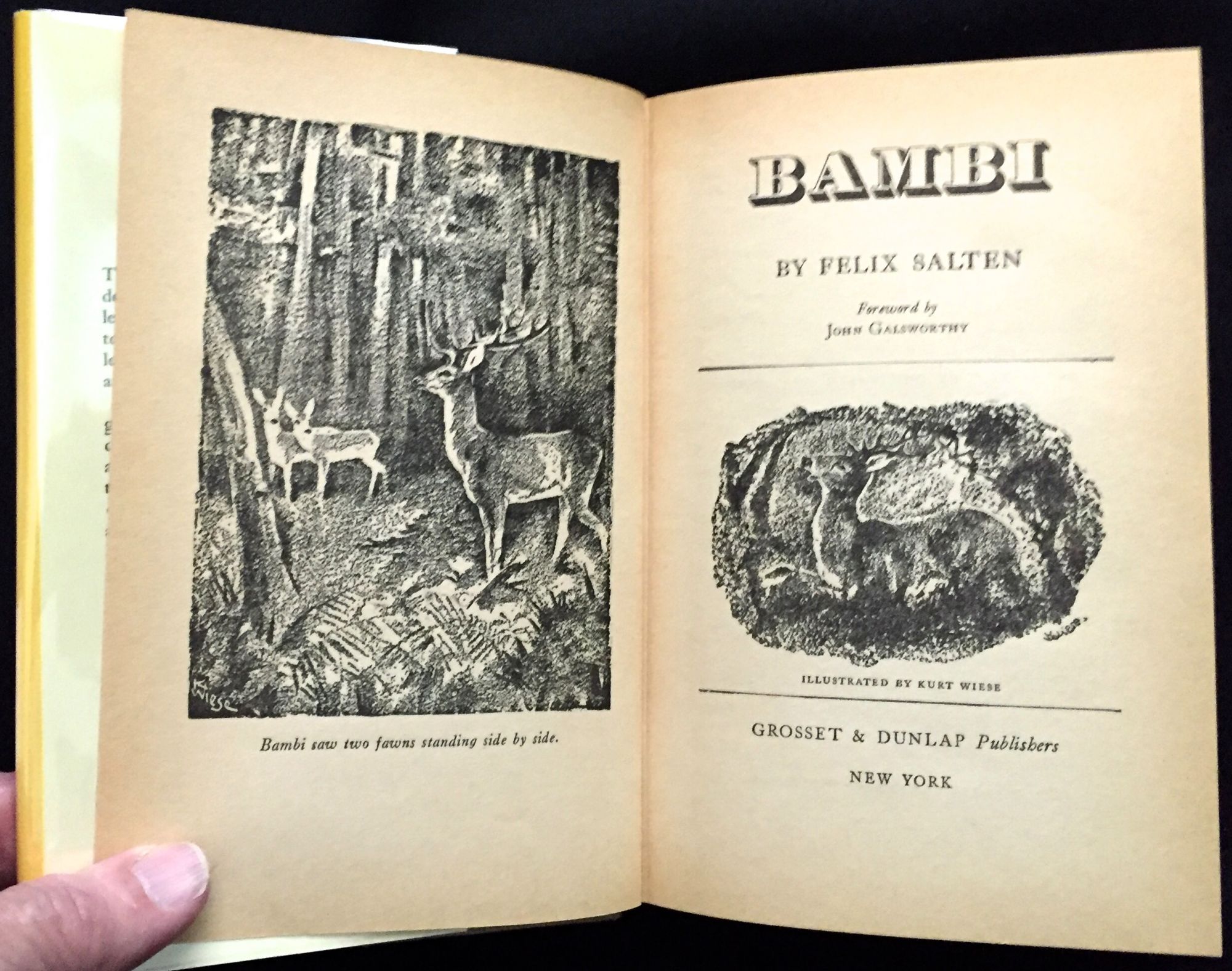
The edition of the book I read I found some years back in my attic (two copies of it in fact) in one of the many boxes of books that had been left up there for many decades by my wife's family. The book was published by Noble and Noble, with a brief forward by John Galsworthy and illustrations by Kurt Wiese. It looks like it dates from the World War II era, since there is an announcement on the copyright page declaring the book to have been made in strict conformity with WPB regulations of essential materials. It is a nice little book, though unfortunately I got something on my hands one day while I was reading it and smudged the cover.
The Bourgeois Surrender Challenge
1. Chicken Soup For the Cat Lover's Soul.......................................2,055
2. Philip Pullman--The Subtle Knife...................................................718
3. Jane Yolen--Owl Moon...................................................................268
4. Emile Zola--Germinal.....................................................................158
5. Bob Grant--Bambi (Golden Book)..................................................134
6. Kenneth Oppel--This Dark Engineer................................................84
7. Mary Eberstadt--It's Dangerous to Believe.......................................57
8. Victor Hugo--The Man Who Laughs.................................................37
9. Pippa Mattinson--Total Recall...........................................................28
10. Victor Digenti--Windrusher............................................................21
11. Velda Brotherton--Once There Were Sad Songs............................21
12. Maxim Gorky--Mother....................................................................20
13. Felix Salten--Bambi's Children........................................................13
14. Susanne Davis--The Appointed Hour................................................7
15. David Zindell--Splendor....................................................................5
16. Jana Richard--Lies and Solace...........................................................5
First Round
#16 Richard over #1 Chicken Soup
This is a pretty excruciating matchup.
#2 Pullman over #15 Zindell
In battles of two genre books, I am going to go chalk until the final four from now on.
#3 Yolen over #14 Davis
The Yolen book is a children's book but it did win the Caldecott medal
#4 Zola over #13 Salten
A rare clash of IWE authors in the Challenge. I am actually curious about the Bambi sequel, but it wasn't enough for me to give it a win here.
#5 Grant over #12 Gorky
Upset card played over another IWE stalwart.
#6 Oppel over #11 Brotherton
#10 Digenti over #7 Eberstadt
Eberstadt's book is about religion and contemporary issues, not a genre novel. Unfortunately Digenti has an upset card.
#8 Hugo over #9 Mattinson
No one really studies like this anymore, but at least someone else wishes they did.
Elite Eight
#2 Pullman over #16 Richard
#3 Yolen over #10 Digenti
#4 Zola over #8 Hugo
Another clash of titans
#6 Oppel over #5 Grant
Oppel uses up his upset card.
Final Four
#2 Pullman over #6 Oppel
#4 Zola over #3 Yolen
Champiuonship
#2 Pullman over #4 Zola
Pullman had a upset coming that he didn't have to use until the final. His books certainly appear to be popular. I have no idea what they are about.
Another American book--it seems like about the fourth or fifth in a row--from that 1900-1940 period that thus far dominates this list. While I do love much of the literature of this period, after this one, I am ready for a little break from it, which it looks like I am going to get (towards of this, perhaps because it coincided with St Patrick's Day, I felt a craving for an Irish novel of the old kind, which sort of thing I have not read in a long time. I don't have any coming up however). Back Street is not a terrible book, and the premise of the story seems to me a good enough one, but it isn't great, it's quite a bit longer than it needs to be, it's depressing, and, compared to the best books of the period, it's rather drab and colorless.
I noted during the Sholem Asch post that the IWE list did not feature a lot of Jewish writers, and many of the ones it did seem to be rather obscure now. As with Gertrude Stein previously, I had not realized that Fannie Hurst was Jewish. Unlike in the Gertrude Stein book, there is an emphasis in Hurst on the distinction and line between Jews and gentiles, though in contrast to the what some might expect, this works decidedly to the advantage of the Jewish characters in her book, who mostly become wealthy and powerful, while the main ethnic German characters mostly stagnate or decline into shabbiness.
The IWE said of Back Street that it was "the only one (of Hurst's novels) that critics have treated as significant literature", though I don't think many do anymore. The only other title by this author that is recognizable even to me is Imitation of Life, which like Back Street, was adapted several times into notable movies, in particular the 1959 Douglas Sirk version (which I have seen recently but have not gotten around to writing up on the other blog yet). It also notes that "Fannie Hurst, born of a Jewish family in St. Louis, wrote Back Street with peculiar (sic) knowledge of the wholly similar German and upper-class Jewish communities of Cincinnati at the turn of the century". Kind of a peculiar sentence.
The first note I took was on page 48, when the young Kurt Shendler, who would later go on to become an automobile tycoon, unsuccessfully attempts to woo the heroine Ray:
"There's not a doubt in my mind that, let alone, you'll go down in the history of this town as one of its first crack business girls. But you're going to quit it and go down in the history of my life instead." The last part of this prophecy did not come to fruition. My comment was "male arrogance even among betas". Shendler's character was a little odd in that even after coming a millionaire many times over he remained fixated on Ray and never seems to have any other love interest, which I think is implausible.
On page 50 I wrote, "(The depiction of) melancholy nostalgia brought about by change is good (well-done). Refers to Ray's life after her father's death and the sale of his business to new ownership. I was experiencing a lot of similar emotions at the time.
I'm not going to gratuitously recount all of the social observations about marginalized groups in these books anymore. We all know what they are. Judging by this and the Imitation of Life movie that I saw alone without consulting her biography, this author was quite progressive for her era, if tame by present standards.
p. 252, a reference to the "One-Hoss Shay", a recent favorite from my reading of Holmes
.
As noted above, another between the wars look at the Midwest, following Lewis, Dreiser, Tarkington, et al, Cincinnati and Youngstown especially making rare appearances in literature, or at least literary-like books such as I read. I feel like this region's former strong presence in the national reading life has become underappreciated.
Note around 2/3rds of the way through: "Pace little slow, repetitive. Depressing, without Tolstoy quality mind to carry book (acknowledging that Anna Karenina or The Death of Ivan Ilych could be considered to be depressing). Lead character ultimately lacks agency of a kind (though she regards Hugo, Freda, etc, as hopeless in this regard).
Since I think this book is no longer well known, the plot involves a beautiful, rather languid young woman who ends up falling in love with and becoming the mistress of the eventual head of a major international bank, giving up everything else in her life. The title comes from the idea that she inhabits the "back streets" of her lover's life. He sets her up in a relatively shabby apartment in New York for example, in contrast with his Park Avenue mansion, and when he brings her to Europe she is relegated to a nondescript pension while the magnate and his family stay in the most lavish hotels. The mistress seems to be comparatively independent and resourceful in most situations apart from the banker but she has barely any ability to protest the most constricting and insensitive decisions he repeatedly makes for her, so it is difficult for me to develop any real feel for what she is supposed to be as a character.
p. 348 "She found herself committing the cardinal sin of wishing the passing of time."
p. 350 "He waved her back to her position on her knees on the floor. 'Stay that way. I like it.'"
Isolated like this it sounds like innuendo, and maybe it is, but in fact they are just talking, and I assume this is meant to illustrate the attitude of Saxel rather than to be titillating.
One area where I did feel the book to resonate a little was in its generational relation to me, especially when I thought Fannie Hurst was born in 1889, as printed in the IWE, though everything on the internet places her in 1885. The difference is not that great, though 1889 would put her right in the middle of the Lost Generation, which corresponds exactly with my birth position (1970) in the middle of the so-called Generation X, and these two generations are of course supposed to be correlated in the cycle. This is a long way of saying that this strikes me as being Generation-X like in its character, being rather gloomy, pessimistic, resigned, not much given to genuine indignation in the way that the neighboring generations on either side seem to be. I still don't think it's a great book, but I can feel the mood that infuses it.
Towards the end after Saxel dies basically from overindulgence in unhealthy food and the now-abandoned Ray is aging: "God this book is depressing." Excerpt from pages 403-4:
"Dentistry had become so terribly expensive...One dentist in Louisville diagnosed her trouble as pyorrhea and advised a period of three months treatment before estimating the amount of salvaging work that might then be done...the price of even the preliminary treatments mounted into the hundreds...At first this was repelling and not to be considered, but after months of the considerable odds and ends of dentists' bills, for just temporary reliefs...she surrendered, and two weeks later, with a temporary 'set' in her mouth, began the long period of attempting to adjust the rigid plates to her healing gums...It was horrible."
I worry about my own situation endlessly, but in this world people in old age are selling off possessions to buy chicken feet and cabbage. Maybe it would not take much to get me there without my wife and family, but I hope I have assembled a capable enough support group to stave off such an ugly fate.
I was unable to find an older hardcover edition of this online that appealed to me, so I ended up reading it in a "Vintage Movie Classics" paperback, which series actually includes a few other books on this list (Alice Adams, Cimarron).
The Challenge
1. John Steinbeck--East of Eden...........................................................1,719
2. Jeffrey Eugenides--The Marriage Plot................................................737
3. The Young Pope (TV show).................................................................525
4. Death Race (movie-2008)....................................................................354
5. Guy de Maupassant--Bel Ami.................................................................53
6. Ken Ham & A. Charles Ware--One Race, One Blood...........................31
7. Dave Donelson--Heart of Diamonds......................................................17
8. Cheryl Mendelson--Love, Work, Children.............................................12
9. Alexandre Dumas--The War of Women...................................................4
10. Thalia Field--Experimental Animals......................................................4
11. Richard Crockatt--Einstein & Twentieth-Century Politics....................1
12. James Bell Pettigrew--Design in Nature, etc.........................................0
13. Litteratura Norteamericana...................................................................0
The field features three IWE list authors (Steinbeck, de Maupassant, and Dumas) with books that did not make the cut for the master list.
1st Round
#13 Litteratura Norteamericana over #4 Death Race
#5 de Maupassant over #12 Pettigrew
#11 Crockatt over #6 Ham & Ware
A lot of Einstein books seem to pop up on this list. I read one of them last year. Ham and Ware appear to be pop Christian writers of some kind. At first glance I would have to say their book is unfortunately titled. Even if they are advancing the idea that we are all one in Jesus, it immediately conjures up images of white supremacists and other undesirable elements.
#10 Field over #7 Donelson
Donelson looks like a dreaded genre book.
#8 Mendelson over #9 Dumas
Mendelson gets an upset.
2nd Round
#1 Steinbeck over #13 Litteratura Norteamericana
#2 Eugenides over #11 Crockatt
The Eugenides here is a Pulitzer Prize winner.
#10 Field over #3 The Young Pope
#5 de Maupassant over #8 Mendelson
Mendelson comes up short in a bid to take down two 19th century titans of French literature back to back.
Final Four
#1 Steinbeck over #10 Field
#5 de Maupassant over #2 Eugenides
I gave Eugenides a chance to go toe to toe here, but de Maupassant's book is older, shorter, and foreign, if we count French classics as foreign, and Eugenides has no upset cards to play so he loses in a good game.
Championship
#1 Steinbeck over #5 de Maupassant
Steinbeck does have an upset card to play, and he needed it here, since East of Eden is even longer than The Marriage Plot. Believe it or not, I have never read Steinbeck before. His most famous books are on all my lists, but none of them have come up yet.
Perhaps the most celebrated Americans in Paris book of them all, by the middle I was staying up late consuming baguettes and wine by the light of the stub of a candle babbling to my imaginary brilliant friends with even more fervency than usual. I enjoyed it very much, and was very into it. It is written as if it were a more or less true account of the lives of Gertrude Stein and Alice B Toklas. Evidently considerable portions of the book are not "true" or have been greatly embellished or whitewashed, though whether this is done to the point of being problematic I am not convinced. The point of literary and artistic production, which some people in our time seem to have forgotten, is to capture and fuse the all too fleeting highlights into an elevated sense of life, which is certainly accomplished here. Once I happened by accident to acquire an earlier draft of Boswell's Journey to the Hebrides that had been printed for the use of scholars and other curious parties. While it probably gave a more accurate sense of what the journey was really like on a day in, day out basis, it naturally lacked the high spirit and beauty of the published book that is what is of main interest to readers. Naturally a similar magic of time and place and character pervades this book as well.
I made a lot of notes on this book. Between the epigrammatic style and the characteristic anecdotes of many of the Notable and Great there is much material of the highest interest to me. So this will be a long posting.
As I moved through this I had occasion to do some internet searches about Gertrude Stein and other personages from the book, and I noted that a lot of the biographical sources pointedly identify her as a "Jewish-American writer". Once I saw that it struck me that of course she was, but I had had no conscience sense of it in reading the book because she never makes any reference to herself, or her parents or siblings or other relatives, as being Jewish or doing anything that might be considered explicitly characteristic of a Jewish identity. The only appearance of the word "Jew" in the book comes when Gertrude Stein remarks that a visitor to the house whose appearance she did not like "looks like a Jew", to which her interlocutor (Alfy Maurer, described as "an old habitué of the house") replies "he is worse than that," after which the matter is dropped.
The famous line(s) about Gertrude Stein conversing with the geniuses while Alice talked to the wives. There don't seem to have been any other women geniuses apart of course from Gertrude Stein.
p. 27 "Van Dongen (a painter) in these days was poor, he had a dutch wife who was a vegetarian and they lived on spinach. Van Dongen frequently escaped from the spinach to a joint in Montmartre
where the girls paid for his dinner and his drinks." I have to admit, I love the idea of this kind of life, absent the poverty. But if one has to be poor, Montmartre circa 1905 seems like the way to go.
p. 27 again, on a woman visitor to the house in these early years (Evelyn Thaw, "the heroine of the moment": "She was so blonde, so pale, so nothing, and Fernande (Picasso's live in companion at the time) would give a heavy sigh of admiration." I love that "so nothing" (!)
I had never heard the story about the infuriated public trying to scratch off the paint at one of Matisse's early exhibitions. That's insane.
p. 35 "In those days (we are still in the 1903-1907 chapter. I will note when we move on in time.) you were always going up stairs and down stairs."
I suppose I should say something about the techniques of a) writing another person's autobiography and/or b) writing your own autobiography in the guise of another person. It is done really well here and works beguilingly. As a class of reader who favors execution over novelty, I would love to read other books after the same pattern if they were done as well.
p. 49 My note--We can skip Picasso on Americans. We won't learn anything.
p. 50 Or maybe not. "There was a type of american art student, male, that used very much to afflict him, he used to say no it is not her who will make the future glory of America."
p. 52 "Baltimore is famous for the delicate sensibilities and conscientiousness of its inhabitants." I had never heard nor noticed this. One's instinct is to take it as dated information, but I am slowly coming around to the belief that if you dig deep enough there is no dated information.
p. 60 Still in the 1903-1907 chapter, but a good observation looking somewhat ahead, to the future death of the poet and bon vivant Guillaume Apollinaire: "It was the moment just after the war when many things had changed and people naturally fell apart." The breakup over time of this great prewar Montmartre-based circle of young artistic people with Picasso at the center is one of the more poignant partts of the book, though the twin (narrative) excitements of World War I followed by the emergence of a second group of youthful artists in the 20s mitigates some of the effect of contemplating the fleetingness of almost all really meaningful social intercourse.
p. 77 "Because Picasso is a spaniard and life is tragic and bitter and unhappy."
Now I am in the section "Gertrude Stein Before She Came to Paris". In the part where she talks about having been William James's favorite student in her college years I noted "real genius finds its like." Now I suspect this relationship may perhaps be one of the parts of the book that may been embellished, slightly or otherwise. A little embellishment of this sort does not really bother me if it improves the book.
That chapter was short, and I'm in the 1907-1914 chapter, which is probably the central one in the book.
p. 88 "Gertrude Stein insisted that no one could go to Assisi except on foot." I could still get to Assisi someday I suppose, though it isn't easy to see when that might happen, or what other options might pull me in a different direction if I ever do go anywhere again.
p. 91 "I always remember Picasso saying disgustedly apropos some germans who said they liked bull-fights, they would, he said angrily, they like bloodshed. To a spaniard it is not bloodshed, it is ritual." Ritual is deep and meaningful. People who don't have it are lacking in understanding.
p. 107 A very beautiful passage about the aftermath of a Montmartre party: "It was all very peaceful and about three o'clock in the morning we all went into the atelier where Salmon had been deposited and where we had left our hats and coats to get them to go home. There on the couch lay Salmon peacefully sleeping and surrounding him, half chewed, were a box of matches, a petit bleu and my yellow fantaisie. Imagine my feelings even at three o'clock in the morning. However, Salmon woke up very charming and very polite and we all went out into the street together. All of a sudden with a wild yell Salmon rushed down the hill." For some reason it was this particular memory that inspired me to write "I am dead inside" beside it in the margin.
Great photo of the celebrated duo at home.
p. 111 "I could perfectly understand Fernande's liking for Eve. As I said Fernande's great heroine was Evelyn Thaw, small and negative." I laughed.
p. 112 "And so Picasso left Montmartre never to return." Extremely poignant. The great spirit's time among this scene at least has passed.
p. 125 After the Italian futurists' big Paris show. "Jacques-Emile Blanche was terribly upset by it. We found him wandering tremblingly in the garden of the Tuileries and he said, it looks alright but is it. No it isn't, said Gertrude Stein. You do me good, said Jacques-Emile Blanche."
Now I've advanced to the chapter titled "The War." Whenever the opening scenes in the summer of 1914 appear in a novel written by someone with firsthand reminiscence of the time, whether in Russia, or France, or Austria, or anywhere else, it is always good, and always serves as a jolt to the book. The emotional upheaval of that initial embarking into war was obviously incredible, and one of the defining periods in the lives of everyone who lived through it.
p. 172 More name-dropping, as Picasso is hanging with the young Jean Cocteau! with whom he was heading to Italy. "One day Picasso came in and with him and leaning on his shoulder was a slim elegant youth." Oh yes. "Everybody was at the war, life in Montparnasse was not very gay...he too (Picasso) needed a change." Picasso and Cocteau would spend a lot of time together over the next 50 years, even appearing on celluloid together in Cocteau's 1960 film Orpheus Descending, which I was immediately recalled to when I came on this paragraph.
p. 187 (Driving through the north of France at the end of the war in the service of the American Fund For French Wounded) "Soon we came to the battle-fields and the lines of trenches for both sides. To anyone who did not see it as it was then it is impossible to imagine it. It was not terrifying it was strange." For what it's worth. Stein and Toklas, who lived until 1946 and 1967 respectively, also waited out World War II in France, though they moved out of Paris to the Auvergne-Rhone-Alpes region for the duration. Their friend Bernard Fay, who appears in the latter part of this book, became a high ranking official in the Vichy regime and seems to have arranged for the safety both of their persons and of Stein's art collection. In both written works and interviews that it doesn't seem to have been necessary to have made (she could have returned to America, at least before the occupation set in, for example) Stein made some incredibly naïve, tone-deaf, obtuse statements in praise of the collaborationist government. Considering all of this, her reputation doesn't seem to have taken that much of a hit, in that I think it's still considered O.K. to read about her and her scene in the happier times. Perhaps because she was a woman, and Jewish as well, her conduct during this period has been to some extent excused (on account of) her (being) comparatively powerless and not really understanding what was going on? Though given the resources she had access to, her American citizenship, and her fame in international high culture circles, I can't consider her to be that powerless. Maybe people feel that it doesn't matter, or that she really was a unique sort of genius and cannot be expected to experience moral crises and the like the same way that other people do. Picasso stayed in Paris during the occupation, which I had not realized, though he seems to have lain low and not exhibited any paintings during those years. Anecdotes on Wikipedia indicate that there was antagonism between him and the Germans. Of course everyone is in a different position relative to danger/power, etc in such times of turmoil, yet if we would be good we are expected to hold and behave with more or less the same attitude.
p. 189 "We once more returned to a changed Paris." After the war. I always in books and other art like the theme of how times change, the charm (? I can't read my note) if you are in it, and it is stimulating (and you are thinking?)
Now we are in the postwar (1919-1932) period. Hemingway has shown up. While Hemingway may have been an unbearable jerk later in life when he became famous and was surrounded by sycophants if he was hanging out with anybody at all, he seems to been a very attractive person as a young man, with a charming, life of the party type of energy. I found in this part that I missed him when he wasn't there, and he seems to have been generally popular with the older as well as the younger writers. I even thought he made a pretty good joke (p.200): "(Hemingway) said, when you matriculate at the University of Chicago you write down just what accent you will have and they give it to you when you graduate."
p. 212 Stein on the Hemingway era: "It became the period of being twenty-six. During the next two or three years all the young men were twenty-six years old. It was the right age apparently for that time and place."
p. 213 "Hemingway had then and has always (had) a very good instinct for finding apartments in strange but pleasing localities and good femmes de ménage and good food."
p. 238 "Gertrude Stein did not like hearing him (Paul Robeson, who was brought to the house) sing spirituals. They do not belong to you any more than anything else, so why claim them, she said. he did not answer...Gertrude Stein concluded that negroes were not suffering from persecution, they were suffering from nothingness. She always contends that the african is not primitive, he has a very ancient but a very narrow culture and there it remains. Consequently nothing does or can happen." I assume these statements were based on some thought process which is not however explored or elaborated on further. So I can't really understand what is meant by them.
p. 246 "(our finnish servant) finds it difficult to understand why we are not more modern (with regard to modern conveniences, electricity, radiators, etc). Gertrude Stein says that if you are way ahead with your head you naturally are old fashioned and regular in your daily life." Of course I am comparatively old fashioned and regular in my daily life, so this appealed to me.
p. 251 "Bowles told Gertrude Stein and it pleased her that Copland said threateningly to him when as usual in the winter he was neither delightful nor sensible, if you do not work now when you are twenty when you are thirty. nobody will love you." I have lived that. It is true. I try very hard to impress the fact upon my children.
I did love this book but seeing as it has taken me almost three weeks to do this report I also am missing the old warhorse books that make up this list and I am looking forward to getting back to it.
12. The Good Immigrant (ed. Nikesh Shukla)...........................................5
13. Merry A. Foresta--Artists Unframed....................................................3
14. Al Jolson--"California Here I Come" (record).....................................2
15. The World of Matisse 1869-1954.........................................................2
16. History of Gambling in America..........................................................1
1st Round
#1 Hamilton over #16 History of Gambling
Hamilton is a past champion of the challenge, and I enjoyed her book very much and found it useful. There is no rule banning past champions from competing again if they qualify (only books from the IWE list itself are ineligible), though in general I will probably prevent them from winning unless there is no desirable competition.
#15 Matisse over #2 Vampyr
#3 Dolan over #14 Jolson
#4 Rigby over #13 Foresta
One of those dreaded allotted upsets.
#5 King over #12 Good Immigrant
The Good Immigrant appears to be a British anthology. There aren't any copies of it in any of my libraries.
#11 Glass Animals over #6 Talese
I was actually excited to see Talese qualify for the Challenge. Unfortunately the Glass Animals had a designated upset to burn, and they burned it here.
#7 Watts over #10 Belshaw
#8 Sussman over #9 Johnson
2nd Round
#1 Hamilton over #15 Matisse
I was inclined to choose the Matisse here, but Hamilton comes in with all kinds of backup advantages to push through the early rounds.
#3 Dolan over #11 Glass Animals
#8 Sussman over #4 Rigby
#5 King over #7 Watts
This was a real battle, as these books are similar both in length and date of publication. King has a slight edge in all of the distinguishing categories however--1 year older, 22 more reviews, 71 pages shorter, etc.
Final Four
#1 Hamilton over #8 Sussman
If Hamilton had not already won the championship she would have easily carried off the title here. The Sussman looked interesting, though for some reason I thought it dated from the 50s, which would have made it more interesting. It actually was published in 2014, which causes me to be a little distrustful of it, as it would to be making an argument for a position that all respectable people, and most scientists as well, already seem to accept as fact.
#3 Dolan over #5 King
Dolan seems to be another murder book. I want to minimize those as much as possible since they quickly become repetitive, to me. The King, however, is a similar kind of book, and Dolan comes in with an upset card that he hasn't needed in the first two rounds against musical acts.
Championship
#3 Dolan over #1 Hamilton
I decided to see how the tournament played out and to have Hamilton drop the final unless the opponent was impossible. Dolan is not quite impossible and he is the survivor from the other side of the draw, so he gets an improbable victory.
The Winner. Born: Rome, N.Y. Colgate University. Age uncertain.
The Jewish authors who made the pre-1960 IWE reading list are in many instances not those who would seem obvious today. There is no Bellow, no Mailer, no Malamud, no Singer (Roth was obviously too young to have his early works considered), no Kafka, no Dorothy Parker, no Salinger even. Marx and Freud did make it, as did Proust. Kafka's Prague contemporary Franz Werfel, like Asch famous for novels about Biblical and Christian themes (a genre that is itself well-represented on this list) made it, as did Herman Wouk and some of the American playwrights of the 30s such as Kaufman and Hart. Anne Frank is on as well. I suspect that a few of the other late 19th and early 20th century French, German, Austrian or Russian authors on the list who are not as well known today might turn out to be Jewish, but I have not done the research on all of these yet. What immediately strikes one about those included on the list is that they tend more towards the sober and scholarly end of the distribution, whereas the more comic and bombastic/fantastical authors are held in higher regard today. It is a very old WASPy, and more specifically old Yankee list for sure, which however, despite its shortcomings and oddities, such as its fondness for doorstop historical fiction about early American history, I think is a good one. Old Yankees, though they continue to loom somewhat sinisterly in the national imagination, are getting ever harder to find in actual life even on their native ground, and their presence in and influence on American literary culture withers more and more every year. When I was younger I used to frequent numerous antiquated libraries in New England which partook of this old time atmosphere, even the books on the shelves in many instances not having been replenished in decades. These reminiscences date back 30 years now however, and even most of these places have been remodeled and brightened up and made more accommodating to technology, many of the books which formerly furnished the rooms on shelves reaching from floor to ceiling having evidently been discarded or relegated to the off-limits storage area in the basement. But I am getting far off of the subject of The Apostle now.
Sholem Asch was born in 1880 in Kutno, Poland, which was at that time part of the Russian Empire. He lived in Warsaw for a few years as a young man and got married there, then went abroad, eventually making his way in 1910 to the United States, where he remained for the duration of the first World War and beyond, becoming a citizen in 1920. He went back to the newly independent Poland after the war, and then lived in France for a while. returning to the United States in 1938. He seems to have stayed in the U.S. until some time in the 50s, after which he spent two years in Israel, where his house is preserved as a museum, towards the end of his life. He died in London in 1957. I note all of this because the biographies of people impacted by tumultuous historical upheavals are of interest to me. He wrote in Yiddish and was a prolific author no matter where he happened to be living, writing in the neighborhood of thirty books, the majority of which look to be weighty in length, tone, and subject matter. The Apostle, which depicts the life of St Paul,is actually the middle volume of a trilogy of novels about the lives of major early Christian figures, the other two being The Nazarene, about Christ himself, and Mary.The Apostle however is the only one of these, or any other of Asch's books to make the IWE list.
I liked this quite a bit, even if it is perhaps a little overlong. It is distinguished by an earnest seriousness that seems strange to us ("us" referring to that imaginary segment of the contemporary intellectual world that is super smart and well-informed whose sensibilities are remarkably in "sync" with mine) because earnest has become to my thinking something of a derogatory word that implies futility and a certain limitiation of ability when applied to intellectual pursuits. He was thoroughly Jewish, and led a thoroughly Jewish life, socially, culturally, and so on, so I doubt it would have been possible for him to adopt any of the more drastic Christian beliefs under any circumstances, but he was able to grasp the possibility of others' doing so. To be sure there is much more emphasis on Paul's Jewishness, and the Jewish origins of the entire Christian movement, than is usually found in Christian origin literature. There is always a fashion, maybe more prominent nowadays than ever, to be skeptical that the stories and major figures of the New Testament, including Peter, Paul, and Christ himself, have any basis in reality whatever, in some instances to the point of arguing that every aspect of them is entirely fictitious. What Asch believed as far as this goes I suppose I don't know, but he treated the stories and ideas of the gospels and epistles, whoever wrote them and who and whatever they are supposed to be referring to, very seriously, which is an approach most modern Christian debunkers don't see themselves as having to do. He knows that the power of the story is important in any case.
As with other long books I have had for this list recently, I neglected to take any notes until I was about 300 pages in, when I thought I had better jot some things down for the report. And as usual, once I began I ended up with quite a lot.
What prompted me to begin writing notes was a debate between Paul and his faction of Messianists and an opposing one led by some older school Jews regarding the necessity or not of circumcision for initiation into the new covenant ("circumcision a big deal" reads my note).
"He who cannot summon up enough courage to submit to circumcision for the sake of the God of Israel, is not worthy of admission into the congregation of the Messiah. He is a coward who cannot fight the battle of the Lord. For the Messiah is the battle of the Lord. And only those shall be admitted to the ranks who have the strength to give their blood to the covenant: even as it is written: `And in thy blood shalt thou live!'"--p.336
I took a moment to note the general awesomeness of the Jews across history, though perhaps there is some playing up in this author of their centrality and dynamism in the life of the Roman Empire.
The more the book went on and Paul began his travels throughout the Empire, Asch began to emphasize the myriad abusing and tormenting of human beings that underlay its entire operation. The first instance that pushed me to feel the necessity of making some record of my impression was the section on the bronze-working slaves of Corinth who passed away their entire lives in caverns feeding the smelting ovens and never seeing the light of day. I can't quote the whole section, but I will lift some especially pertinent sentences: "The life of these cave-workers was a short one." Regarding the mixers, whose work required a higher degree of skill which afforded them somewhat better treatment than the oven slaves: "Their beds were comfortable, but they were chained to them. For them as for the others, the cavern was a living tomb." "Most of the children taken into this work were such as had some physical defect, or some sickness, for which reason they could not be sold as house servants or prostitutes. These unfortunate discards of humanity were the dregs of the slave markets...When night came their bodies collapsed about the blocks and stalls at which they had worked all day. In the morning the overseers woke them with the lash..." (pps. 429-431) And on and on. I remarked at the time that this part was good, but Asch was just getting started with the depiction of atrocities. They seemingly kept getting worse with each change of scene.
After that I didn't make any more notes until page 654, at which time Asch dropped Sabina Poppea, the ultra-cultured wife of the manchild emperor Nero and diva superbabe of her generation, on my head. "Sabina had dreams of becoming the `Helen of Rome', with a temple of her own, in which worshipers would offer sacrifice after her death." She kept five hundred asses which accompanied her on all of her travels, as she maintained her glorious complexion by bathing regularly in their milk. On being introduced to the concept of resurrection, "Poppea was deeply interested; the possibility that she could arrange to be resurrected in all the beauty and charm which she alone possessed was something to be looked into."--p.656. However, "Any hint that worship of the Jewish God was bound up with duties, penalties, obligations, self-denials, discipline of any sort, she rejected. This was not in her style."--p.657. She capriciously punishes one of her attendants by pinching her breast with a pair of tweezers as hard as she can until the slave collapses.
The catalog of atrocities indulged in by the Romans never fails to fascinate. There is a section devoted to the epidemic of dumping bastards and other unwanted babies alive into the Cloaca Maxima, which is depicted here as a stream into which all of the sewage and other refuse of the capital was dumped and sent on its way out to see, Then there was one of Nero's parties, which took place on barges in a lake full of alligators:
"...in any case he (Nero) would enjoy the spectacle of the terrified slaves who, from their small boats, had to bring the dishes to the barges. The reptiles, their appetites awakened by the odor of food, swam after the boats and set them rocking. The girl dancers who had to perform on narrow ledges running round the barges were pale with terror; and the guests, reclining on couches at their tables, laughed drunkenly at the antics of slaves and dancers. The laughter rose into a shout of excited merriment when an unhappy youth or girl, unable to endure the test, fell with a scream into the water. A huge pair of reptilian jaws closed on the white body, and the water was stained red."--p.680
There is no reason not to believe I guess that the Romans really enjoyed watching people get eaten by alligators. Middle American types have always hard time understanding this as a major strain in the human character that their society has largely been able to suppress, at least in this kind of raw form.
PP 700-701 brings the graphic torture of the character Antonius. It occurred to me rather belatedly, that he must have been supposed to be St Anthony, though I cannot find a St Anthony whose dates and mode of life corresponds with this guy's. Nonetheless, several of the minor characters sneaked up on me as being major biblical personages, Lukas, Marcus, etc, which I did not pick up on until they began to do fairly obvious things that signified who they were. Oh yes, about that torture:
"The bones of his hands and arms and legs had been cracked one by one between the claws of iron pincers. The skin had been torn, strip by strip, from his quivering flesh. One by one the nails of his fingers had been pulled out by the roots. His flayed feet had been held over a slow fire. He lost his human aspect and was reduced to a bundle of raw, blistered flesh."
It is remarkable what these early Christians had (and were willing) to suffer to be near God while Jimmy Swaggert and his ilk (or me, though officially I claim not to really believe in any kind of divinity or afterlife) don't have to suffer anything. It is true, Paul and his early followers were often buoyed by visions of and meetings with Jesus himself. Of course Jimmy Swaggert probably claims that he has talked to Jesus too, so it's really a puzzle why American Christians get to have the easiest of earthly passages.
After Nero had most of Rome burnt down, he famously (assuming the story has not been debunked) and absurdly pinned the blame on the Jews and their Christian adjuncts and held a giant entertainment in which members of these unfortunate groups were to be killed en masse for the delight of the Roman crowds. The show was boring, however: "...the Christians did not fight (in the gladiatorial arena); they only prayed and let themselves be eaten...here and there even the dulled, brutish heart of the Romans were touched by the spectacle of so many women and children fed to the wild beasts."
Last note, on the conditions at the Tullianum prison, the last destination of saints Peter and Paul prior to their respective executions:
"They were not starved to death so much as eaten to death. Food of some kind was given them, but they in turn, while still alive, were eaten by monstrous rats and crawling things which bred in countless numbers in the foulness of the cells and corridors. The prisoners were chained, either to rings in the walls or to great, immovable blocks of wood. The floors of the prison were littered with human offal, with moldering bodies and bones gnawed clean, and the poisonous air ate into the lungs and skin. A thick ooze dripped from the walls..." I think you get the picture. At the time I guess I thought this was the worst of all the executions and tortures, but probably the endless parade of them over the last half of the book had softened me up, and when they brought the rats in, I was finished, you know.
The Bourgeois Surrender Challenge
The major words used to produce this Challenge were obviously heavily Rome or Jewish-specific, which could have produced great results, but in this case produced a list of contestants I have no interest in reading. However, I have to try one of them, so I am going to go straight with the shortest of these that I can check out of the library
1. Acharya S--The Christ Conspiracy: The Greatest Story Ever Sold......................373
2. Peter Heather--The Fall of the Roman Empire......................................................167
3. Elaine Pagels--The Origin of Satan.......................................................................166
4. John MacArthur--One Perfect Life........................................................................148
5. John L Allen, Jr--The Global War on Christians..................................................101
6. Dietrich Bonhoffer--Letters and Papers From Prison............................................85
7. Simon Schama--Landscape and Memory................................................................42
8. Saul: The Journey to Damascus (movie).................................................................33
9. Mark A Gabriel--Journey Into the Mind of an Islamic Terrorist............................19
10. James Wasserman--The Temple of Solomon.........................................................12
11. Copan and Litwak--The Gospel in the Marketplace of Ideas................................12
12. The Real Jesus: A Defense of the Historicity and Divinity of Christ (movie).......11
13. Makers of Ancient Strategy (ed. Hanson)..............................................................11
14. Robert Silverberg--Needle in a Timestack.............................................................10
15. Stuart Munro-Hay--The Quest for the Ark of the Covenant....................................5
16. Mark Gibbs--The Virgin and the Priest...................................................................4
Round of 16
#1 S over #16 Gibbs
#15 Munro-Hay over #2 Heather
#3 Pagels over #14 Silverberg
#4 MacArthur over #13 Makers, etc
#5 Allen over #12 The Real Jesus
#6 Bonhoffer over #11 Copan and Litwak
#10 Wasserman over #7 Schama
#9 Gabriel over #8 Saul....
Elite 8
#15 Munro-Hay over #1 S
#3 Pagels over #10 Wasserman
#4 MacArthur over #9 Gabriel
#5 Allen over #6 Bonhoffer
Final Four
#3 Pagels over #15 Munro-Hay
#4 MacArthur over #5 Allen
Championship
#3 Pagels over #4 MacArthur
Nothing much to be said about these. Pagel's book is 214 pages. She is a professor at Princeton, so the odds that she is a total crackpot are reduced somewhat, I suppose.