Showing posts with label New England. Show all posts

Thursday, May 6, 2021

Connecticut

The first state that is actually near me.

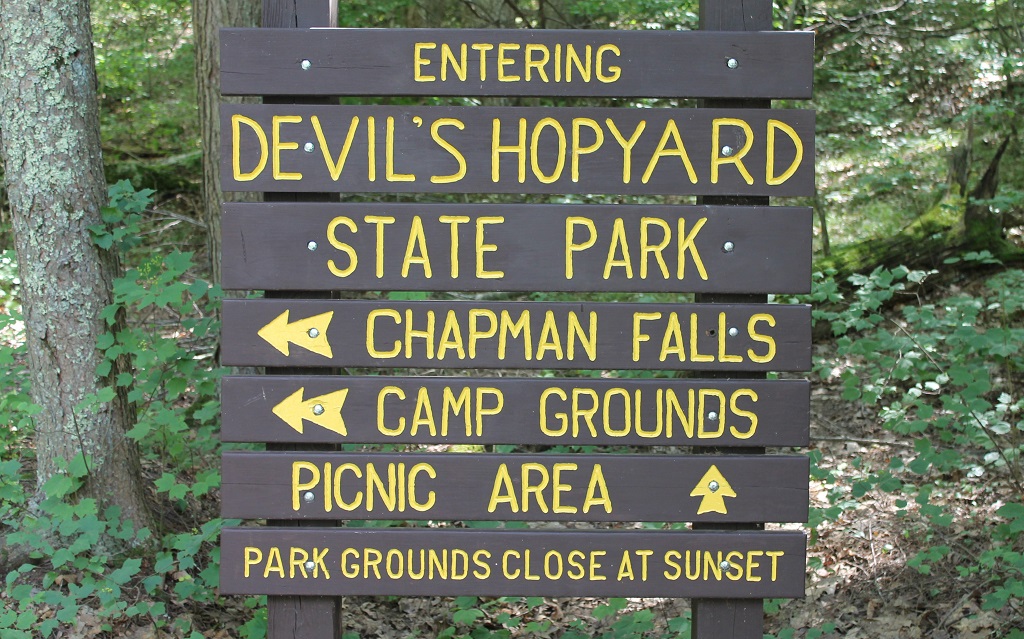
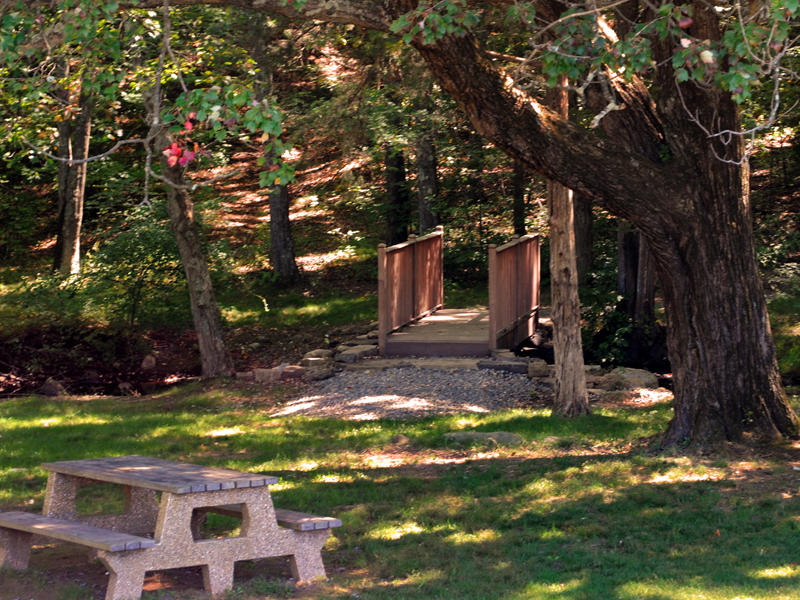
1. Devil's Hopyard State Park, 7 miles east of East Haddam, on State Highway 85. "Rugged Ravine, five waterfalls, unusual rock formations; hiking trails and picnic grounds."
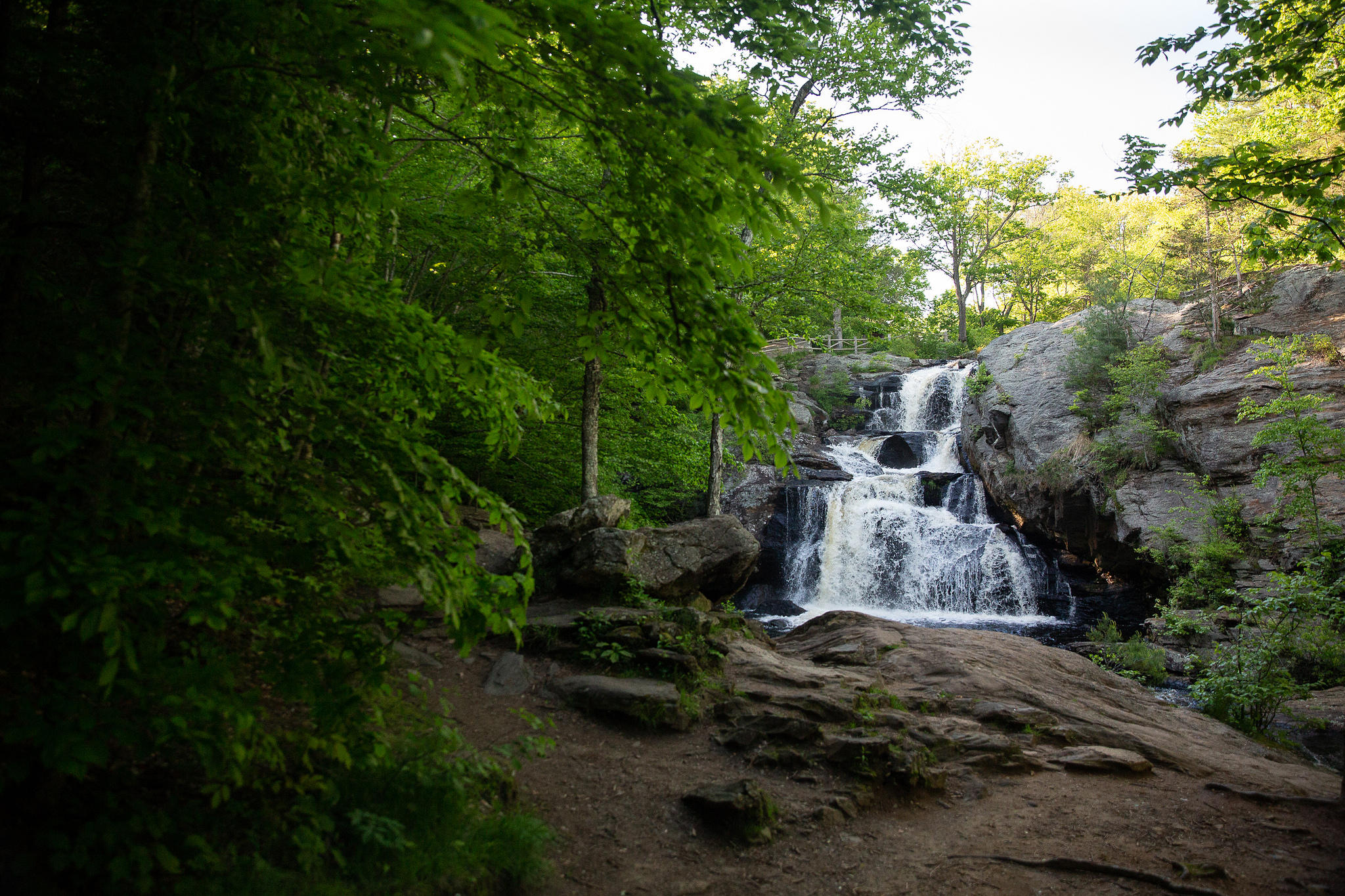

I visited this place back in 2010. Here are some pictures and some account of that expedition, Part I, and Part II. Looking back I have very fond memories of this trip now. We went down for I believe a two night stay around the middle of August, right before school started, and I enjoyed that time so much that for many years afterwards I tried to do something similar every year. While some of those trips, especially the first few years afterwards, also hold some good memories--we went to Boothbay Harbor in Maine one year, and the White Mountains in another one--they never quite matched for me that Connecticut trip. I think it was partly the children's ages--we only had the four boys then, and their ages were 8, 7, 4 and 1, so they pretty much went along with anything. Also at that time we could also still fit in one hotel room, which as they got bigger and we had one and then two more children, became impossible. We took a few camping trips, which the younger children at least actually liked, but I never really warmed to camping. Also one year--the last we tried this August mini vacation--we tried to camp on Cape Cod, which is a mistake because, as I realize now, it rains there much more frequently than anywhere else in New England, and by the third day our tents were so soaked through that we just gave it up and came home. But I will always look back at the Devil's Hopyard trip as a high point of the older boys' childhoods. 

2. Fort Shantok State Park, 4 miles south of Norwich, on State Highway 12. "Once the site of an old Mohegan Indian village. Contains the remains of the old Shantok Indian fort, and the Shantok burial ground, now surrounded by a log stockade."


In 1995 the state of Connecticut returned the site to the Mohegan tribe. It is very near the famous (in New England) Mohegan Sun Casino, which is on the same tribal lands, and which was not yet in operation in the 1960s. I have never been to a casino, which is the kind of place I suspect I would enjoy going to, or would have when I was younger. Twenty years into having children and with no end in sight I am out of practice of doing, or even imagining myself doing, anything that could be considered "adult" "fun" of this sort. Indeed, after spending much time over these decades dreaming about traveling again someday or living the international expat life instead of being tied down to my job and family I worry am losing interest in it and growing cranky about it now as either an impossibility or a frivolity. I'll see a video now of attractive 29 year old westerners living in some tropical place especially, and even if they aren't partying that much, whereas up until very recently I would have been envious, my reaction now all of a sudden is that somehow they shouldn't be doing that, it's not quite right. But why wouldn't it be right? When I was that age I would have loved the idea of doing that sort of thing, though I would have preferred to be in one of the European capitals.

There is a banner on one of the Google search items for Fort Shantok stating that it is permanently closed but I cannot find any corroboration for this. There is a review from someone claiming to have there as recently as 4 months ago, though 3 months ago a commenter wrote that there are no signs for this park in the neighborhood and that he was unable to find it. 

3. Colonial Museum, in Israel Putnam Memorial Campground, 5 miles southeast of Danbury, on State Highway 58. "Contains many interesting relics from the Revolutionary War."     


I think this is what they are talking about, and it is still open, though I don't know whether it is open right now. It is part of the Putnam Memorial State Park in Redding, which is Connecticut's oldest state park, dating to 1887. The current museum was built in the 1920s. Due to declining visitation throughout the 1970s and 80s the park was decommissioned for most of the 90s but re-opened as a state facility in 1997. Other features include a visitor's center and a statue of Israel Putnam (donated 1969), the grounds being where Putnam passed the winter of 1778-9. As you probably know, this general is most celebrated for his successful leadership at the battle of Bunker Hill, where he gave the legendary order, "Don't fire until you see the whites of their eyes." This sounds like my kind of place. I hope they are doing better. Maybe I could stop in sometime on my way to Philadelphia--it's right off I-84--if I ever take a trip down there again. 


4. Barnum Institute of Science and History, in Bridgeport, on U.S. Route 1. "Contains personal belongings of P. T. Barnum, born in this city, and of Tom Thumb, the 26-inch midget who was the star attraction of Barnum's circus." 
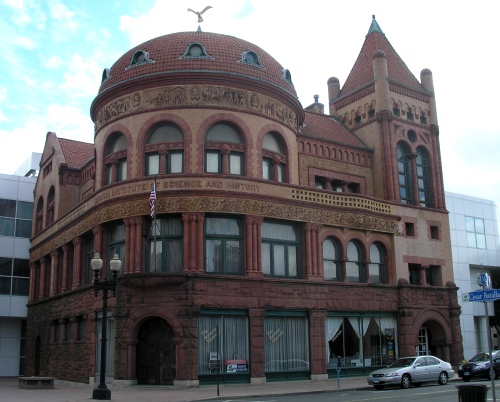

Now called the Barnum Museum, this place is closed currently due to the pandemic, but is expecting to be open again once all of that is over. This institution seems to be too historically important to have been allowed to be turned into a spectacle. In 2016 it received a grant from the National Endowment for the Humanities, and admission is free, with donations accepted. Bridgeport is a pretty run down city on I-95 that I suspect most people, including me, have not given much thought to visiting, but I'd go see this. Maybe I could combine it with a ride up to New Haven for pizza afterwards, as I have reading about the pizza in New Haven (Frank Pepe's and the other place that I don't remember the name of but that knowing people claim is better) for at least 25 years now but have never gone down to have it. 

5. Traveler's Tower, in Hartford, on U.S. Route 6. "The highest building in New England, 527 feet high."
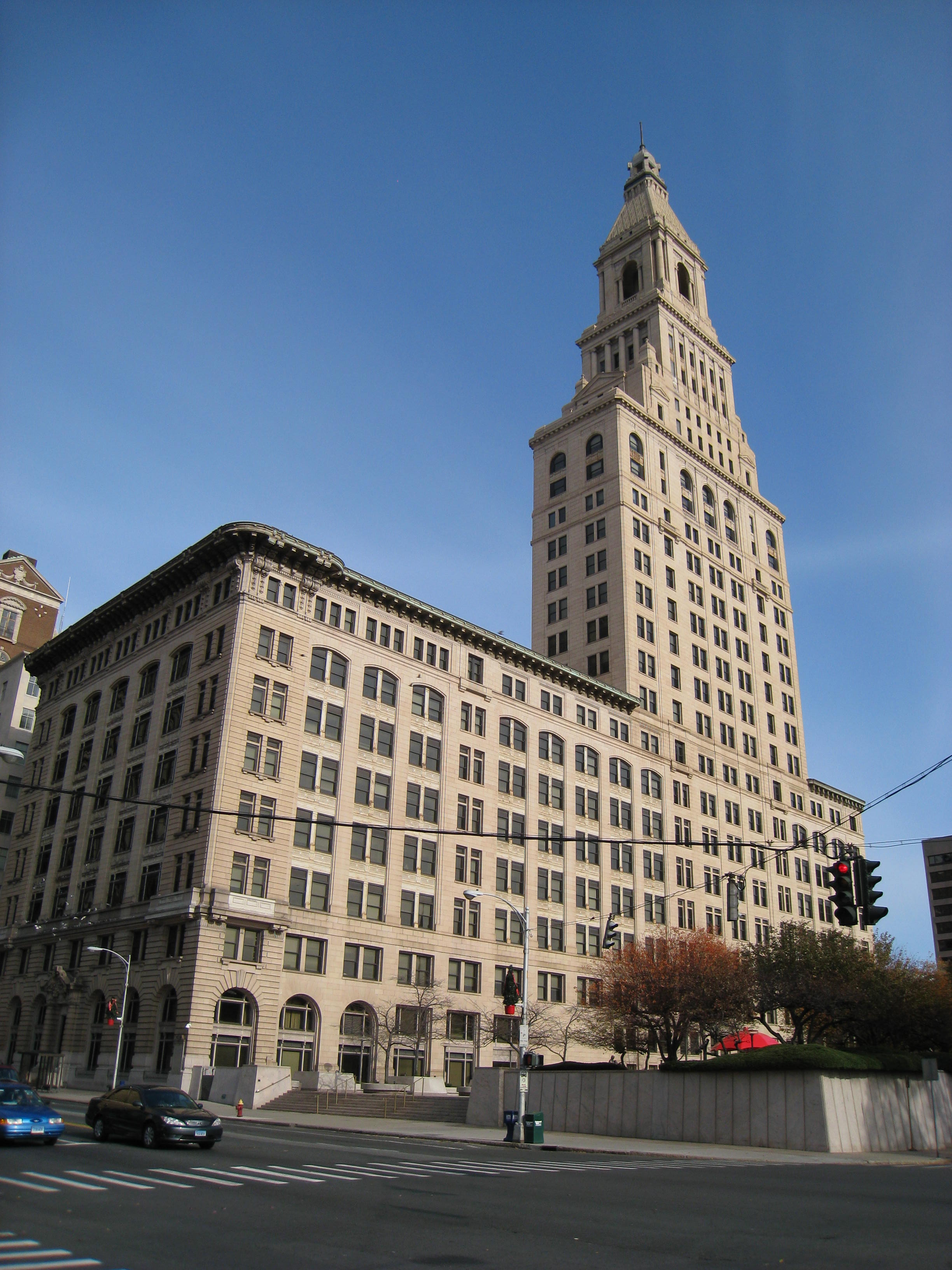

The seventh tallest building in the world when it was constructed in 1919, it was dethroned as the tallest in New England in 1964 by the Prudential Building in Boston (itself since surpassed by the John Hancock Tower, the reigning champion since 1976). It still houses the headquarters of the Traveler's Insurance Company. There is an observation deck on the 27th floor, although since 2017 even this doesn't appear to be open to the public (they stopped giving tours of the rest of the building in the 1990s).


6. Children's Museum, in Hartford, on U.S. Route 6. "Contains fossils, shells, insects, birds, animals, and things of interest about the Indians of North America." 


Somewhat to my surprise, given the usual associations that come with calling something a "children's museum" nowadays, this institution still exists and still specializes in animal and science exhibits (I don't what happened to the Indian exhibits; there is no reference to them on the website at least). The museum has relocated to West Hartford from its original location, though that happened in 1958. An article appeared on March 5, 2020 reporting that plans were afoot to relocate again to a new state of the art building in Hartford, but I am guessing this has been put on hold for the time being. Looking over the reviews, there are some complaints about the building being run down and the exhibits dated, but of course that is exactly the sort of attraction I am looking for. A lot of people still like it.


In the California post I stated that it was the only state in the set whose article included a gallery of famous residents, but I was wrong! Connecticut has a list too. Here is who was considered to be historically notable in state history in the environment of 1960. 

"More famous inventors have come from Connecticut than from almost any other state. In addition to the men mentioned in other sections of this article* are John Fitch, who made the first steamboat, Samuel Colt, who perfected the revolver, Charles Goodyear, who discovered a practical way of hardening rubber, called vulcanizing, and David Bushnell and Simon Lake, who made improvements on the submarine. Eli Whitney, who invented the cotton gin, made his home in Connecticut.

The famous circus man, Phineas T. Barnum, was born there, as was Noah Webster, who wrote the first American dictionary. 

Many important people also made Connecticut their home, including the writers Harriet Beecher Stowe and Mark Twain." While this wording implies that the inventors and other notables mentioned previously were not important people, I don't think that is what was intended. 

*Among these I see Eli Terry and Seth Thomas ("improved the modern clock"); Linus Yale ("the locks people have on their houses were invented by" him); John Ireland Howe, inventor of "a machine to make pins and needles"; Ethan Allen; and Benedict Arnold.




Thursday, October 15, 2020

Hank James--The Bostonians (1886)

This is, in my opinion, one of the better Henry James books. It is not the only one that I have thought especially well-done, or been able, at least in my own mind, to follow, but it is one of the few that I can honestly say I have enjoyed and really looked forward to reading the next chapter every morning (the others that come to mind being the early The American and the much shorter Turn of the Screw and Aspern Papers). This middle period book has some of his clearest and best sentences in describing thoughts and motivations--not as exquisitely subtle, I suppose, as in the later masterpieces, but as I have not to this point really been able to follow the thought processes in those later books the full glory of their subtleties have been kind of lost on me. The IWE introduction notes that:

"The Bostonians is a novel of James's 'middle period.' He was in the realm of high society as usual, this time in the very starched Boston of the late 19th century. The novel was not successful when published and James was very unhappy. Among other things, it was considered wicked. Perhaps it was and still is, but it is among his most important works."


Here is my book, accompanied by some seasonal spirit. It is the Modern Library edition with one of their especially attractive jackets. I got it at a library book sale in 1986. 


The 'wickedness' I assume refers to the numerous blatantly lesbian characters and their implied domestic arrangements, though how x-rated in the physical sense matters really got between Verena and Olive (or even, for that matter, Dr Prance and Miss Birdseye), I don't have a great sense of. Also, on the overall Henry James starchiness scale, I would rate this one as being on the lower end. It's set entirely in America. One of the main characters is from Mississippi. The crowd in New York is rich and given to sumptuous dining and so on, but I don't remember encountering anyone there whose breeding would be considered by James or anyone else to meet the highest standard compared to the French aristocrats and the like who populate his other novels. Olive is perhaps the starchiest character in the book, and she is designated on multiple occasions as a "provincial." 

p. 18 "...the Back Bay (don't you hate the name?)" I've always kind of found the name unsatisfying too, for various reasons. When I used to take Amtrak in the 80s and 90s, the train always stopped at the Back Bay Station (I don't know whether it still does), which was modern and ugly, and no one ever got on or off, and I am still kind of vague as to what it is, or is supposed to signify (I know it was an actual bay that was filled in and made into a somewhat fashionable neighborhood around the time this novel was written, but I don't have much of a sense of what it is now).

p. 21 "'In sympathy with what, dear madam?' Basil Ransom asked, failing still, to her perception, to catch the tone of real seriousness. 'If, as you say, there is to be a discussion, there will be different sides, and of course one can't sympathize with both."

p. 31 "They sat there as if they were waiting for something; they looked obliquely and silently at Mrs. Farrinder, and were plainly under the impression that, fortunately, they were not there to amuse themselves."

I mark down these early quotations as a way of building up to anything it might occur to me to say later on. 

p. 43 "...the time hadn't come when a lady-doctor was sent for by a gentleman, and she hoped it never would, though some people seemed to think that this was what lady-doctors were working for."

(handwritten note I can't read--There are a lot of little (somethings?) of interest here).   

p. 46 "I am only myself, I only rise to the occasion, when I see prejudice, when I see bigotry, when I see injustice, when I see conservatism, massed before me like an army...I must have unfriendly elements..."

p. 50 "He had a passionate tenderness for his own country, and a sense of intimate connection with it which would have made it as impossible for him to take a roomful of Northern fanatics into his confidence as to read aloud his mother's or his mistress's letters."


p. 76 "But except when her mother made her slightly dizzy by a resentment of some slight that she herself had never perceived, or a flutter over some opportunity that appeared already to have passed...Verena had no vivid sense that she was not as good as any one else, for no authority appealing really to her imagination had fixed the place of mesmeric healers in the scale of fashion." I have met a few people in the course of my life of this genuine democratic mindset, mostly in northern New England. 

p. 116 "There was nothing in the house to speak of; nothing, to Olive's sense, but a smell of kerosene; though she had a consciousness of sitting down somewhere--the object creaked and rocked beneath her--and of the table at tea being covered with a cloth stamped in bright colors." The snobbery is really brutal whenever Verena's parents come into the story.

It is odd how reading these 100 year old books seems so outdated to me now in a way that it did not even in 1990. The world (social, institutional) of the past still seemed basically relatable then in a way that it doesn't now. So many things--the racial and cultural makeup of society, particularly with regard to peoples who were virtually unknown in Western countries even 30-40 years ago, male social roles, educational structures, in addition to the obvious technological changes with regard to consuming books and newspapers, have perhaps changed more in the last 30 years than they did in the previous 100, as far as the pursuit of literary engagement goes. 

p. 152 "She went so far as to ask Olive whether taste and art were not something...Miss Chancellor, of course, had her answer ready. Taste and art were good when they enlarged the mind, not when they narrowed it."

p. 248 On the Memorial Hall at Harvard, which you can still wander into today, or at least could 15 or 20 years ago: "The effect of the place is singularly noble and solemn, and it is impossible to feel it without a lifting of the heart. It stands there for duty and honor, it speaks of sacrifice and example, seems a kind of temple to youth, manhood, generosity. Most of them were young, all were in their prime, and all of them had fallen..." It is a rather beautiful place. I should make a point of going down and visiting it if it ever opens to the public again. I have frequently of late been afflicted with a more than usual longing to travel as a result of my reading--with The Betrothed, it was Milan, with Bonjour Tristesse it was Nice and the Riviera, with Boris Godunov it was Moscow. But I could actually go to Boston. Olive lived on Charles Street, which has a lot of upscale shops and the like now, but the nineteenth century buildings and atmosphere are pretty well-preserved.


Memorial Hall, Harvard University

James, who went to Harvard, saw it as decidedly inferior at that time to the European Universities, and perhaps it was, though the rise of American power and influence over the ensuing century have allowed many of its students and faculty members of this general period to remain well-known names.

p. 246 While touring one of the Harvard Libraries, there is a mention of the card catalogue. A system still current 100 years on, in 1986, when I acquired my copy of this book, but now of course antiquated.

The depiction of Verena's simplicity but "preternatural candor" is good. It is difficult to write a character like that. In fact I think all of the characters in this are quite well-done and multi-dimensional. It's one of his best books for that.

p. 280 "...he wanted to see her alone, not in a supper-room crowded with millionaires." Don't we all, pal.

In the present social environment, it is clear which characters we should sympathize with (not Ransom!), but H.J. is a little more ambiguous. I think he is more sympathetic to the claims of women than was usual in that era--he must have had something of a curious and open mind, if the ideas were presented in a guise adequate to his perceptiveness--but I do not think he saw how realistically these were supposed to come off on a societally broad scale. 

p. 343 "I am so far from thinking, as you set forth the other night, that there is not enough woman in our general life, that it has long been pressed home to me that there is a great deal too much. The whole generation is womanized; the masculine tone is passing out of the world; it's a feminine, a nervous, a hysterical, chattering, canting age, an age of hollow phrases and false delicacy and exaggerated solicitudes and coddled sensibilities, which, if we don't look out, will usher in the reign of mediocrity, of the feeblest and flattest and the most pretentious that has ever been." Dull-witted men never learn. 

p. 348 "...the beer-saloons, with exposed shoulders and sides, which in New York do a good deal toward representing the picturesque, the 'bit' appreciated by painters, announced themselves in signs of large lettering to the sky." The days when German and Irish immigrants (my people, or 3/4 of them) teemed in New York.

Is Verena, the "daughter of New England", the most appealing H.J. heroine? I think so, though most modern readers must be disappointed by her submission to such a distastefully anti-feminist man. I am not being sarcastic either, even I find it difficult to take the smug superiority of Ransom, who is the prototype of the mansplaining, mediocre, worthless white guy we have all come to know and hate. Unfortunately in 1880 there is no one who can really put him in his place.


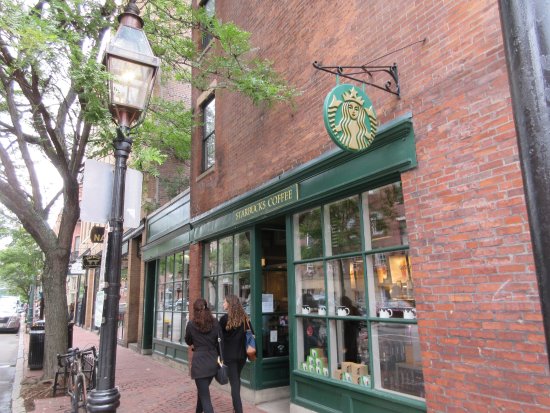
Starbucks on Charles Street, Boston, MA

I did write this on Twitter as well, and it didn't get a bug response, but Henry James didn't like beer, I don't think. Whenever a character is drinking it, usually in a German tavern or beer-garden, we can take it as a fair sign that he is down on his luck.

This is, incredibly, the end of Henry James on the IWE list. We do not see him again. One could almost think (if they hadn't left out The Ambassadors) that they just took the first three of his books alphabetically and said, we've reached our quota of Henry James, we'll stop now. This was a decent sample--The American and this book, as noted above, are two of my favorites of his, though I would have chosen something else in place of The Awkward Age, which I made a fairly strenuous effort to get into but just could not. The choices do feel rather random. While the final three extremely difficult novels, along with Portrait of a Lady and maybe Turn of the Screw (?) seem to be the most highly regarded of his books now, what were the most celebrated ones in 1960? Portrait still, and perhaps Daisy Miller, neither of which were chosen for this list. I don't know. But it is nonetheless farewell to Henry James, unless we have the good fortune to encounter him sometime in our Challenge.   

The Challenge

1. Pride and Prejudice (movie-2005).....................................................................................14,920

2. Min Jin Lee--Pachinko.........................................................................................................6,426

3. Margaret Mitchell--Gone With the Wind..............................................................................4,674

4. Raina Telgemeier--Drama....................................................................................................4,427

5. Gregory Maguire--Wicked....................................................................................................3,475

6. Narrative of the Life of Frederick Douglass........................................................................2,216

7. Philadelphia (movie-1993)..................................................................................................2,195

8. Nancy Isenberg--White Trash...............................................................................................1,849

9. Sharon Kay Penman--A King's Ransom..................................................................................450

10. Kira Jane Buxton--Hollow Kingdom.....................................................................................437

11. Chris Ware--Rusty Brown......................................................................................................303

12. Robyn Carr--The Wedding Party...........................................................................................282

13. Aiden Thomas--Cemetery Boys............................................................................................220

14. Arthur Conan Doyle--The Return of Sherlock Holmes.........................................................140

15. Gus Pelagatti--Wicked Wives.................................................................................................106

16. Tillie Walden--Are You Listening?..........................................................................................80

1st Round

A high qualifying threshold for this tournament, leaving out some books I have heard of. 

#16 Walden over #1 Pride and Prejudice

#15 Pelagatti over #2 Lee

Pelagatti had an upset.

#3 Mitchell over #14 Conan Doyle

IWE authors generally get an immunity through the first two rounds, unless they come up against a book with an upset, which is the case here.

#4 Telgemeier over #13 Thomas

Cartoon/graphic novel over a Young Adult novel featuring a trans protaganist. 

#5 Maguire over #12 Carr

Carr is a romance novel. I need to figure out a way to minimize their qualifying for the tournament, since when they come up they always have a lot of reviews, much more than popular history or science books.


#6 Douglass over #11 Ware

Ware is another comic book. I hope these aren't going to start qualifying in large numbers (though the acclaimed Persepolis is a past winner of this tournament, and I did read it).

#10 Buxton over #7 Philadelphia

The 1984 Merchant Ivory adaptation of the Bostonians did come up as an entrant for this tournament, but with only 69 reviews, it was the 17th place finisher and didn't qualify. I am putting it on my to-watch list anyway, although I suspect I am not going to like it that much.

#8 Isenberg over #9 Penman

As you know I am generally down on genre books as far as this competition goes unless they are regarded as classics of a kind.

Quarterfinals

#3 Mitchell over #16 Walden

Walden is another graphic novel.

#15 Pelagatti over #4 Telgemeier

Pelagatti is a novel based on the seventeen murders of husbands by their wives in Philadelphia in 1938, which I had never heard of, though apparently it really happened.

#5 Maguire over #10 Buxton

The Maguire book is highly celebrated. Buxton's is science fiction set in a post-apocalyptic Seattle.

#6 Douglass over #8 Isenberg

The white trash book got some positive press, but I am not that hyped to read it. 

Semifinals

#3 Mitchell over #15 Pelagatti

#6 Douglass over #5 Maguire

Championship

#3 Mitchell over #6 Douglass

Both of these books have appeared in this tournament before, both are of course very famous--there is some dispute over whether Gone With the Wind is worthy of being considered a classic, but it is at the very least iconic and has been well-loved by a certain class of reader. I have only avoided reading myself to this point because of its enormous length. It does have another upset to use here--it would be hard to justify passing over Douglass otherwise--and I think it is time to have a go at it.


Wednesday, October 9, 2019

Eugene O'Neill--Beyond the Horizon (1920)


This is the fourth Eugene O'Neill play to come up, and I am still only in volume 3 (of the IWE list). However there are only four more over the last seventeen volumes, so I am halfway through with him already. Beyond the Horizon is the one of earliest date among these works, all of which were produced between 1920 and 1933. The IWE introduction is animated, so I'll print it in more or less its entirety.


"This was O'Neill's first big success. It won the Pulitzer Prize in the year it was produced. O'Neill was never more effective dramatically; his scenes rise to breathtaking peaks, fall into breathing-spell valleys, and finally, almost imperceptibly, lead into the subdued tone of an ending that is the more effective by its contrast."


I am assuming that this play, perhaps more than others on this program, needs to be seen performed. Reading it is fine in its way, it generates plenty of nostalgic feeling for me, especially as the geographical and cultural world that O'Neill inhabits is as close to that of my own as almost any of the writers on this list, though I do not experience the emotional swings as violently as the playgoer who wrote this summary seems to have. The plot has a lot in common with the famous movie It's a Wonderful Life, if every turn in the story had resulted in complete disaster--the main character forgoes an opportunity to go on a voyage to stay home and get married and the wife ends up detesting him; the brother does leave the farm for a promising opportunity, has a massive fight with the father and ends up never speaking to him again; the father dies and the son that stayed behind runs the family concern into the ground, with the accompanying poverty and bankruptcy; the doomed couple has a child and the child dies; and on and on. It's relentlessly grim, to be truthful, though I can believe that nothing quite like it had been seen on the American stage when it first appeared.


Act I, Scene II: Robert's uncle, the ship captain, when Robert tells him he won't be going on the journey:


"I'm ashamed of you, Robert, to go lettin' a little huggin' and kissin' in the dark spile your chances to  make a man out o' yourself."


Once people in a Eugene O'Neill play start being negative (which usually happens in the first few pages) you know things are not going to turn out happily.


Act II, Scene I, stage directions--things have already gone severely downhill:


"MRS ATKINS is in her wheel chair. She is a thin, pale-faced, unintelligent-looking woman of about forty-eight, with hard, bright eyes. A victim of partial paralysis for many years, condemned to be pushed from day to day of her life in a wheel chair, she has developed the selfish, irritable nature of the chronic invalid."


She is of course younger than I am now, though people got old, or were old, early back then. In the literary worlds of the past, fifty is a venerable age at the very least. There aren't many people at all hanging around who are much older than that.


Later in the same scene, Ruth the disappointed wife unloads on Robert:


"...living with a man like you--having to suffer all the time because you've never been man enough to work and do things like other people. But no! You never own up to that. You think you're so much better than other folks, with your college education, where you never learned a thing, and always reading your stupid books instead of working...If I could have seen how you were in your true self--like you are now--I'd have killed myself before I'd have married you! I was sorry for it before we'd been together a month. I knew what you were really like--when it was too late."


My wife could talk to me like this, but, thankfully, she does not.


While I grasp that there is an element of theatrical effect involved, the extreme aging and complete physical decline of the young couple in Act III--by which time they would have been 31 and 28 or so at the most--strikes a 21st century sensibility as almost too exaggerated. Though these kinds of bad marriages, especially among the non-privileged classes who largely eschew them now, really did seem to kill people at this time.


It is worth noting (again) that many O'Neill characters are not terribly intelligent or sophisticated in comparison with their fellows in the literary canon. The characters in this play are not the outright inarticulate brutes that populate some of this author's other work, but Ruth and her mother at least seem kind of dull-minded. My impression is that women in general are not depicted as terribly dynamic, intellectually or otherwise, across all of the O'Neill plays, which would not be uncharacteristic of the male writers of his generation. His dialogue is a mix of outbursts of raw emotion with elaborate speeches articulating the characters' sense of their own doom. I suspect that because of the influence of this style on subsequent generations of American film and theatrical writing, it does not always occur to us that it is kind of strange.


This was the 3rd play, along with Ah Wilderness! and All God's Chillun Got Wings, in volume 342 of the Modern Library, and I have now done all three of them for this program, the whole book. It will sit up on the shelf now until the end of my days, perhaps never to be pulled down again. It isn't in very good shape. The cover is still attached in both the front and back, but not by much. It came from the Library of Trenton High School in Trenton, Michigan. Judging by the penciled in notes in the margins, it was once in the possession of someone who played Mrs Miller in a production of Ah Wilderness!. Now I am wallowing in nostalgia for the half-baked mental universe of my youth. The season contributes to that, evoking as it does fall afternoons in the library and the hopefulness of the new school that not only has not yet died in October, but seems to be just on the point of ripening..But I will stop.


The Challenge


A pretty lousy one.


1. Donald McCaig--Ruth's Journey...…………………………………….311
2. Robyn Carr--The Best of Us...…………………………………………283
3. Daylight (movie--1996)………………………………………………..207
4. Robert Marasco--Burnt Offerings...…………………………………….94
5. Kendall Taylor--Sometimes Madness is Wisdom...……………………..11
6. John Chamberlain--The Roots of Capitalism...…………………………..1
7. Patricia D'Antonio--Nursing With a Message...………………………….1
8. Sebastian Howley--Deathbed...…………………………………………..1
9. S. D. Lowendowski--Snapped...………………………………………….1
10. Louis Boudin--A Socialist Empire: The Incas of Peru...………………..0


Sparsely Attended Wednesday Night Games


#7 D'Antonio over #10 Boudin


The second straight Challenge for which Boudin has qualified. It makes me feel like my wholly innocuous searches are being tampered with.


#8 Howley over #9 Lowendowski


The Thursday Quadruple Header


Noon Tip-Off


#7 D'Antonio over #2 Carr


The D'Antonio book is extremely short.


2:30 pm


#6 Chamberlain over #3 Daylight


Evening Session 7 pm


#8 Howley over #1 McCaig


Upset


9:30 pm Nightcap


#4 Marasco over #5 Taylor


The Taylor book is about F Scott Fitzgerald's marriage, and is the only entry in this group that is the kind of book I would normally be interested in. But I am so far behind on this list that I am going to be looking for shorter books for a few sessions here if it can be helped.


Friday Prime Time Doubleheader


7pm


#4 Marasco over #8 Howley


No prayer for Howley. The Marasco book appears to be a genre novel, but it was published in 1973, at least, which might make it of interest to me.


9pm


#7 D'Antonio over #6 Chamberlain


Championship Saturday Night


#7 D'Antonio over #4 Marasco


The D'Antonio book is only 145 pages, so even if it is terrible, the agony won't last long.

Tuesday, November 28, 2017

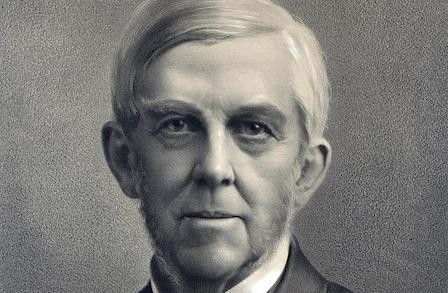
Oliver Wendell Holmes--The Autocrat of the Breakfast Table (1858)

While I liked it, I have to say this is an odd book to take up in 2017. I'm not sure that I will remember anything about it a week from now other than such things as have a direct resonance with me--in this instance the importance of breeding and the need in a young man to have a tireless ambition and drive. Much of the other incidental stuff was not terribly vivid to my mind. Writing in the 1960s, the IWE editor says of the book that it "is generally considered Holmes's masterpiece (which suggests the presence of other contenders. I have actually read his equally florid novel Elsie Venner, if that is one of the contenders the writer has in mind). The introduction goes on to say that "The humor, urbanity, iconoclasm and scholarship of the essays are almost unique for their times and are timeless, being as good reading today as then." As a indicator of how much times have changed, it is almost impossible for me to imagine anyone with credibility saying anything like this today. Once again one is reminded of the question I have often had occasion to ask here, where have all the old Yankee/WASPs gone, even in New England? There were still some around in my youth in the 80s, and in books and articles about the region even from that time the character is still highly prominent compared to now. Have those that are left gone way underground (or over-ground, as the case may be)?


The copy of the book that I bought (online) was a special boxed edition published in 1955 by the Heritage Press of Norwalk, Connecticut, with an introduction by Holmes' fellow super-Brahmin Van Wyck Brooks and nostalgia-inducing pen and ink illustrations by R. J. Holden. It is noted in the introduction that no less a figure than Henry James, Sr (father of the famous philosopher and novelist brothers) called Holmes "the most intellectually alive man I ever knew". Indeed, Holmes's mind was by all accounts the type which the higher sort of formal education once sought to cultivate, yet it is hard to imagine him being broadly admired in this way today, mainly because of his race/gender/caste/ethnicity combination, since his primary sins (social and intellectual snobbery, ethnic chauvinism) are not exactly absent among the classes correspondent to his today, though it seems to be a more intolerable trait when found in a person like Holmes. There is also the problem that however impressive his mind was to his contemporaries, it led him to hold a lot of social views that are not currently held to possess much intelligence, let alone any other value, which naturally throws the quality of the other facets of his mind under suspicion.


It is noted that the takedown of Holmes and the other old Yankee writers began at least as far back as Mencken and the rise of ethnic America, which I guess would include my people, a period now a century in the past.


After the Brooks introduction there are three prefaces written by Holmes himself for each of the three editions that came out in his lifetime, the original in 1858, the later ones in 1882 and 1891, at which latter dates Holmes was 82 years old. These prefaces are consistent in their emphases on technological and scientific progress, which were of course immense over the course of his career (1831-91, roughly, as well as social progress, which he hinted in 1891 of having expectations of great changes in that area in the 20th century, though he did not speculate on the specific forms they might take). He was progressive and elitist at the same time, his progressivism taking the form of believing in the possibility of uplifting the unenlightened peoples of the world to the Anglo-Saxon level, or some facsimile of it. I wrote "we'll see if he lists his views on the potential/proper role for women in the book proper." I don't recall anything worth noting on this matter coming on, but that is why I take notes, because I remember very little of what I read.


p. 1 "We are mere operatives, empirics, and egotists, until we learn to think in letters instead of figures." Of course I want to believe this. Whatever it is, something is missing from the data driven understanding of existence as concerns achieving some sense of wholeness as a human being
.
p. 4 On the virtue of mutual admiration societies of high achieving males: "Foolish people hate and dread and envy such an association of men of varied power and influence, because it is lofty, serene, impregnable, and, by the necessity of the case, exclusive." Do foolish people have a choice in the matter, so far as their essential foolishness can be effected?


I am already noting at this early stage that the book looks to be extremely quotable throughout. Then I wrote that the thinking people (illegible) who have (illegible) lost their taste for this sort of writing seem to think/live after a similar manner.
It's hard to get a cute girl picture to come up in a search for OWH Autocrat, etc, but this Boston duck boat driver will do.


I write my illegible notes in the book in pencil, in which I am hindered by the circumstance that my pencil sharpener does not evenly sharpen the pencils and makes them difficult to write with. I know that there are myriad easy ways to correct this situation, but nothing is really easy with me when it comes to trying to carry out some semblance of the life of the mind. I will never quite permanently solve my pencil problem, or my note taking problem, or my slow writing problem, or any other minor and irritating problem that besets me.

I forgot about when Holmes by way of establishing the mental climate out of which the book arose, introduced it as a world where most people listened to a hundred sermons a year.


Holmes likes a man of family. This hurts for me, since a lot of the more intelligent modern people seem to like that too, and the family that I came out of at least doesn't seem to excite anybody very much. He reverts to this theme several times in the course of the book, lamenting mésalliances in marriage between people whose backgrounds and breeding are not well matched. "No. my friends, I go (always, other things being equal) for the man who inherits family traditions and the cumulative humanities of at least four or five generations."


p. 43 "The woman who calc'lates is lost...Put not your trust in money, but put your money in trust." On matrimony. My poor wife trusted...So much so that she has said that if she were ever to remarry, it would only be for money.


p. 45 "Except in cases of necessity, which are rare, leave your friend to learn unpleasant truths from his enemies; they are ready enough to tell them."


p. 46 "Therefore conversation which is suggestive rather than argumentative, which lets out the most of each talker's results of thought, is commonly the pleasantest and the most profitable." Yes, but we must be convinced that our interlocutor is not an absolute dunce who is even capable of saying anything worth our listening to, which is rare in our time.


p. 54 "How many people live on the reputation of the reputation they might have made!" Not many anymore I wouldn't think. We've set ourselves with some dedication to snuffing out that kind of conceit.


p. 54 "When one of us who has been led by native vanity or senseless flattery to think himself or herself possessed of talent arrives at the full and final conclusion that he or she is really dull, it is one of the most tranquillizing and blessed convictions that can enter a mortal's mind." Yes and no. It may be liberating to an extent for the non-genius himself to realize his limitations, and it is certainly applauded by all the people who were annoyed by his ridiculous pretensions, but the people he has close relationships with who rely on him to some degree do not happily welcome the definitive proof that their fortunes are chained to a dullard with little prospect of improvement.


This is essentially the edition of the book I have, though instead of this teapot I have a red rectangle with a gold border and the initials O.W.H. imprinted on the field in gold letters.


p.58 There was a reference to news from India which was unclear to me, but a little research indicates that he must be referring to the Sepoy Rebellion of 1857. I am so conditioned to assume that insightful and adroit minds even in the past must have at some level been suspicious of the virtues of European colonialism (and certainly some were), that I thought that perhaps Holmes's references to unidentified women and children being outraged and babies being killed were oblique statements against British conduct, and that his referring to the Indians as the inferior race was ironic. But no, he was taking the pro-English position all the way.


Holmes ascribes powers to genuine (high) poetry and its relations/interactions with human souls that may contain some truth, but are largely foreign to the way almost everyone intelligent experiences life now.


He also makes an interesting mechanical comparison of the making of a poem to that of a fine violin, that time is necessary to dry out and fit together the many parts of which it is composed to produce the grand effect.


p. 146 I like the account of his morning rowing around Boston.


Holmes's own poems are interspersed throughout the book. They are for the most part not very good, difficult to read and scant on impressions and images. There are two poems that are moderately famous, or used to be, "The Chambered Nautilus", and "The Wonderful One-Hoss Shay", the latter a comic poem, that are markedly better than the rest.


p. 171 Holmes on people who smile stupidly for no good reason in social interactions: "...it is evident that the consciousness of some imbecility or other is at the bottom of this extraordinary expression. I don't think, however, that these persons are commonly fools. I have known a number, and all of them were intelligent. I think nothing conveys the idea of underbreeding more than this self-betraying smile." Underbreeding seems to me a useful concept that is not discussed nearly enough in our time.


He muses on how "there is no looking glass for the voice", such that people have no real sense of the sound of their own voices, and how pleasant it would be to be able to inhabit another form and be able to observe oneself speaking and moving. (Of course the technology to do this had not yet been developed in the 1850s).


There is a long and pleasant section about the trees of New England which is perhaps of greater interest if one happens to live here. Holmes notes many particular favorites and claims to "have as many tree-wives as Brigham Young has human ones." The loss of our elm trees was such a blow to New England's historical character. Holmes mentions them extensively, as does almost everyone who writes about the region prior to World War II.


Holmes sees the English and American varieties of elms as characteristic of the creative force of the respective countries. The English he describes as "compact, robust, holds its branches up, and carries its leaves for weeks longer than our own native tree", and the American as "tall, graceful, slender-sprayed, and drooping as if from languor." How this is related to the creative force of America especially I am hazy on.


pp. 261-2 "Qu'est-ce qu'il a fait? What has he done? That was Napoleon's test...Is a young man in the habit of writing verses? Then the presumption is that he is an inferior person. For...there are at least nine chances in ten that he writes poor verses." Common knowledge (sort of) now, but worth being reminded of and impressed on the young.


p. 279 "One's breeding shows itself nowhere more than in his religion."


If you have stuck out this post to this point, I thank you and consider you a true friend. I may not exactly be a tortured soul, but I do feel that I never quite made it as a fully accepted member of the educated classes, and I am lonely in my interests.


The Challenge
1. M. R. Carey--The Girl With All the Gifts.......................................................2,525
2. Haraki Murakami--1Q84................................................................................1,687
3. Tana French--The Secret Place.......................................................................1,663
4. Rachel Macy Stafford--Hands Free Mama.......................................................326
5. Jay Winik--1944: FDR & the Year That Changed History...............................301
6. Rachel Macy Stafford--Hands Free Life...........................................................222
7. D. H. Lawrence--Women In Love......................................................................147
8. John Whyte--Is This Normal? The Essential Guide to Middle Age & Beyond...35
9. Kathleen Ann Goonan--In War Times.................................................................28
10. Germany 1945: The Last Months of the War......................................................0


A small, but pretty strong field for our game, with seven 100+ scoring entrants and the top three seeds all north of 1,500!


1st Round


#7 Lawrence over #10 Germany


The Germany book appears to be a bilingual coffee table book of photographs that was published in Germany and has had no U.S. release. I read Women In Love, which does not appear on the IWE list and therefore qualifies for the Challenge, as the second book on my "A" list way back in December of 1994. It was not my favorite book at the time, though a few years later when I was about 28 I read The Rainbow, which preceded it and follows many of the same characters, and liked it very much, though I don't know if I would feel the same about that one if I read it now either.


#9 Goonan over #8 Whyte.


A close battle. The book about aging was not tempting enough to me to give it the edge here.


Final Eight


#9 Goonan over #1 Carey


Carey is a dreaded genre book. Also my library didn't have it.


#7 Lawrence over #2 Murakami


I was a little excited about the Murakami, which seems to have the status of a contemporary instant classic, but at 925 pages and with a tough matchup in its first game, it falls.


#6 Stafford over #3 French


French is a mega-genre writer, and her book is long. Plus Rachel Macy Stafford is a Generation X (b. 1972) supermom/superwife, Southern Christian variety, and what is not to like about that (if you're me)?


#4 Stafford over #5 Winik


While I acknowledge I have a crush on Rachel Macy Stafford, that is not the whole reason why she triumphs here over a major history. The 1,027 page length of the competitor's offering was what mainly killed it. Jay Winik has a demonstrated fondness for identifying years or even months that changed everything and writing books about them. Another title of his is April 1865: The Month That Saved America.


Final Four


#9 Goonan over #4 Stafford
#7 Lawrence over #6 Stafford


I was feeling guilty about passing over so much literature.


Championship


#9 Goonan over #7 Lawrence


Upset special. The Goonan is another science fiction book, which I have not have good experiences with so far (ed--apart from the Ray Bradbury book; I liked a lot of those stories), but I am willing to give it another try.


Wednesday, June 7, 2017

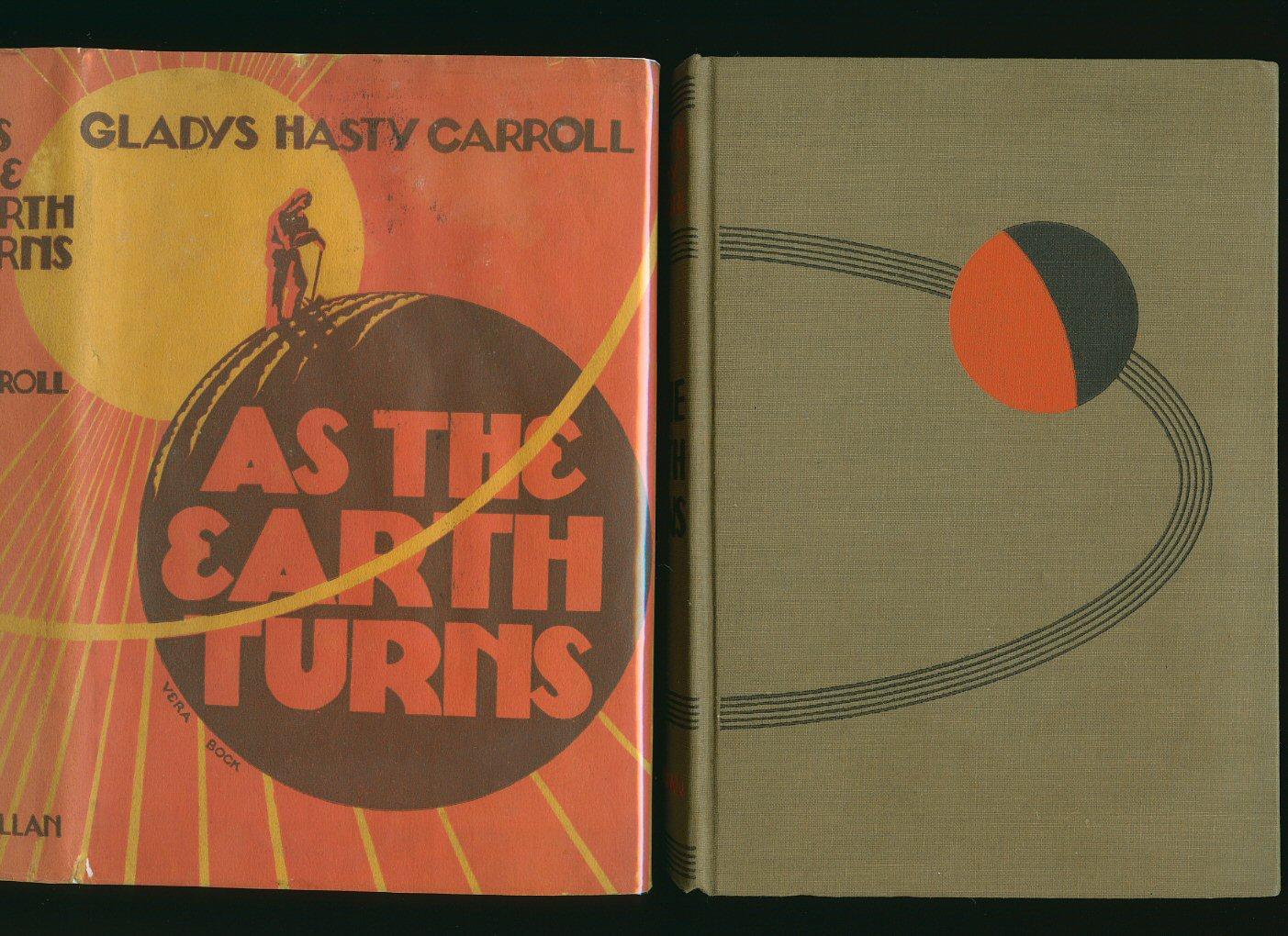
Gladys Hasty Carroll--As the Earth Turns (1933)

One last American novel from the era between the World Wars before we leave this particular turf for a while.


Somewhat forgotten today--I can only find one other blog post about it on an internet search--As the Earth Turns depicts a year (1932, to be precise) in the life of a Maine farming family. It was a great success in its time, finishing as the #2 best-selling novel in the United States for its year (behind only the previously-written-about-here Anthony Adverse!) and inspiring a film adaptation in the next one. It is of especial interest to me perhaps because it is set about 40 miles from where I live now (the author was born in Rochester, N.H. and lived most of her life just across the river in South Berwick, Maine, on which the town of Derwich in the book is presumably based) as well as a similar distance in the other direction from where I lived in Maine as a teenager. As with most of these IWE books, I liked it better than almost anything else I read, if not quite as enthusiastically as my encyclopedia's editors did. These extolled it as "very fine", said that it "richly deserves its great success" and that its "central character, Jen, is an admirable creation." It is a quiet book about ordinary things in particular lives, but it does evoke well the (somewhat incredibly)lost people and way of life that predominated in much of this part of the world eighty years ago--the childhood of my grandparents--and had not entirely disappeared even thirty years ago. But the reader who cares will get a sense of my thoughts and feelings about this book through the many notes I have taken on it which I must get to now.


p. 61 (keeping up my habit on holding off on note-taking until I start to get a feel for the book): "It was the spell the male on the farm had the power of casting over his women when occasion demanded it. The rooster swelled up, stretched his neck, and crowed, when he had done it. The bull threw back his head and roared." What exactly has been done to the men in our time? The absoluteness of the decline on all fronts cannot be explained as easily or contentedly as people seem to want it to be.


p.86 On a farmhouse restored for a soon-to-be-married couple: "Margaret would go inside the house and keep it, while Ed worked for her in the fields." Strict gender roles and the proper carrying out of them are taken very seriously in this book. Carroll is sympathetic towards those weaker or flightier souls who cannot maintain the necessary focus and energy or who are inclined towards a different kind of life. However those who live most in accordance with the ideal are the most exalted characters.


p.115 "Most people nowadays had no time to search the woods and nobody knew the herbs, which to use or where to find them, but went to drug stores, and likely paid a dollar for nothing half so good to clear the blood as thoroughwort." While accurately, and from Carroll's point of view probably lovingly drawn, I admit I find these unwaveringly hard-working and frugal old Yankees kind of tiresome and humorless.
No connection with the book, but this picture kept coming up so why not

p.195 "They interest me. I haven't had much chance to get used to people of another race. Come to think of it, until now there's never been anybody but Yankees around here, except the woodchoppers. That's unusual...You know, Jen, I've never even yet seen a negro in my life! Nor a Chinaman nor a Jap!" This is spoken by Olly. He is the educated one, who is in college. This extreme racial (or non-racial) dynamic was still the case here until very recently. Certainly it was that way when I lived in Maine in the 80s and even in the late 90s in New Hampshire seeing a nonwhite person more than once a week was still a rarity. The nonwhite population of these states even now are only around 5%, but that is a substantial increase from 0.2, which is what they were up to about twenty years ago.


p.196 More on this topic of non-Yankee people, referencing an exotic family of Poles that has settled in the neighborhood, the consideration of whom brought up the subject in the first place: "They plowed and planted and drove past the edge of the lane every day. Their baby had the croup and their children went to school with George's and the Forrests and the rest. There was nothing in that to make anybody think of Chinamen and negroes and give himself the shivers."


p. 219. On the patriarch and master Maine farmer of the story: "For Mark Shaw the country outside of Derwich was shut off by hills he could never see over, and the language there was one he could not use; unless the children were at home they were 'away', and more than that, switchboards, airports, colleges, bosses, salaries, courses, he could not grasp; thinking of it bewildered him."


p. 242 Romance, Yankee style: "He liked the sound of her voice. He liked the way her hair shone and her hands moved. He sat watching her. 'One man alone can't get ahead fast, though, on a place like mine that needs so much done to it.' 'Not fast,' Jen agreed."


Jen, who is nineteen and more or less has not stopped working and cooking and keeping the house in perfect order since her mother died when she was ten, is the heroine of the story. She came off to me in the reading as a grim, humorless, judgmental person giving off something of a lesbian vibe, though I really don't think homosexuality among these types of characters would have been on Carroll's radar in the early 1930s. I think we are supposed to think that she cooks and works endlessly out of love or effusive self-expression, but she seems to be more of an inflexible adherent to duty, for whom pleasure independent of that fulfillment does not even exist.


p. 246 Regarding the Polish boy who is determined to stay and make the farm work even when his parents have given it up (and who is in love with Jen): (Mark) "As I see it, it'll show what he is. What he does." (Jen) "Yes. It's a matter for judgment."


Obviously this sort of judgment is still cast now in other forms, but the severity here seems a bit much.


As with Margaret Landon, whom I wrote about around this time last year, when Gladys Hasty Carroll died in York, Maine on April 1, 1999 at the age of 94, I was probably in the vicinity, as that is only about 55 miles or so from here and we go to the beach there at least 3-4 times every summer. I don't know what I did that day, as it was a Thursday, and I was off on Thursdays in those days, but my wife would have had to work, so I was probably home, and I probably spent most of the day writing, as that was before my children were born and that was when I making whatever push I could be said to have made in that area. It is sad, other than the children very little has changed in my personal life since 1999. I was already married then, I lived in the same house and already had the same job that I have now. I have become smarter about some things I am sure but so has everyone else. My expression is not much more incisive or arresting than it was then, and my writing at least has declined a lot.


p. 278 "Jen and her father stood by with pleasant faces, non-committal. They had neither time nor money for a fair, nor wish to mix themselves with crowds and noise and skin-games going on." Continuing the theme that work is the only way to get/earn anything in this life. George, the brother who is inept at running his farm and is forever in debt and various financial distresses who blew off a day of work to spend money he didn't have at the fair, is the forerunner of the helpless modern man so familiar to us.


p.312-313 George again. "As a boy he had once shot a deer and this one triumph teased his memory in the fall until he left everything to try again, though deer were few and his aim not of the best." Times have changed. With regard to the deer population I mean.


The writing gets a bit mawkish at the end.


With all of the emphasis in the book on making sure young people hit their teenage years ready to work and otherwise pull their weight I realized that aside from the setting of the book taking place in a farm community the overall demographic situation, which was that that prevailed in most times and places, required young people to be ready to assume mature roles at young ages with an urgency that simply does not exist today, where most people in their twenties are superfluous to the economy and the organization of society. There are very few people in this book who are much over sixty. Mark Shaw, who is the patriarch and village elder of the book, is identified as being fifty-two.  In any event they are outnumbered by a factor of five or six by the under-thirties, as was generally the case in reality, whereas with us there are actually more people alive in the 50-70 age cohorts than in those from 30-50, and about equal to those currently in their 20s. The point being that all the lamenting about young people failing to take on the markers and responsibilities of full blown adults is tied in with there not being any real necessity, and less room, for them to seriously do this given the current distribution of population and economic resources/power among various age groups.


As noted above, this will be our last old American book for at least a little while, as none of the next five items on the list fit this description, though they all look to be pretty short (2 plays and 3 poems), so maybe I'll be back in this genre before the end of the summer. I haven't looked beyond these next five for now.


Last year at this time I was very emotional and probably mildly depressed. For some reason my oldest child's graduating from 8th grade and my oldest daughter's finishing preschool were a very great deal to me. My second son, who has also gone to the school for 8 years, is graduating from it next week, and it does not seem to be arousing the same cathartic emotion in anyone, including me, though I still think of it as a big deal, and it has been as huge a part of his life as it was for his brother. For whatever reason I seem to be calmer and in a better overall frame of mind this year, despite the election and the impending decline/collapse of everything that is supposed to be following upon it.


The Challenge


Once again a very small field despite what I thought was a strong group of keywords. I begin to suspect that the Internets have figured out my scheme.


1. A Douglas Stone--Einstein and the Quantum......................................................78
2. Lisa Miller--The Spiritual Child...........................................................................63
3. John A. Farrell--Richard Nixon: The Life............................................................47
4. Ryan Berg--No House to Call My Home..............................................................20
5. Ben Jonson--Bartholomew Fair.............................................................................5
6. Mrs Beeton's Everyday Cookery............................................................................4
7. A Violin's Life: Music For the Lipinski Stradivari (record)...................................3
8. Kelsey Neilson--Coolibah Creek...........................................................................2
9. Dario Castello--Sonate: Concertate in Stil Moderno, Libra Primo (record).........2
10. Craig Morrison, PhD--American Popular Music: Rock n' Roll...........................1


Qualifying Round


#10 Morrison over #7 A Violin's Life


A mild upset in that I didn't expect any libraries to carry a copy of the Morrison book. But one did.


#9 Castello over #8 Neilson.


The Castello appears to be a distinguished record.


Quarterfinals


#1 Stone over #10 Morrison
#2 Miller over #9 Castello


#3 Farrell over #6 Mrs Beaton
#5 Jonson over #4 Berg


The surprise here was that Berg couldn't break into any libraries.


Semifinals


#1 Stone over #5 Jonson


Two reasons for this choice, despite the Jonson being much shorter and probably the greater work of literature: In the first place I have already read a lot of things like Jonson, including several works by Johnson himself for this list. Second, one of the main purposes of the creation of the Challenge was to get more popular non-fiction into my routine, and I seem to have been getting away from that as late. In short the Stone is the sort of book I invented this game for.


#2 Miller over #3 Farrell


It came down to 374 pages versus 737.


Championship


#1 Stone over #2 Miller


Stone seems a more likely candidate to hold my interest. A pretty clean tournament this time. The two books in the final were evenly matched in terms of size and publication dates. It is probably a bland generalist of book but I am kind of in the mood for something like that. (addendum--as noted in the monthly update, I am already well into this book, which is not bland nor especially generalist, unless the knowledge of math and physics somewhat above the usual high school level is more widespread than we have been led to believe. I have enjoyed it, though it requires a lot of effort (for me) to try to keep up with the scientific concepts as best as I can, and I am kind of exhausted by it.


The author discusses the book. I should watch it myself.

Friday, September 5, 2014

Eugene O'Neill--Ah Wilderness! (1933)

Famous for being the happy Eugene O'Neill play--the only one, apparently, that can be thus described. As I noted in my last posting, I am in a stretch of shorter readings for this list, and Ah Wilderness! clocks in at a breezy 141 pages. From the IWE introduction:

"Among O'Neill's most popular plays, Ah Wilderness! deserves a special place as the easiest for any amateur group to produce. Its characters and sets are conventional and it is over at a convenient hour. It has a happy ending."


My 1960s-era Modern Library copy (cast off from the Trenton (Michigan) High School library), was marked up with an actress's notes for the role of Essie, the mother of the family. The aroma of decades old cigarette smoke still emanates deliciously from the pages, which is entirely suitable and welcome to me, given the nature of this list and my motivations for taking it up in midlife, The play itself has a nostalgic aspect, being set on July 4th and 5th, 1906, and featuring young love as one of its main themes. The central family in the drama are a middle-aged husband and wife with six children (though only the younger four still live at home and feature in the play), who live in a spacious Victorian house in Connecticut (New London, most likely). Other than the circumstances that both the parents and children are about ten years further along than we are in age, and the father, who runs the local newspaper, is a man of substance and influence in the town, the situation bears a remarkable resemblance to my own family--indeed, they even share their surname with us. When I was sitting on my porch reading it in the languid last days of August I could almost feel as if I were in the scene, or that it was all taking place in the dining room just behind me. Doubtless all of this influenced my mood and opinion with regard to the play, which were positive.


One of the reasons I was eager to embark on this particular list was all of the American literature that is on it between the Civil War and World War II that was once famous and alive in the general culture (or at least the literate parts of it) that has been forgotten or ceased to be as important. I find that I like a lot of that stuff, and always have. If you subscribe at all to generational theory, Eugene O'Neill's place in the saeculum lines up almost identical to mine (in the theory, generations last approximately 20 years, and there are four generational archetypes; Eugene O'Neill was born 82 years before I was, into the Lost Generation, the last 'nomad' cohort). Generally I don't think of myself as having much in common with Eugene O'Neill, but he was about the same age as I am now when he wrote this, and it was similarly in the midst of a period of difficult economic times and major transitions in the social and economic bases of life. That is about the extent of my insight as to why he suddenly broke from form and wrote a mildly nostalgic comedy--the only such effort of his career--in his mid-40s.

Being Eugene O'Neill even in his light play there is an alcoholic character whose behavior and issues are extreme and disturbing by our standards, and there is a whole long scene set in a dive bar among tarts and tough talking Mickeys. He can never get away from that world entirely.


George M Cohan as Nat Miller in the original production of Ah Wilderness!

The Bourgeois Surrender Challenge

The magic words from this book brought up a deluge of recent best-sellers, which produced a high-scoring and competitive challenge with a (to me) surpise winner.

1. John Sandford--Field of Prey.......................................................................2,972
2. Harlen Coben--Six Years..............................................................................2,798
3. Dale Carnegie--How to Win Friends and Influence People.........................2,306
4. J.R. Ward--Lover at Last..............................................................................2,138
5. Cassandra Clare--Clockwork Princess.........................................................1,919
6. Rick Riordan--The Lost Hero.......................................................................1,833
7. John Grisham--The Confession....................................................................1,665
8. Joel C. Rosenberg--Damascus Countdown.................................................1,568
9. Garcia & Stohl--Beautiful Darkness............................................................1,334
10. James Dashnel--The Scorch Trials............................................................1,326
11. Keith Richards--Life.....................................................................................991
12. Michael Connolly--Reversal........................................................................863
13. David Nicholls--One Day............................................................................622
14. Michael Crichton & Richard Preston--Micro..............................................592
15. Clive Cussler--The Striker...........................................................................591
16. C.J. Box--Breaking Point............................................................................556
17. Becca Fitzpatrick--Crescendo.....................................................................468
18. Bella Andre--Always on my Mind...............................................................341
19. J.R. Ward--Crave........................................................................................249
20. James Rollins--The Sixth Extinction..........................................................169
21. Tracie Peterson--A Sensible Arrangement.................................................140
22. Nicole Krauss--Great House......................................................................137
23. Peggy Hesketh--Telling the Bees................................................................106
24. Chris D'Lacey--Icefire................................................................................102
25. Snyder/Albuquerque/King--American Vampire, Vol. 1...............................88
26. Raymond Khoury--The Templar Salvation..................................................81
27. Wanda Brunstetter--The Healing Quilt........................................................76
28. Ned Beauman--The Teleportation Accident.................................................68
29. Kermit Lynch--Adventures on the Wine Route.............................................44
30. Rae Mariz--Unidentified...............................................................................43
31. Canfield & Hendricks--You've Got to Read This Book................................39
32. George Gissing--The Odd Women................................................................29
33. Sara Yogev--Couples' Guide to Happy Retirement......................................25
34. Emily Eden--The Semi-Detached Couple & The Semi-Detached House.......4
(tie) Elizabeth Taylor--At Mrs Lippincott's..........................................................4
36. Enid Bagnold--The Squire..............................................................................3
37. Rose Macaulay--Non-Combatants & Others..................................................1
38. Erle Stanley Gardner--Case of the Curious Spinster......................................0
(tie) A.E.W. Mason--Dilemmas............................................................................0
(tie) Patricia Lee McComber--Love Lost..............................................................0

The winner is a thriller, another murder book set in the midwest. I don't want to read it. All these murder books strike me as being the same after a while. Maybe it has literary qualities: the author was a two-time Pulitzer Prize winner as a journalist before becoming an author of thrillers. If nothing else, I suppose I could learn more about professionalism and the qualities it takes to ascend to that class by reading him. But then again, if I haven't grasped the tenets of professionalism in work by this point of my life, it seems unlikely I will ever be able to do so. My library owns three copies of Field of Prey, but they are all currently checked out, so I might be able to skirt it.

There are a number of books I would have read on this list if they had won. I would have read the Dale Carnegie, probably the Keith Richards. I definitely would have read the Nicole Krauss book (isn't she one of those contemporary with-it Brooklyn literary people?), the old writers at the bottom, Gissing and Bagnold and Eden and Taylor and Gardner. But they didn't win, and I must move on with the master list.


Wednesday, August 14, 2013

Robert Penn Warren's Grave, Stratton, Vermont 7-30-13

We made a trip out to this very tiny graveyard, which lies within the Green Mountain National Forest in the vicinity of a settlement that I am not sure even qualifies as a town. The cemetery is down a long gravel road, and no other cars or people passed by in the entire 30-45 minutes that we were there.


We took our lunchboxes and had a picnic. The spot is tranquil and beautiful and well-maintained.


Given that Robert Penn Warren as an author is so strongly identified with the South, it was somewhat of a surprise to find his grave in this well-kept but obscure corner of Vermont. Evidently he summered there for many years.


What thoughts did I have at this memorial? Nothing pertinent. I do not know very much about Robert Penn Warren, other than that he had a successful career, and people trusted and respected his talent and knowledge in literary matters, which has always struck me, absurdly really, as the most desirable state to which a person could attain. I thought about the loneliness of the spot, the now complete passing of Warren's literary generation, which retained some prominence and authority even in my youth. I thought about the universal male desire for money, power, and sex, and thought that in his own milieu Warren seemed, compared to me anyway, to have attained a fair portion of the first two of these--I don't know about the sex. So yes, this is what I thought about, in between my major concerns about my children behaving, not climbing on or tipping over gravestones, and so on.  


This has a Vermont Life magazine feel to it, don't you think. I must confess, I love that magazine. Though the older numbers from the 60s and 70s are a world of their own that can never be recaptured, I like the newer issues too.


I thought this was an unusually beautiful tree. It reminded me of one that used to be in my grandparents' yard.