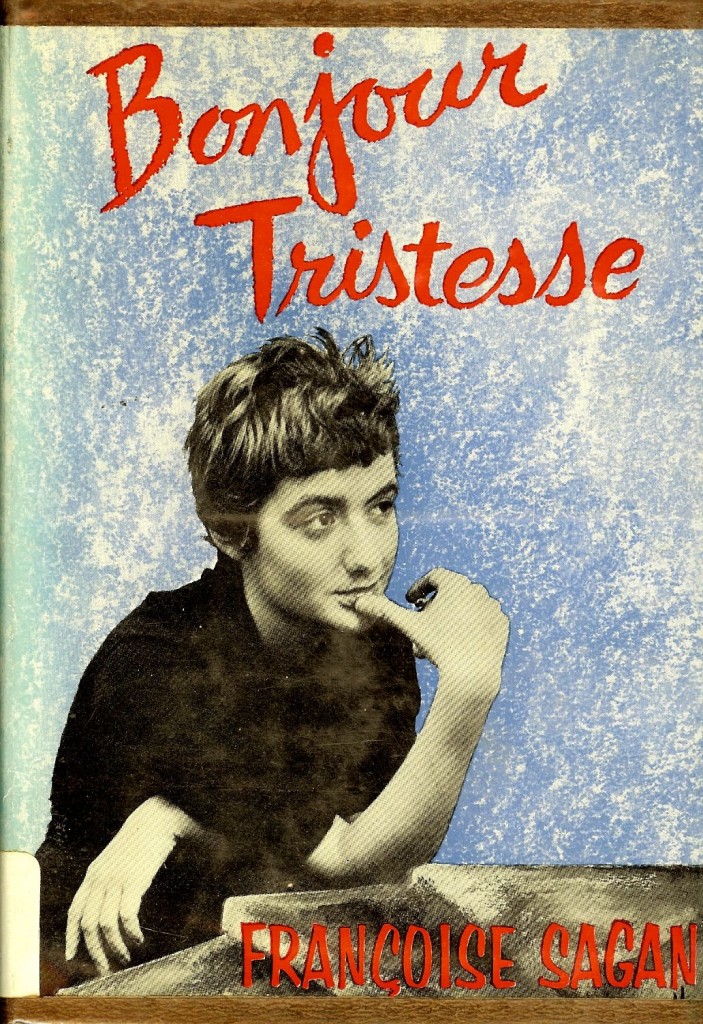
Francoise Sagan was the latest born (1935) of all the writers on this circa 1960-composed list. She died in 2004, the author of many books and plays, though none of her later works equaled the success and influence of this, her first novel (she remained a colorful and adventurous figure throughout her career, being convicted for cocaine possession as late as the 1990s). In retrospect it is a little difficult to appreciate what the big deal was. At the time the book was considered something of a French (and female) counterpart to Catcher in the Rye in its depiction of stylishly jaded affluent young people, but the writing isn't on that level. Even though it is only 128 pages the plot moves along rather slowly and in truth not a great deal happens--it probably could have been even shorter than it was without any sacrifice of quality. By current standards the famously scandalous parts of it are not all that alarming--even the (largely blase) parts where the 17 year old Cecile goes to bed with her 25 year old boyfriend, while they might officially be met with distaste and disapproval in the present environment, are obviously neither dark nor dangerous in the way that one would expect such an "inappropriate" relationship to be. Escapism for repressed (really repressed) women perhaps? This doesn't seem like a book that men at that time, especially older men, would have been that interested in, though obviously someone was buying all of those little red printings of the book during its initial success that I have come across dozens of copies of in used book stores over the years.
Having said all of this, I still liked it and am glad to have finally read it, as it was something of a cultural touchstone during the 50s and even long afterwards, when it would be referred to mockingly in association with wide-eyed American tourists, especially women, with silly or exaggerated romantic notions of France. If it were 400 pages I don't think there would be much justification for still reading it, but at the length it is, and as it does partake of the attractive spare, pointed French literary style that was prevalent in the 40s and 50s, I think it is worthwhile. I know that others are, supposedly, engaging with books more pertinent to the present hour, about critical race theory and structural injustices and the like, while I am hiding out on summer vacation on the Riviera in the 1950s, towards the end of which my sentiment was, "more of this candy, please."
Just a few short quotes, as always for the sake of my own remembrance.
pp.9-10 "Although I did not share my father's intense aversion to ugliness--which often led us to associate with stupid people--I did feel vaguely uncomfortable in the presence of anyone completely devoid of physical charm. Their resignation to the fact that they were unattractive seemed to me somehow indecent."
p. 13 "He refused categorically all ideas of fidelity or serious commitments. He explained that they were arbitrary and sterile."
p. 19 "'What you call types of mind are only mental ages.' I was delighted with her remark. Certain phrases fascinate me with their subtle implications, even though I may not altogether understand their meaning. I told Anne that I wanted to write her comment in my notebook."
p. 54 "They had a night of love to look forward to; I had Bergson."
I just recently acquired some writings by Bergson. He was one of the three writers included in the edition of the Nobel Prize Library I got in order to read the last selection for this list (Benavente).
p. 64 "She brought with her the aura of a kept woman, of bars, of gay evenings, which reminded me of happier days."
p. 97 "At six o'clock we drove off in Ann's car. It was a huge American convertible, which she kept more for publicity than to suit her own taste, but it suited mine down to the ground, with all its shiny gadgets."
p. 104 "It amused me to think that if one told the truth when drunk, nobody believed it."

p. 105 "Already I almost shared Anne's condescending attitude toward our friends; it was catching."
p. 114 "How difficult she made life for us through her dignity and self-respect."
The Competition
1. Jodi Picoult--Small Great Things...……………………………………..11,183
2. Mary Ann Shaffer--The Guernsey Literary & Potato Peel Pie Society.....7,452
3. Ann Patchett--The Dutch House...…………………………………………….3,215
4. An Affair to Remember (movie-1957)……………………………………2,338
5. Ernest Hemingway--A Moveable Feast...………………………………...1,325
6. Sebastian Barry--Days Without End...……………………………………...803
7. Matthew Quick--Forgive Me, Leonard Peacock...…………………………334
8. Daniel Mendelsohn--An Odyssey: A Father, a Son, and an Epic...………...205
9. The Affair (TV--Season 5, Episode 4)……………………………………...203
10. Brenda J. Webb--Mr Darcy's Forbidden Love...…………..……………...141
11. Willow Aster--Downfall...………………………………………………...131
12. Jane Porter--The Good Wife...……………………………………………...85
13. Cyril C. Richardson--Early Christian Fathers.............................................64
14. L'Hotel de la Plage (movie--1978)...............................................................53
15. James Martin SJ--A Jesuit Off-Broadway.....................................................37
16. Marlene Riggs--Love Me Best.......................................................................16
Round of 16
#1 Picoult over #16 Riggs
I'm not going to read a Jodi Picoult book if I can help it (I actually started one once back when she was really popular and had to give up pretty quickly) but she can still beat a standard order romance novel.
#2 Shaffer over #15 Martin
This was an extremely close game as the books were nearly identical in length and apparent quality. I gave the nod to Shaffer as this is the second time recently--perhaps the second time in a row--that this book has qualified for the tournament, and that experience begins to count for something in the early rounds.
#3 Patchett over #14 L'Hotel de la Plage
Patchett is a former champion of this tournament, for the somewhat acclaimed novel Bel Canto, which I however did not like very much. This movie, a 1970s French beach flick, though necessarily defeated here, looks interesting.

#5 Hemingway over #12 Porter
#11 Aster over #6 Barry
The Barry book received some acclaim, but it was fated to be the victim of an upset here.
#7 Quick over #10 Webb
#8 Mendelsohn over #9 The Affair
There is a decent selection of books here which for the most part did not have to face each other in the first round.
Elite 8
#13 Richardson over #1 Picoult
#2 Shaffer over #11 Aster
#8 Mendelsohn over #3 Patchett
This was another tightly contested matchup. Patchett's book was even a finalist for the Pulitzer Prize. I was swayed in the end by the lingering memory that I found her other book to be quite overrated.
#7 Quick over #5 Hemingway
Upset special. I haven't looked at the Peacock book to this point, so I don't know yet how formidable it may or may not be, but Hemingway was the heavy favorite to win the championship here, obviously, and he is knocked out.
Final Four
#2 Shaffer over #13 Richardson
#8 Mendelsohn over #7 Peacock
The Peacock book seems to fall into the Young Adult category, which puts it at a disadvantage.
Championship
#8 Mendelsohn over #2 Shaffer
This Mendelsohn is just too heavy-hitting of a guy to go against in this spot. He is one of those resume monsters, of exalted American birth and exquisite upbringing and education. He has been eating, breathing and sleeping culture and learning at pretty much the highest levels this society has to offer for a long time. Better luck next time, Shaffer, if we see you again.