Showing posts with label Sinclair lewis. Show all posts

Thursday, February 15, 2018

Sinclair Lewis--Babbitt (1922)


It seems to have just gotten harder to steal pictures.


From the IWE's introductory comments:


"Main Street was Sinclair Lewis's first and biggest success on the subject of small-town quasi-culture, but Babbitt, which came two years later, was a better book on the same subject. If it is not Lewis's best novel (a rank that is usually accorded to Arrowsmith or Dodsworth), it is not far from it."

I haven't read Main Street (which is also on this program) since I was in high school and I haven't any sense at this point how it compares to Babbitt (or whether it even matters anymore), but I did just read Arrowsmith and wrote about it here within the last year, and while that did strike me as the more accomplished book from the literary standpoint, there was, somewhat to my surprise, much in Babbitt that I found poignant--the trip to Maine with Paul, especially the poker, and then the return trip the next year without him got to me the most, but there were numerous episodes that struck deeper than I would have expected them to throughout the book. While Babbitt's personality and business-oriented outlook on life are decidedly unlike mine, he is the same age that I am or have recently been--46, 47, 48--and a lot of the impulses and disaffections he has upon reaching this stage of life ring true to me (Lewis himself was only 36-37 when this was published). I didn't make as many notes as I wish I had now, in part because I was quite engaged by it, in other part because I have been really more than usually depressed this winter, and while these old books are often a great comfort to me in such times, I still didn't have much energy for writing thoughts down. While certainly Lewis would never have intended his novel to induce nostalgia, it ends up having something of that effect, to me at least, because the world of 1920s America still retains some vividness for me. I suspect even such sense as I have for it must be increasingly lost to younger people though.

I'm tempted to write more about my depression, but I might do something that alludes to it on the other blog after I finish this.

I made my first note on page 164, a sentence about a civic convention that I found funny:

"The pastor of the First Christian Church of Monarch...informed God that the real-estate men were here now."


This was set in, if not the absolute heyday of train travel, still a dynamic period for it. The description of the brand new station at Zenith is clearly intended to be satirical, but from the vantage point of our own era of transportation it sounds rather nice:

"It was a new and enormous waiting-room, with marble pilasters, and frescoes depicting the exploration of the Chaloosa River Valley by Pere Emile Fauthoux in 1740. The benches were shelves of ponderous mahogany; the news-stand a marble kiosk with a brass grill."


There is a suggestive undertone throughout the book as well that electricity, plumbing, appliances and other modern wonders are perhaps not appropriate for the masses, as of course most middle-aged people at least in 1922 would have grown up without them. When this novel first came out and for the fifty-sixty years afterwards when it enjoyed some fame, it was primary noted for its satire, but that is now the most dated, heavy-handed aspect of it. It has other, much more subtle, redeeming qualities though.

Prohibition made forty-five year olds have to act surreptitiously like teenagers. This is at the hotel at the realtors' convention:

"At half-past seven they sat in their room, with Elbert Wing and two up-state delegates. Their coats were off, their vests open, their faces red, their voices emphatic. They were finishing a bottle of corrosive bootlegged whisky and imploring the bell-boy, 'Say, son, can you get us some more of this embalming fluid?'"

The quest for illicit booze did make some of the forty-something women more festive though than perhaps they would otherwise have been inclined to be.

I didn't note what page I was on, but at one point I wrote, 'Still interesting, but hard to see where book is going between Paul (spoiler alert--Paul goes to jail for shooting his wife, non-fatally), Babbitt's midlife crisis, return to Maine, etc. Never clear why Babbitt loves Paul so much, more seemingly even than his own family.'

p. 339 "Their life was dominated by the suburban bacchanalia of alcohol, nicotine, gasoline, and kisses."
I liked this sentence.

p. 391 I'm not really in the right frame of mind to make political pronouncements, but I thought this sentence about The Good Citizens' League, accepting a membership in which marks the end of Babbitt's identity crisis and his firm return to sound business principles and all the rest of it, was too obviously pertinent to the present not to recognize it:

"All of them agreed that the working-classes must be kept in their place; and all of them perceived that American Democracy did not imply any equality of wealth, but did demand a wholesome sameness of thought, dress, painting, morals, and vocabulary."

Absolute equality of wealth will obviously always be problematic given the different natures of people, especially in large societies, though perhaps there could be somewhat more of it than there is at present. And there doesn't seem to be much danger nowadays of the working classes forming any kind of a threat to the established order, so that keeping them in their place is not as much of a labor-intensive-task as it may once have been, but the gist is familiar.  



I have not elaborated much on what I think it is that this book gets right that makes it as affecting to me as it was, but I think it is the way that one's life (often) feels as it is becoming stalled in the 40s, especially the late 40s, when I think it really hits you that if you aren't declining already, or at least not too much, that that might start accelerating noticeably at any time. In some ways of course I stopped going forward a long time ago, but the continuous adding of children over the years kind of masked that and gave me a sense, certainly that I was still relatively young and had a long future ahead of me, but that my experience, life force, or whatever, was still expanding. But all of a sudden I feel disturbingly old and vulnerable, and I'm wondering what I was thinking having another baby at age 45, as beautiful and delightful an addition to the human community as she is. I feel like I'll be lucky to see her get her through high school and college, and making it to her 30th birthday seems like a longshot. For that matter I could really go at almost any time. I know that was always the case but up until two months ago I had no real consciousness of that, it was not real to me. Anyway, a lot of the better part of this book is about this creeping sense of the genuine futility of one's existence and how to keep moving forward. Paul of course was pointedly unable to do this.


No uploadable pictures of the book anywhere. I'll have to get my own camera working again.

For a relatively famous book there aren't a lot of attractive editions of it available on the market. There was an evidently limited run Modern Library edition in the 50s but I couldn't find any copies of this online. There was one advertised that I tried to order but I was sent a 1960s era Signet paperback or something like it instead. I ended up getting a bland gray Harcourt Brace edition from the 50s which matches my copy of Main Street.
The Challenge

1. Rebecca Skloot--The Immortal Life of Henrietta Lacks..............................5,819
2. Kate Turabian--A Manual For Writers of Research Papers, Theses, etc.......752
3. Ruth Rendell--The Girl Next Door.................................................................423
4. Gloria Steinem--Marilyn................................................................................231
5. The Reverend William J. Barber II--The Third Reconstruction.....................110
6. Praxis II Middle Scholl English Language Arts...............................................44
7. Natalie Babbitt--The Eyes of the Amaryllis......................................................33
8. The Wise Owl Guide to...(DSST): Here's to Our Health..................................12
9. DSST Principles of Statistics Exam....................................................................9
10. Girl Gangs, Biker Boys, and Real Cool Cats (eds. McIntyre & Nette)............3
11. Victor Hugo--William Shakespeare..................................................................0
12. Isabel Burton--The Life of Captain Sir Richard Burton....................................0

Once again a complete field of 16 eludes us. The top four seeds--all women, incidentally--receive first round byes.


1st Round

#5 Barber over #12 Burton

While Sir Richard Burton is an interesting subject, the 1893 biography of him by his wife doesn't seem to have earned a reprint anytime in the last 100 years and no one carries a copy of it.

#11 Hugo over #6 Praxis

#7 Babbitt over #10 Girl Gangs, etc

The Girl Gangs book, the subtitle of which is Pulp Fiction and Youth Culture 1950-1980 looks somewhat interesting, but no one has it.

#8 Wise Owl Guide over #9 DSST Principles

Round of 8

#11 Hugo over #1 Skloot

The Hugo book is only available in a couple of academic libraries, but they do have it. As I am currently weary of the kinds of contemporary writers that my game keeps turning up, the 19th century European giant had a decided psychological advantage.

#2 Turabian over #8 Wise Owl Guide

#7 Babbitt over #3 Rendell

Rendell is a straight genre book. I'm not exactly sure what this Babbitt is, but it looks like it might be more soulful. It's also older, dating I believe from 1977.

#4 Steinem over #5 Barber

Kind of a toss-up that the higher seed wins by a hair.


Final Four

#11 Hugo over #2 Turabian

#4 Steinem over #7 Babbitt

The Steinem would probably be something different and more interesting. A ho-hum final four.

Championship

#4 Steinem over #11 Hugo

The Steinem book is in my library, and it's also pretty short. I might have been inclined to go with Hugo anyway because my intellect is in such decay, but I will give this a try.



Friday, April 21, 2017

Sinclair Lewis--Arrowmith (1925)

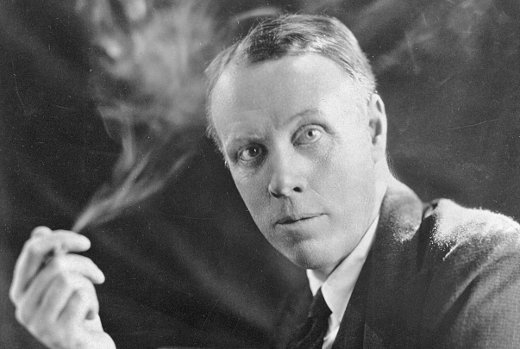
Forgot to put a picture of the Author in here anywhere

Here is another swell book from pre-World War II, and more specifically 1920s America, winner of the Pulitzer Prize for 1926. For some reason I never realized that the Pulitzer Prizes for a given year were awarded for works that were published or produced the previous year.1925 of course was one of the great years of American literary history, with at least The Great Gatsby and An American Tragedy coming out in addition to Arrowsmith. While I probably like both of those other books a little more, Arrowsmith is a worthy competitor to them. Its literary style is not as charming as Gatsby's, but it is in certain ways a more serious and mature and interesting book. In our time Lewis  has faded, among people who are influential in these matters anyway, as a significant writer, his books largely dead and unread apart from some odd hobbyists and nostalgists such as myself. When he is mentioned by these influential people, they usually don't have anything very complimentary or gracious to say about him, though the primary targets of this disdain seem to be Babbitt and Main Street, which I have not really read (though both are on the IWE list!). I did read Main Street in high school, but I don't count anything I read in either high school or college as far as making a critical assessment of it relevant to my life now, though developing the habit and being exposed to the general thought and conversational patterns of people possessed of literary intelligence even without much in the way of understanding was of greater value to my subsequent life, such as it is, than the slightly more informed readings I am doing now. Arrowsmith at least I found to be a lively, interesting book about a perfectly ordinary and obvious subject, the career of a doctor and researcher, that even talented novelists do not usually handle so skillfully. The general mindsets of its more serious characters do not strike me as far different from those in similar positions today, and the parts that are more dated are mostly so in a good way, in that they recall the flavor of this lost America, which a lot of people I guess wish would get even more lost than it already is, but I love it.  

Whether or not Lewis's decline in stature is due to his being so American in the particular Midwestern way that he was, that cannot help him. Ironically, his career was substantially built on critiquing and trying to distance himself from the type of people that society was producing. However when you grow up on the prairie in the 1890s and 1900s, a long way from anywhere, with the type of education that that entails, it is probably impossible that cosmopolitanism of either the breezy or deeply intellectual variety can ever become second nature to you; and Lewis clearly struggled with this in his writing, not, in my opinion, without some substantial success.

As has been my wont lately, I didn't make any notes for this review until I was at about page 190 (after which point I made a lot), and my first one was surprisingly critical, though not wholly inaccurate--"He telegraphs and betrays his distance/sense of superiority to his characters a little too insistently"--adding then--"But the story is good and the evocation of this old America, Midwest, etc, is priceless."  

For example the part where Arrowsmith leaves Wheatsylvania (the godforsaken town in North Dakota where his wife was from and where they lived for a while at the beginning of his career) and everyone who has been antagonizing him the whole time he's been there is upset that he's going is great.

Description (p.204): "She must have been a veritable girl of the late eighties and the early nineties (1880s an 90s, obviously--ed.), the naïve and idyllic age of Howells, when young men were pure, when they played croquet and sang Swanee River; a girl who sat on a front porch enchanted by the sweetness of lilacs, and hoped that when Almus and she were married they would have a nickel-plated baseburner stove and a son who would become a missionary or a millionaire."

The introduction of Orchid, the highly appealing nineteen year old daughter of Arrowsmith's boss in Iowa (the aforementioned Almus), who was fond of languishing around his office in the afternoons and distracting his thoughts from both his career and his marriage, is great too. Nothing but trouble, I guess, yet I'm sure almost any man who doesn't have, or never has had, an Orchid in his life longs for one.  

1910s and 20s era civic boosterism--the idea that the members of a town's professional class had an obligation to be cheerleaders for their city--is one of those things I'd always vaguely heard about, but did not have a good picture of what it was before this book. It's hilarious. I especially love the flying of pennants bearing the town's name from one's car in jaunts across the county and further afield (which Arrowsmith pointedly resists doing).

p. 233 On anxiety caused by Orchid: "'I've won her,' he gloated...Probably never has gloating been so shakily and badly done."

p 234-5 More on this subject that is so fascinating to me: "'I can go as far as I like with her to-night...But she's a brainless man-chaser...All the better. I'm tired of being a punk philosopher...I wonder if these other lucky lovers that you read about in all this fiction and poetry feel as glum as I do?...I will not be middle-aged and cautious and monogamic and moral! It's against my religion. I demand the right to be free--" He doesn't end up going too far with Orchid though he "masterfully seized her wrists, and kissed her as she deserved to be kissed." Unfortunately he then "immediately ceased to be masterful." (And no, I don't think kissed here is a euphemism for anything more explicit).


p.352 The dynamic Swedish doctor and Martin's whilom mentor Sondelius during preparations for a journey to the West Indies island on St Hubert (which does not appear to be the name of an actual West Indian island?) where they are headed during a bubonic plague outbreak to combat the disease and hopefully do some substantive research on the phage injections they are using in this cause: "You shall not inject me till you will inject all my negro friends down there too." Wow, somebody in a novel at this time who is not completely and obliviously racist in all situations. (There was to be a control group among the local black population that did not receive the injections so that the effectiveness of the phage could be demonstrated and established, bringing scientific glory and prestige to Arrowsmith and the Institute where he worked).

p.381 Sondelius kept his word and did not take the phage as, initially, the experiment went forward. I found his deathbed wishes to be worth noting: "...yoost once more I would like to see Stockholm and Fifth Avenue on the day the first snow falls, and Holy Week at Sevilla. And one good last drunk!"
p. 384-5 "It's that renovated old part of Brooklyn where writers and economists and all those people, some of them almost as good as the very best, consort with people who are almost as smart as the very smartest." Some things are, if not eternal, at least recurrent.

p. 369 "Like most white Americans, Martin had talked a great deal about the inferiority of negroes and had learned nothing whatever about them." More progressivism. Martin was taken aback momentarily upon meeting a black doctor (M.D. from Howard) on the island, but he recovered pretty quickly.

p. 402 Despite the eventual failure of the mission from the research/science point of view (nothing could be decisively proved due to the chaos/breakdown of scientific discipline that overwhelmed the project, the Institute was able to spin the relative humanitarian success of it in containing the outbreak and saving more lives than otherwise would have been the case). "...the papers were able to announce that America, which was always rescuing the world from something or other, had gone and done it again."

p. 414 "Aware only of Madeline Fox and Orchid Pickerbaugh, who were Nice American Girls...and of Leora...Martin knew nothing whatever about Women." Needless to say, I am very partial to Nice American Girls. I wish there were many more of them. Are they still even considered to be a distinct species?
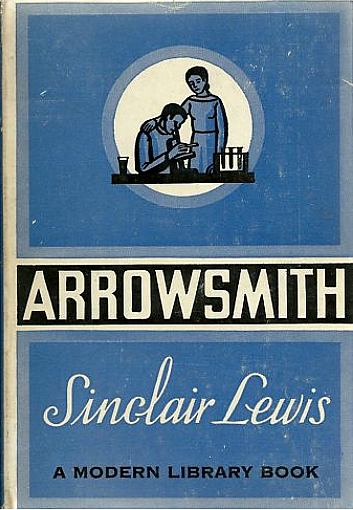
Dust jacket of the Modern Library Edition, which was not the edition I read, actually, though I do like this cover a lot. I used the Nobel Prize Edition, which has a striking blue cover with an embossed imprint of the Nobel Prize medal on the front beneath which Lewis's signature is imprinted in gold lettering. I bought this book at a library sale in Elkins Park, Pennsylvania in 1986 for 35 cents, at which time I bought cheap used copies of many of the books on the IWE list that I have been toting around for thirty years and am finally getting around to reading now. This Nobel Prize set must have sold well, as there are numerous copies available at Amazon and elsewhere, starting at $4 without shipping and handling. 


The 1931 film directed by John Ford and starring Ronald Colman and Helen Hayes is still held in pretty high regard today though it requires a little effort and/or expense to track down a copy of it. I've got it on my list of things to see when I get the chance. 
The Challenge

A combination of medical terminology and place and character names specific to this book constituting such a large portion of the magic words has resulted in a considerably reduced field.

1. Anthony Marra--A Constellation of Vital Phenomena......................... .........1.040
2. Roland Merullo--Breakfast With Buddha..........................................................813
3. L'Auberge Espagnole (movie)...........................................................................160
4. How Learning Works: 7 Research-Based Principles for Smart Teaching.........95
5. Arrowsmith (movie)........................................................................................... 26
6. William Carlos Williams--Doctor Stories..........................................................23
7. Christopher Golden, ed.--Seize the Night...........................................................18
8. Elliott & Nelson--The Curious Mr Catesby.........................................................6
9. Abby H. P. Werlock--Companion to the American Novel, Vol. 1.......................0

8-9 Game

#8 Elliott and Nelson over #9 Werlock

Both books actually are available in a New Hampshire library, though not one of the ones at which I have privileges.
The young Myrna Loy was also in the 1931 movie, as Arrowsmith's aristocratic second wife.

Quarterfinals

#1 Marra over #8 Elliott & Nelson

I had never heard of this Murra book (2013) but it is apparently very popular, and all the libraries have it.

#2 Merullo over #7 Golden

Same for the Merullo (2007). We could be headed for a 1 vs 2 final.

#6 Williams over #3 L'Auberge Espagnole

#5 Arrowsmith over #4 How Learning Works, etc

I'm sort of breaking a rule by having a movie beat a book, but I really don't want to read that book.

Semifinals

#1 Marra over #6 Williams

Williams normally would have triumphed here, but Marra was primed for an upset. He's only 32 or 33, a native of Washington, D.C., product of the Landon School, USC(!) and the U Iowa writer's program.

#2 Merullo over #5 Arrowsmith

Championship

#1 Marra over #2 Merullo

In the dream matchup, the books are fairly evenly matched in time (6 years) and length (50 pages) Merullo (born 1953 in Boston; Phillips Exeter, Brown, Suffolk Law School) has the catchier title for his spiritual novel, and he has had a pretty distinguished career, though I had never heard of him. However, I have decided to go with the Marra, which is a product of the very different genius of the younger generation and is probably farther from where I ever conceived of literature going, which as it was the closest thing to a consuming adult interest I ever had, is something I should look into.


The face of a successful modern author

Tuesday, June 17, 2014

Edith Wharton and the Pulitzer Prize

In my haste to publish my last article, I forgot that I had wanted to mention some things about the Pulitzer Prize, which was awarded in 1920 to The Age of Innocence. As with other artistic awards, the Pulitzer Prize in the non-journalism categories has almost always been played down by the better writers themselves, and, taking the cue from them, in our days this damping of enthusiasm has spread to much of the reading public. In prestige it is my sense that it has been surpassed by the National Book Award, which looks over time to have a better track record, at least for picking things that later critics and writers have favored; still, the advantage is slight, and it is not something that serious people allow themselves to get overexcited about. The Pulitzer still carried some middlebrow cache in the 60s however--my encyclopedia list duly notes when one of its selections was thus honored, and they did choose 13 fiction winners and 9 drama winners from the 1920-1955 era for inclusion. In 1920 the fiction prize was being given for just the 3rd time, but evidently it was a big enough deal that many of the big writers of the time were aware of it and considered it worth noticing--Pulitzer himself of course had been a titan in the business of the printed word, which meant nothing to purer literary spirits like Ezra Pound, but any kind of prize bearing his name would likely have piqued a certain amount of interest in anyone who wrote at least in part with an eye towards getting or maintaining an upper middle class income.

The point of all this being that according to the chronology of Edith Wharton's life given in the Library of America, the Pulitzer committee actually chose Sinclair Lewis's Main Street (which also appears on this reading list later on--1920 was an exciting year for books in America) as the winner, but the trustees of Columbia University, to which Pulitzer had left the money for and administration of the prizes (and which still administers them, by the way), rejected that selection as too controversial and awarded the prize to Wharton, who, it is said, was appalled by this cowardice and began a correspondence with Lewis which continued for many years afterwards. Wharton was evidently not so appalled that she refused the prize, as Lewis himself would do in 1925 after winning for Arrowsmith (he appears to be the only one who has done so however, for fiction anyway; I had thought it was a more regular occurrence. On the other hand there have been three posthumous winners). Perhaps she was not aware she could do so.

All this information is really nothing to the point, but I had wanted to mention it. It tells us nothing about the meaning of the book. I usually know nothing about the meanings of books, though in this particular instance I think I have slightly more of a grasp on it than usual, because its main themes resemble impulses and feelings that most people living in any kind of conventionally structured society will have. But I would have trouble disconnecting what I think is going on in the book from my personal feelings and experience, and I don't want to go into that on a blog at this time.