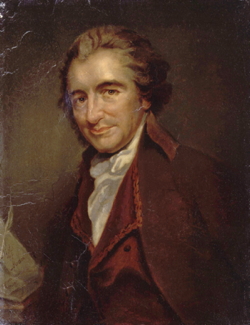
Thomas Paine is a fun guy to have on the list. Not only does he remain very dear to Americans of a certain imperfectly balanced tilt, but the tourist sites associated with him are in good locations, and have in themselves been the source of considerable wildness. These are welcome qualities in the ordinarily dry world of literary tourism.
Just one of Thomas Paine's celebrated works got officially tapped for this roll call of immortals--in my memory I thought two or three had made the cut--the 1795 tour de force The Age of Reason (author age at publication: 58):
"Thomas Paine wrote Age of Reason in 1793 and 1794, when he was France participating in the French Revolution (and considered himself a citizen of France). The book is of historical importance because it created such a furor, especially in the United States, where it was published. Even today there will be those who disapprove its being summarized here. At the time, Age of Reason was called 'atheistic'; but this was a misuse of the word, because in the book Paine affirms belief in one God and in human immortality. Rather than being an attack on religion, the book is an attack on literal interpretation of the Bible, specifically the Authorized ('King James') version."
This seems to have been the standard mid-century opinion. The introduction to Age of Reason in the volume pictured below also makes the argument that Paine was completely misunderstood and was in fact a deeply religious man. I have not read this particular work, so I cannot comment on it specifically, however I have read the Rights of Man and my impression, and the one I would imagine most modern readers would get from that book is not of a deeply religious man, if they even had a conception of what that means. He was doubtless a man possessed of extraordinary animal spirits and a tireless capacity for outrage and antagonizing those in authority who were offensive to him, which temperament, as William James for one observed so lucidly in his Varieties of Religious Experience, is frequently more conducive to an intense spiritual life than that of what he refers to as the 'ordinary sluggard'. Paine's spirituality, I think it is safe to say, was not characteristic of the school known as Moralistic Therapeutic Deism, the squishy, inoffensive, nondemanding spiritual-but-not-religious creed which is viewed as the predominant (and false) understanding of the spiritual life among our modern day educated population.

My Thomas Paine book. Another author, another Modern Library edition--it won't be like this all the way through, though the series does match up pretty well with the list we are currently working on. This edition, from 1945, is a rather odd one, in that in addition to the man's own famous works--Common Sense, The Crisis Papers, Rights of Man, The Age of Reason, and two letters to George Washington--there is a two-page wrap-up entitled "Tom Paine: an Estimate" which is written in an ebullient, boosterish, unmeasured tone, and a 300-page novel of what looks to be uncertain literary merit about Thomas Paine's life by the heretofore unknown to me Howard Fast.
My hastily written summary of The Rights of Man, dated March 7 of this very year, 2012, is enthusiastic. 'Invigorating stuff. Man had a genius for contrariety, though perhaps overly optimistic re. democracy. Love reading him though. Makes one feel vital, alive.' You get the idea. I have often thought, if there is any epoch of history from which I wish there were more literary works, it would be the early years of the American republic, around 1780 to 1810/1820 or so. The optimism and energy and general personality of the free portion at least of the population of the new nation at that time seem to have been extreme, unique, and remarkably effective by historical standards in that period. For writings from the time which capture this spirit you have Paine, you have the Federalist Papers, which can be an exciting read in the right frame of mind, Jefferson's various writings, such speeches and anecdotes of George Washington that were recorded, the Constitution, Benjamin Franklin's Autobiography, which I know was written before the revolution but I think still fits in with this theme, Lewis & Clark's Journal: I want more stuff in this mode, or at least a greater sense of its carrying weight in the culture, because those years are essential to whatever this country is now, and in many instances and aspects in a more positive sense than any comparable period of time.
His prediction regarding the potential imminent abolition of war in Europe when the intrigue of royal courts should be replaced by democratic government was somewhat premature (especially as the book was published in 1791).
Paine is against taxes.
He swats his philosophical enemy Edmund Burke around so much that at first you wonder why Burke is still relatively respected today, and at second how much Paine is willfully misinterpreting and misrepresenting the crux of Burke's arguments.
'Man has no authority over posterity in matters of personal right; and, therefore, no man or body of men had, or can have, a right to set up hereditary Government.' This point is hammered home a lot. Paine loathed hereditary privilege with a righteous fervor that at least as far as its effective expression goes, seems to be absent from our current political discourse.
His book over-romanticizes the representative system. He is blind to its defects.
"...the routine of office is always regulated to such a general standard of abilities as to be within the compass of numbers in every country to perform, and therefore cannot merit very extraordinary recompence." Evidently this is no longer the case.
"We already see an alteration in the the national disposition of England and France towards each other..." Maybe not. "That spirit of jealousy and ferocity, which the Governments of the two countries inspired, and which they rendered subservient to the purpose of taxation, is now yielding to the dictates of reason, interest, and humanity." International strife is just a masquerade to bolster taxation? Paine wasn't much of an economist either, at least of the type that is in fashion nowadays. He considered domestic trade preferable to foreign because only half of the benefits rested with the Nation. Ha!
"Yet from such a beginning, and with all the inconvenience of early life against me, I am proud to say that with a perseverence undismayed by difficulties, a disinterestedness that compelled respect, I have not only contributed to raise a new empire in the world, founded on a new system of Government, but I have arrived at an eminence in political literature, the most difficult of all lines to succeed and excel in, which Aristocracy with all its aids has not been able to reach or to rival." This is an excellent distillation of the revolutionary mentality, which I admire by the way, even though I am nitpicking at some of his arguments. Multitudes of eminently qualified people in his own day took apart his arguments much more harshly that I have and Thomas Paine came back firing with twice as much venom in every instance, absolutely convinced of his righteousness and the evil of his enemies. That is the revolutionary spirit.
Illustration of how the world has changed since the 1790s: "To form some judgment of the number of those above fifty years of age, I have several times counted the persons I met in the streets of London, men, women, and children, and have generally found that the average is about one in sixteen or seventeen." This is probably not a precise calculation, but I do often think that we don't realize how skewed towards the middle-aged and elderly the population of our current society is compared to almost all of human history and the kinds of odd effects this dynamic is producing on us.
Paine does seem to be in favor of taxation/redistribution as long as it is on his terms. Defunding the Duke of Richmond's pension and slapping a tax on 'luxuries' as defined by himself, such as idle land on the estate of an aristocrat that is potentially a common good. We have been unsure of both the desirability and justness of this type of action over the last 30 years, but I'm pretty sure this sentiment is going to come back, in the United States anyway, especially when the generation that is now under 35 or so begins to come into power. The timing of this for me will probably work out that the day after I finally attain the raise and other assets to plausibly be able to call myself prosperous, be able to pay for my children's school, and so on, the tax rate will be raised to 75% or something, kind of like in the Bohumil Hrabal book I Served the King of England in which the day after the main character, after decades of struggle, becomes an official millionaire, the communists overthrow the government and declare all millionaires criminals. But I actually do want to live in the best possible society, and I don't think the current economic structure is very conducive to that at all, so I probably wouldn't be all that upset if it happened anyway.
The 'estimate' of our author in my book makes a lot of claims about the man that I am not entirely convinced of as yet, but this paragraph strikes as hitting somewhat close to the truth:
"Paine has that rare historical distinction of being unique; there are no comparisons, because there has been no one, before him or since, quite like him. He had the fortune to arrive in the right place at the right time, and once there, he accepted history instead of attempting to avoid it."
Paine was born at Thetford in Norfolk in England. My 1970s era reference book gives the site of the birth as the garden of Grey Gables in White Hart Street. The site is evidently now occupied, conveniently, by the Thomas Paine Hotel, and the address is 6 Thomas Paine Avenue. This indicates to me that our guy is not forgotten. Thetford has a train station, and is on several lines originating in Norwich, and connects with Cambridge, Sheffield, Manchester and Liverpool, though there appears to be no direct service with London (change at Cambridge).
Paine lived briefly at Sandwich, in Kent, when he was 22. He was married there and set up in business as a staymaker, which seems to be an old term for a corset-maker. His business failed and shortly afterwards his wife died, at which time he was still just 23. His residence at 20 New Street still stands and is preserved as a rental cottage. Sandwich appears to be an extremely well-preserved and hopelessly quaint medieval town. Sandwich God bless them has rail service from Ramsgate and London (mainly Charing Cross, but also 3 trains a day to St Pancras).
The main Thomas Paine attraction in the United States is his cottage and adjoining museum in New Rochelle, New York, which is turning out to be quite a literary place (see Robert E Sherwood). I am thrilled to see that this complex appears to be back in operation as it was shut down for a time in 2009 as a result of, among other things, the selling off of 'priceless artifacts and documents' by the former president of the board--who had originally been hired as a janitor and lived rent-free in an apartment above the museum. I bet this kind of stuff does not go on at the Jane Austen museum. I would be keen to go to that Swing Dance Party that is being held at the museum on the evening of December 7, though I am not sure what swing dancing has to do exactly with Thomas Paine. The point is, it doesn't matter.
I have always liked the Westchester suburbs of New York City, and I pass through there several times a year on various journeys south. I frequently stop to eat in this area. It still retains a lot of that old New York atmosphere.
Here is a little video of the site:
Thomas Paine is also too cool to have his remains deposited in an identifiable place. He did once, on the grounds of the farm where his museum now is, and the spot is marked by a nice plaque. However:
"When William Cobbett returned in November 1819 from his second visit to America he caused great excitement at the Custom House by having the bones of Tom Paine in his luggage. He had exhumed these from a patch of unconsecrated ground near New York, where Paine had been buried (1809), with the intention, advertised in the Political Register, of raising money to build a mausoleum to house them in England as an object of pilgrimage, but instead of subscriptions he received only ridicule, as in Byron's lines:
'In digging up your bones, Tom Paine,/Will Cobbett has done well;/You visit him on earth again,/He'll visit you in hell.'"--The Oxford Literary Guide to the British Isles.
No one seems to know definitively what became of the bones after that.
Besides the enormous quantity of literary scholarship and commentary devoted to the works of this most fascinating founding father, there are many videos discussing his work on Youtube by well-known and little-known commentators alike--there appear to be several hours worth of Christopher Hitchens interviews alone which are solely devoted to talking about Paine. I have decided not to put any of them on here because they are all quite long and I don't have time to listen to them at the moment. Doubtless anyone who wants to find them can easily do so.
Thomas Paine's current-day fans seem to be on the whole as angry and impetuous as he was, perhaps especially towards each other. Here is a former trustee of the now-closed Thomas Paine museum (not to be confused with the cottage above, though it sits, shuttered, a couple of hundred yards down the street from it) breaking down the myriad reasons why he won't be attending this year's scholarly conference on our author in New Rochelle. Here, a no-nonsense visitor from Seattle concisely lays out all that is lacking at the mess that is the New Rochelle memorial from both the historical and the touristic point of view. Pretty damning review, though I still think it would be worth stopping by sometime if I were in the area. For me, even just a half hour walking around the abandoned grounds and reading the uninspired monuments would be a happy respite from the monotony and moment to moment insignificance of ordinary life.

