Showing posts with label boston. Show all posts

Tuesday, August 10, 2021

August 2021

A List: City of God (Augustine)..............................................................................541/867

B List: Between books    

C List: Sir Walter Scott--Rob Roy................................................................................7/501

Bonus: Zena Hitz--Lost in Thought.........................................................................126/210

I finally finished Buddenbrooks on 8/4, so I will eventually get up a report on that, though probably not before the last part of August, as there is probably no way I can get it done this week, and next week I am going to be on vacation. The next book on that list is another long one, which will probably take me through all of the rest of August and September, if it ever arrives, which it hasn't yet. So activity on this blog will continue to be light for a while. As to my other one, which I haven't updated since May, I am hoping that when school starts up again, in addition to being able to read a little more, I can get back into something of a more regular writing routine, even if it is just the blogs to start. I want to get in some exercising too, not because I am getting fat, but because I would like to maintain a somewhat healthy look, and as I am getting bored with my social life I would like to keep my options open for having a better one as much as possible--at this point of my life I have to concede that my brains are not enough to get me there on their own. We'll see what happens. 

This was not a productive month of reading. My mother came to visit for two weeks in July, and she is even harder to escape from than my regular family. Augustine is coming along slowly. His theme of the two cities (That of Man and that of God) is starting to come into clearer focus. This book is kind of an encyclopedic inventory of such religion and history as was known, or at least regarded as important, up to that point, and I like reading books of that sort from time to time. But I can't read that much of it in any given day.

For the C-List I spent most of the month finishing up Madeline L'Engle's short story collection The Moment of Tenderness. It got mixed reviews but other than one story about the devil which I didn't quite understand I thought it was really good. I guess I don't read that many stories. Maybe they all seem good when a real professional writes them, though I think I have some discernment in these matters. I just started Rob Roy today. It is pretty long for a C-list book, but my discovery of what a good novelist Scott is after not having read him my entire life is one of the modest joys I have had in the past two or three years. The first few pages of Rob Roy possess the same inimitable authorly charm that infused The Heart of Midlothian and especially The Bride of Lammermoor, the two books by this author that I have read in the last year or two.

I am working my way leisurely through my old classmate Zena Hitz's book. She draws on a wide array of liberal learning, much of which, even if I cannot claim to have been already possessed of, is accessible enough to me that I can usually make sense of it. The book has an underlying current (though don't all philosophical books to some extent?) of dismay at the current state of universities and intellectual culture, with the obscene lust for social status and material luxury that has permeated and influenced even the way these realms operate beyond what appeared to be the case in much of the known past, even that known to our generation personally ca. 1990. I feel much of the same general dissatisfaction with the state of public discourse and thinking in comparison with the form I thought, or hoped, these things would take in my mature years back then, so I am receptive to the message of the book.


Pictures. I took shockingly few pictures this month, given that it is summer. The above is obviously Boston. We walked the Freedom Trail, where it is kind of difficult to whip out the phone and take a lot of pictures on the interesting parts, at least if you have children. It had been three or four years since we've walked it, so it was new to the younger ones.


This is a pretty wooded trail in southern New Hampshire, I forget what town. It was near Milford. As you can see we got a lot of rain in July. 


This is in Vermont.


Lost tooth.


Maine

Thursday, October 15, 2020

Hank James--The Bostonians (1886)

This is, in my opinion, one of the better Henry James books. It is not the only one that I have thought especially well-done, or been able, at least in my own mind, to follow, but it is one of the few that I can honestly say I have enjoyed and really looked forward to reading the next chapter every morning (the others that come to mind being the early The American and the much shorter Turn of the Screw and Aspern Papers). This middle period book has some of his clearest and best sentences in describing thoughts and motivations--not as exquisitely subtle, I suppose, as in the later masterpieces, but as I have not to this point really been able to follow the thought processes in those later books the full glory of their subtleties have been kind of lost on me. The IWE introduction notes that:

"The Bostonians is a novel of James's 'middle period.' He was in the realm of high society as usual, this time in the very starched Boston of the late 19th century. The novel was not successful when published and James was very unhappy. Among other things, it was considered wicked. Perhaps it was and still is, but it is among his most important works."


Here is my book, accompanied by some seasonal spirit. It is the Modern Library edition with one of their especially attractive jackets. I got it at a library book sale in 1986. 


The 'wickedness' I assume refers to the numerous blatantly lesbian characters and their implied domestic arrangements, though how x-rated in the physical sense matters really got between Verena and Olive (or even, for that matter, Dr Prance and Miss Birdseye), I don't have a great sense of. Also, on the overall Henry James starchiness scale, I would rate this one as being on the lower end. It's set entirely in America. One of the main characters is from Mississippi. The crowd in New York is rich and given to sumptuous dining and so on, but I don't remember encountering anyone there whose breeding would be considered by James or anyone else to meet the highest standard compared to the French aristocrats and the like who populate his other novels. Olive is perhaps the starchiest character in the book, and she is designated on multiple occasions as a "provincial." 

p. 18 "...the Back Bay (don't you hate the name?)" I've always kind of found the name unsatisfying too, for various reasons. When I used to take Amtrak in the 80s and 90s, the train always stopped at the Back Bay Station (I don't know whether it still does), which was modern and ugly, and no one ever got on or off, and I am still kind of vague as to what it is, or is supposed to signify (I know it was an actual bay that was filled in and made into a somewhat fashionable neighborhood around the time this novel was written, but I don't have much of a sense of what it is now).

p. 21 "'In sympathy with what, dear madam?' Basil Ransom asked, failing still, to her perception, to catch the tone of real seriousness. 'If, as you say, there is to be a discussion, there will be different sides, and of course one can't sympathize with both."

p. 31 "They sat there as if they were waiting for something; they looked obliquely and silently at Mrs. Farrinder, and were plainly under the impression that, fortunately, they were not there to amuse themselves."

I mark down these early quotations as a way of building up to anything it might occur to me to say later on. 

p. 43 "...the time hadn't come when a lady-doctor was sent for by a gentleman, and she hoped it never would, though some people seemed to think that this was what lady-doctors were working for."

(handwritten note I can't read--There are a lot of little (somethings?) of interest here).   

p. 46 "I am only myself, I only rise to the occasion, when I see prejudice, when I see bigotry, when I see injustice, when I see conservatism, massed before me like an army...I must have unfriendly elements..."

p. 50 "He had a passionate tenderness for his own country, and a sense of intimate connection with it which would have made it as impossible for him to take a roomful of Northern fanatics into his confidence as to read aloud his mother's or his mistress's letters."


p. 76 "But except when her mother made her slightly dizzy by a resentment of some slight that she herself had never perceived, or a flutter over some opportunity that appeared already to have passed...Verena had no vivid sense that she was not as good as any one else, for no authority appealing really to her imagination had fixed the place of mesmeric healers in the scale of fashion." I have met a few people in the course of my life of this genuine democratic mindset, mostly in northern New England. 

p. 116 "There was nothing in the house to speak of; nothing, to Olive's sense, but a smell of kerosene; though she had a consciousness of sitting down somewhere--the object creaked and rocked beneath her--and of the table at tea being covered with a cloth stamped in bright colors." The snobbery is really brutal whenever Verena's parents come into the story.

It is odd how reading these 100 year old books seems so outdated to me now in a way that it did not even in 1990. The world (social, institutional) of the past still seemed basically relatable then in a way that it doesn't now. So many things--the racial and cultural makeup of society, particularly with regard to peoples who were virtually unknown in Western countries even 30-40 years ago, male social roles, educational structures, in addition to the obvious technological changes with regard to consuming books and newspapers, have perhaps changed more in the last 30 years than they did in the previous 100, as far as the pursuit of literary engagement goes. 

p. 152 "She went so far as to ask Olive whether taste and art were not something...Miss Chancellor, of course, had her answer ready. Taste and art were good when they enlarged the mind, not when they narrowed it."

p. 248 On the Memorial Hall at Harvard, which you can still wander into today, or at least could 15 or 20 years ago: "The effect of the place is singularly noble and solemn, and it is impossible to feel it without a lifting of the heart. It stands there for duty and honor, it speaks of sacrifice and example, seems a kind of temple to youth, manhood, generosity. Most of them were young, all were in their prime, and all of them had fallen..." It is a rather beautiful place. I should make a point of going down and visiting it if it ever opens to the public again. I have frequently of late been afflicted with a more than usual longing to travel as a result of my reading--with The Betrothed, it was Milan, with Bonjour Tristesse it was Nice and the Riviera, with Boris Godunov it was Moscow. But I could actually go to Boston. Olive lived on Charles Street, which has a lot of upscale shops and the like now, but the nineteenth century buildings and atmosphere are pretty well-preserved.


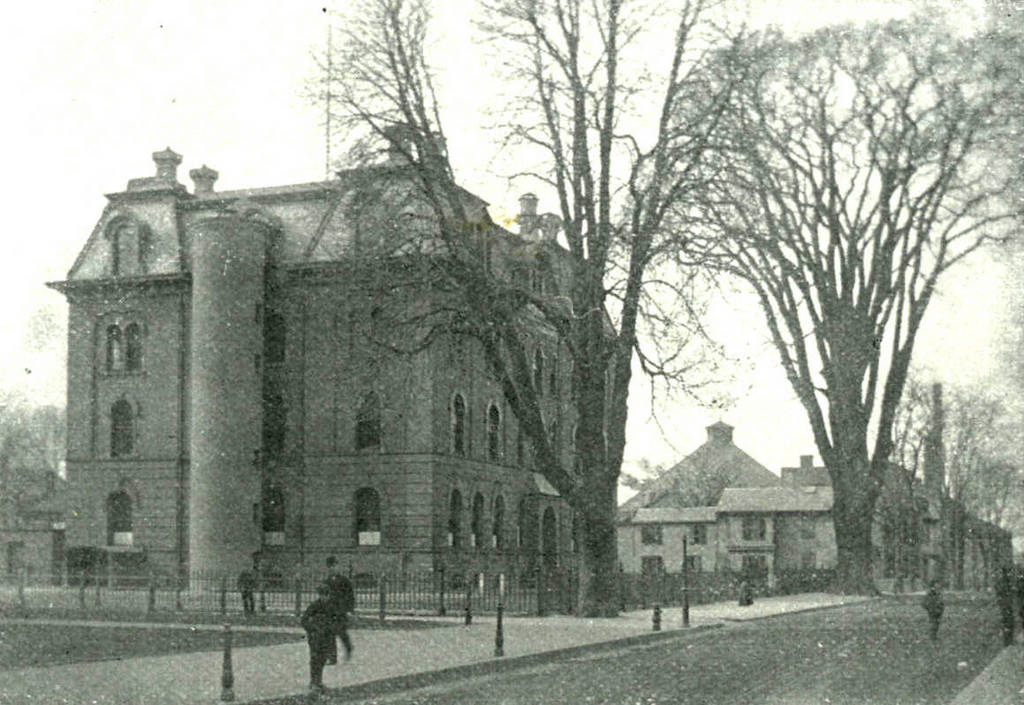
Memorial Hall, Harvard University

James, who went to Harvard, saw it as decidedly inferior at that time to the European Universities, and perhaps it was, though the rise of American power and influence over the ensuing century have allowed many of its students and faculty members of this general period to remain well-known names.

p. 246 While touring one of the Harvard Libraries, there is a mention of the card catalogue. A system still current 100 years on, in 1986, when I acquired my copy of this book, but now of course antiquated.

The depiction of Verena's simplicity but "preternatural candor" is good. It is difficult to write a character like that. In fact I think all of the characters in this are quite well-done and multi-dimensional. It's one of his best books for that.

p. 280 "...he wanted to see her alone, not in a supper-room crowded with millionaires." Don't we all, pal.

In the present social environment, it is clear which characters we should sympathize with (not Ransom!), but H.J. is a little more ambiguous. I think he is more sympathetic to the claims of women than was usual in that era--he must have had something of a curious and open mind, if the ideas were presented in a guise adequate to his perceptiveness--but I do not think he saw how realistically these were supposed to come off on a societally broad scale. 

p. 343 "I am so far from thinking, as you set forth the other night, that there is not enough woman in our general life, that it has long been pressed home to me that there is a great deal too much. The whole generation is womanized; the masculine tone is passing out of the world; it's a feminine, a nervous, a hysterical, chattering, canting age, an age of hollow phrases and false delicacy and exaggerated solicitudes and coddled sensibilities, which, if we don't look out, will usher in the reign of mediocrity, of the feeblest and flattest and the most pretentious that has ever been." Dull-witted men never learn. 

p. 348 "...the beer-saloons, with exposed shoulders and sides, which in New York do a good deal toward representing the picturesque, the 'bit' appreciated by painters, announced themselves in signs of large lettering to the sky." The days when German and Irish immigrants (my people, or 3/4 of them) teemed in New York.

Is Verena, the "daughter of New England", the most appealing H.J. heroine? I think so, though most modern readers must be disappointed by her submission to such a distastefully anti-feminist man. I am not being sarcastic either, even I find it difficult to take the smug superiority of Ransom, who is the prototype of the mansplaining, mediocre, worthless white guy we have all come to know and hate. Unfortunately in 1880 there is no one who can really put him in his place.


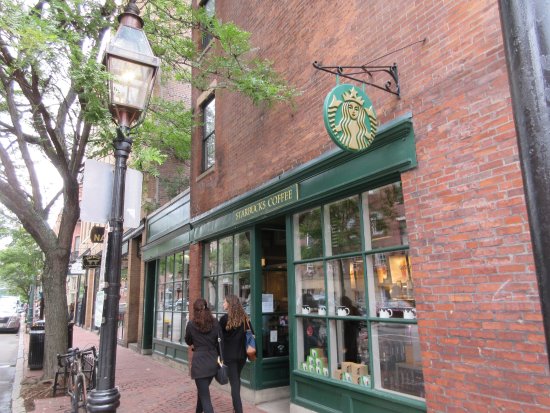
Starbucks on Charles Street, Boston, MA

I did write this on Twitter as well, and it didn't get a bug response, but Henry James didn't like beer, I don't think. Whenever a character is drinking it, usually in a German tavern or beer-garden, we can take it as a fair sign that he is down on his luck.

This is, incredibly, the end of Henry James on the IWE list. We do not see him again. One could almost think (if they hadn't left out The Ambassadors) that they just took the first three of his books alphabetically and said, we've reached our quota of Henry James, we'll stop now. This was a decent sample--The American and this book, as noted above, are two of my favorites of his, though I would have chosen something else in place of The Awkward Age, which I made a fairly strenuous effort to get into but just could not. The choices do feel rather random. While the final three extremely difficult novels, along with Portrait of a Lady and maybe Turn of the Screw (?) seem to be the most highly regarded of his books now, what were the most celebrated ones in 1960? Portrait still, and perhaps Daisy Miller, neither of which were chosen for this list. I don't know. But it is nonetheless farewell to Henry James, unless we have the good fortune to encounter him sometime in our Challenge.   

The Challenge

1. Pride and Prejudice (movie-2005).....................................................................................14,920

2. Min Jin Lee--Pachinko.........................................................................................................6,426

3. Margaret Mitchell--Gone With the Wind..............................................................................4,674

4. Raina Telgemeier--Drama....................................................................................................4,427

5. Gregory Maguire--Wicked....................................................................................................3,475

6. Narrative of the Life of Frederick Douglass........................................................................2,216

7. Philadelphia (movie-1993)..................................................................................................2,195

8. Nancy Isenberg--White Trash...............................................................................................1,849

9. Sharon Kay Penman--A King's Ransom..................................................................................450

10. Kira Jane Buxton--Hollow Kingdom.....................................................................................437

11. Chris Ware--Rusty Brown......................................................................................................303

12. Robyn Carr--The Wedding Party...........................................................................................282

13. Aiden Thomas--Cemetery Boys............................................................................................220

14. Arthur Conan Doyle--The Return of Sherlock Holmes.........................................................140

15. Gus Pelagatti--Wicked Wives.................................................................................................106

16. Tillie Walden--Are You Listening?..........................................................................................80

1st Round

A high qualifying threshold for this tournament, leaving out some books I have heard of. 

#16 Walden over #1 Pride and Prejudice

#15 Pelagatti over #2 Lee

Pelagatti had an upset.

#3 Mitchell over #14 Conan Doyle

IWE authors generally get an immunity through the first two rounds, unless they come up against a book with an upset, which is the case here.

#4 Telgemeier over #13 Thomas

Cartoon/graphic novel over a Young Adult novel featuring a trans protaganist. 

#5 Maguire over #12 Carr

Carr is a romance novel. I need to figure out a way to minimize their qualifying for the tournament, since when they come up they always have a lot of reviews, much more than popular history or science books.


#6 Douglass over #11 Ware

Ware is another comic book. I hope these aren't going to start qualifying in large numbers (though the acclaimed Persepolis is a past winner of this tournament, and I did read it).

#10 Buxton over #7 Philadelphia

The 1984 Merchant Ivory adaptation of the Bostonians did come up as an entrant for this tournament, but with only 69 reviews, it was the 17th place finisher and didn't qualify. I am putting it on my to-watch list anyway, although I suspect I am not going to like it that much.

#8 Isenberg over #9 Penman

As you know I am generally down on genre books as far as this competition goes unless they are regarded as classics of a kind.

Quarterfinals

#3 Mitchell over #16 Walden

Walden is another graphic novel.

#15 Pelagatti over #4 Telgemeier

Pelagatti is a novel based on the seventeen murders of husbands by their wives in Philadelphia in 1938, which I had never heard of, though apparently it really happened.

#5 Maguire over #10 Buxton

The Maguire book is highly celebrated. Buxton's is science fiction set in a post-apocalyptic Seattle.

#6 Douglass over #8 Isenberg

The white trash book got some positive press, but I am not that hyped to read it. 

Semifinals

#3 Mitchell over #15 Pelagatti

#6 Douglass over #5 Maguire

Championship

#3 Mitchell over #6 Douglass

Both of these books have appeared in this tournament before, both are of course very famous--there is some dispute over whether Gone With the Wind is worthy of being considered a classic, but it is at the very least iconic and has been well-loved by a certain class of reader. I have only avoided reading myself to this point because of its enormous length. It does have another upset to use here--it would be hard to justify passing over Douglass otherwise--and I think it is time to have a go at it.


Tuesday, November 28, 2017

Oliver Wendell Holmes--The Autocrat of the Breakfast Table (1858)

While I liked it, I have to say this is an odd book to take up in 2017. I'm not sure that I will remember anything about it a week from now other than such things as have a direct resonance with me--in this instance the importance of breeding and the need in a young man to have a tireless ambition and drive. Much of the other incidental stuff was not terribly vivid to my mind. Writing in the 1960s, the IWE editor says of the book that it "is generally considered Holmes's masterpiece (which suggests the presence of other contenders. I have actually read his equally florid novel Elsie Venner, if that is one of the contenders the writer has in mind). The introduction goes on to say that "The humor, urbanity, iconoclasm and scholarship of the essays are almost unique for their times and are timeless, being as good reading today as then." As a indicator of how much times have changed, it is almost impossible for me to imagine anyone with credibility saying anything like this today. Once again one is reminded of the question I have often had occasion to ask here, where have all the old Yankee/WASPs gone, even in New England? There were still some around in my youth in the 80s, and in books and articles about the region even from that time the character is still highly prominent compared to now. Have those that are left gone way underground (or over-ground, as the case may be)?


The copy of the book that I bought (online) was a special boxed edition published in 1955 by the Heritage Press of Norwalk, Connecticut, with an introduction by Holmes' fellow super-Brahmin Van Wyck Brooks and nostalgia-inducing pen and ink illustrations by R. J. Holden. It is noted in the introduction that no less a figure than Henry James, Sr (father of the famous philosopher and novelist brothers) called Holmes "the most intellectually alive man I ever knew". Indeed, Holmes's mind was by all accounts the type which the higher sort of formal education once sought to cultivate, yet it is hard to imagine him being broadly admired in this way today, mainly because of his race/gender/caste/ethnicity combination, since his primary sins (social and intellectual snobbery, ethnic chauvinism) are not exactly absent among the classes correspondent to his today, though it seems to be a more intolerable trait when found in a person like Holmes. There is also the problem that however impressive his mind was to his contemporaries, it led him to hold a lot of social views that are not currently held to possess much intelligence, let alone any other value, which naturally throws the quality of the other facets of his mind under suspicion.


It is noted that the takedown of Holmes and the other old Yankee writers began at least as far back as Mencken and the rise of ethnic America, which I guess would include my people, a period now a century in the past.


After the Brooks introduction there are three prefaces written by Holmes himself for each of the three editions that came out in his lifetime, the original in 1858, the later ones in 1882 and 1891, at which latter dates Holmes was 82 years old. These prefaces are consistent in their emphases on technological and scientific progress, which were of course immense over the course of his career (1831-91, roughly, as well as social progress, which he hinted in 1891 of having expectations of great changes in that area in the 20th century, though he did not speculate on the specific forms they might take). He was progressive and elitist at the same time, his progressivism taking the form of believing in the possibility of uplifting the unenlightened peoples of the world to the Anglo-Saxon level, or some facsimile of it. I wrote "we'll see if he lists his views on the potential/proper role for women in the book proper." I don't recall anything worth noting on this matter coming on, but that is why I take notes, because I remember very little of what I read.


p. 1 "We are mere operatives, empirics, and egotists, until we learn to think in letters instead of figures." Of course I want to believe this. Whatever it is, something is missing from the data driven understanding of existence as concerns achieving some sense of wholeness as a human being
.
p. 4 On the virtue of mutual admiration societies of high achieving males: "Foolish people hate and dread and envy such an association of men of varied power and influence, because it is lofty, serene, impregnable, and, by the necessity of the case, exclusive." Do foolish people have a choice in the matter, so far as their essential foolishness can be effected?


I am already noting at this early stage that the book looks to be extremely quotable throughout. Then I wrote that the thinking people (illegible) who have (illegible) lost their taste for this sort of writing seem to think/live after a similar manner.
It's hard to get a cute girl picture to come up in a search for OWH Autocrat, etc, but this Boston duck boat driver will do.


I write my illegible notes in the book in pencil, in which I am hindered by the circumstance that my pencil sharpener does not evenly sharpen the pencils and makes them difficult to write with. I know that there are myriad easy ways to correct this situation, but nothing is really easy with me when it comes to trying to carry out some semblance of the life of the mind. I will never quite permanently solve my pencil problem, or my note taking problem, or my slow writing problem, or any other minor and irritating problem that besets me.

I forgot about when Holmes by way of establishing the mental climate out of which the book arose, introduced it as a world where most people listened to a hundred sermons a year.


Holmes likes a man of family. This hurts for me, since a lot of the more intelligent modern people seem to like that too, and the family that I came out of at least doesn't seem to excite anybody very much. He reverts to this theme several times in the course of the book, lamenting mésalliances in marriage between people whose backgrounds and breeding are not well matched. "No. my friends, I go (always, other things being equal) for the man who inherits family traditions and the cumulative humanities of at least four or five generations."


p. 43 "The woman who calc'lates is lost...Put not your trust in money, but put your money in trust." On matrimony. My poor wife trusted...So much so that she has said that if she were ever to remarry, it would only be for money.


p. 45 "Except in cases of necessity, which are rare, leave your friend to learn unpleasant truths from his enemies; they are ready enough to tell them."


p. 46 "Therefore conversation which is suggestive rather than argumentative, which lets out the most of each talker's results of thought, is commonly the pleasantest and the most profitable." Yes, but we must be convinced that our interlocutor is not an absolute dunce who is even capable of saying anything worth our listening to, which is rare in our time.


p. 54 "How many people live on the reputation of the reputation they might have made!" Not many anymore I wouldn't think. We've set ourselves with some dedication to snuffing out that kind of conceit.


p. 54 "When one of us who has been led by native vanity or senseless flattery to think himself or herself possessed of talent arrives at the full and final conclusion that he or she is really dull, it is one of the most tranquillizing and blessed convictions that can enter a mortal's mind." Yes and no. It may be liberating to an extent for the non-genius himself to realize his limitations, and it is certainly applauded by all the people who were annoyed by his ridiculous pretensions, but the people he has close relationships with who rely on him to some degree do not happily welcome the definitive proof that their fortunes are chained to a dullard with little prospect of improvement.


This is essentially the edition of the book I have, though instead of this teapot I have a red rectangle with a gold border and the initials O.W.H. imprinted on the field in gold letters.


p.58 There was a reference to news from India which was unclear to me, but a little research indicates that he must be referring to the Sepoy Rebellion of 1857. I am so conditioned to assume that insightful and adroit minds even in the past must have at some level been suspicious of the virtues of European colonialism (and certainly some were), that I thought that perhaps Holmes's references to unidentified women and children being outraged and babies being killed were oblique statements against British conduct, and that his referring to the Indians as the inferior race was ironic. But no, he was taking the pro-English position all the way.


Holmes ascribes powers to genuine (high) poetry and its relations/interactions with human souls that may contain some truth, but are largely foreign to the way almost everyone intelligent experiences life now.


He also makes an interesting mechanical comparison of the making of a poem to that of a fine violin, that time is necessary to dry out and fit together the many parts of which it is composed to produce the grand effect.


p. 146 I like the account of his morning rowing around Boston.


Holmes's own poems are interspersed throughout the book. They are for the most part not very good, difficult to read and scant on impressions and images. There are two poems that are moderately famous, or used to be, "The Chambered Nautilus", and "The Wonderful One-Hoss Shay", the latter a comic poem, that are markedly better than the rest.


p. 171 Holmes on people who smile stupidly for no good reason in social interactions: "...it is evident that the consciousness of some imbecility or other is at the bottom of this extraordinary expression. I don't think, however, that these persons are commonly fools. I have known a number, and all of them were intelligent. I think nothing conveys the idea of underbreeding more than this self-betraying smile." Underbreeding seems to me a useful concept that is not discussed nearly enough in our time.


He muses on how "there is no looking glass for the voice", such that people have no real sense of the sound of their own voices, and how pleasant it would be to be able to inhabit another form and be able to observe oneself speaking and moving. (Of course the technology to do this had not yet been developed in the 1850s).


There is a long and pleasant section about the trees of New England which is perhaps of greater interest if one happens to live here. Holmes notes many particular favorites and claims to "have as many tree-wives as Brigham Young has human ones." The loss of our elm trees was such a blow to New England's historical character. Holmes mentions them extensively, as does almost everyone who writes about the region prior to World War II.


Holmes sees the English and American varieties of elms as characteristic of the creative force of the respective countries. The English he describes as "compact, robust, holds its branches up, and carries its leaves for weeks longer than our own native tree", and the American as "tall, graceful, slender-sprayed, and drooping as if from languor." How this is related to the creative force of America especially I am hazy on.


pp. 261-2 "Qu'est-ce qu'il a fait? What has he done? That was Napoleon's test...Is a young man in the habit of writing verses? Then the presumption is that he is an inferior person. For...there are at least nine chances in ten that he writes poor verses." Common knowledge (sort of) now, but worth being reminded of and impressed on the young.


p. 279 "One's breeding shows itself nowhere more than in his religion."


If you have stuck out this post to this point, I thank you and consider you a true friend. I may not exactly be a tortured soul, but I do feel that I never quite made it as a fully accepted member of the educated classes, and I am lonely in my interests.


The Challenge
1. M. R. Carey--The Girl With All the Gifts.......................................................2,525
2. Haraki Murakami--1Q84................................................................................1,687
3. Tana French--The Secret Place.......................................................................1,663
4. Rachel Macy Stafford--Hands Free Mama.......................................................326
5. Jay Winik--1944: FDR & the Year That Changed History...............................301
6. Rachel Macy Stafford--Hands Free Life...........................................................222
7. D. H. Lawrence--Women In Love......................................................................147
8. John Whyte--Is This Normal? The Essential Guide to Middle Age & Beyond...35
9. Kathleen Ann Goonan--In War Times.................................................................28
10. Germany 1945: The Last Months of the War......................................................0


A small, but pretty strong field for our game, with seven 100+ scoring entrants and the top three seeds all north of 1,500!


1st Round


#7 Lawrence over #10 Germany


The Germany book appears to be a bilingual coffee table book of photographs that was published in Germany and has had no U.S. release. I read Women In Love, which does not appear on the IWE list and therefore qualifies for the Challenge, as the second book on my "A" list way back in December of 1994. It was not my favorite book at the time, though a few years later when I was about 28 I read The Rainbow, which preceded it and follows many of the same characters, and liked it very much, though I don't know if I would feel the same about that one if I read it now either.


#9 Goonan over #8 Whyte.


A close battle. The book about aging was not tempting enough to me to give it the edge here.


Final Eight


#9 Goonan over #1 Carey


Carey is a dreaded genre book. Also my library didn't have it.


#7 Lawrence over #2 Murakami


I was a little excited about the Murakami, which seems to have the status of a contemporary instant classic, but at 925 pages and with a tough matchup in its first game, it falls.


#6 Stafford over #3 French


French is a mega-genre writer, and her book is long. Plus Rachel Macy Stafford is a Generation X (b. 1972) supermom/superwife, Southern Christian variety, and what is not to like about that (if you're me)?


#4 Stafford over #5 Winik


While I acknowledge I have a crush on Rachel Macy Stafford, that is not the whole reason why she triumphs here over a major history. The 1,027 page length of the competitor's offering was what mainly killed it. Jay Winik has a demonstrated fondness for identifying years or even months that changed everything and writing books about them. Another title of his is April 1865: The Month That Saved America.


Final Four


#9 Goonan over #4 Stafford
#7 Lawrence over #6 Stafford


I was feeling guilty about passing over so much literature.


Championship


#9 Goonan over #7 Lawrence


Upset special. The Goonan is another science fiction book, which I have not have good experiences with so far (ed--apart from the Ray Bradbury book; I liked a lot of those stories), but I am willing to give it another try.