Showing posts with label Knausgaard. Show all posts

Friday, July 7, 2017

The July Update

Like everything else I do, it has to be rushed, and I can't really think or write quickly, but what must be must be.


A List: The Arabian Nights..........................................................781/823
B List: Swinburne, Atalanta and Calydon........................................xi/98
C List: Dava Sobel, The Glass Universe...................................vii/324(?)


Winding down the Arabian Nights. Just finished in the last few days the famous stories of Alaeddin and Ali Baba and the Forty Thieves, with which I was previously unfamiliar. They really are great stories despite being completely ridiculous in many ways. They both have a spiritedness and good humor that carry them to much greater heights than they have any right to go to.


Given that in this month I have only read 2 plays for the B list and subsequently spent 2 weeks producing the essays I make myself finish before I can move on to the next book I had to read more from the C list than I normally would. I got through the entire third volume of Knausgaard since the last update. I thought the first 100 pages of this one, which dealt entirely with his childhood up to about junior high school, were not very interesting, but it picked up and was about as good as the other ones in the end, though overall I guess I would rate it my least favorite so far. When it starts getting to the age when he and his friends are constantly kissing and groping and otherwise ingratiating themselves with girls (at one point he inserts a disclaimer that no one if they knew the spirit and emotions involved could regard some of the rougher and more aggressive behaviors he describes as sexual assaults, and of course I want to believe him, but they seem to be exactly the sorts of things people have in mind when they refer to something by the name of sexual assault) naturally it is extremely depressing for me to contemplate my own life, with its dearth of such action, all of which leads back to, well, everything. No time to get into it here. I have heard that the 4th volume is perhaps the best of the series, as it gets into his college and drinking young adult years. Giving that I still have to get through a number of shorter readings and their accompanying essays for the IWE list I will probably be getting to it sooner rather than later.


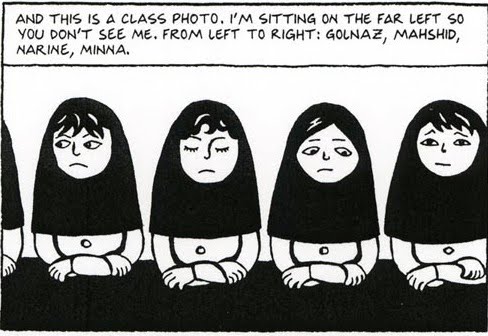
I also read the comic book/graphic novel (though it really is not like reading a novel) Persepolis by Marjane Satrapi which I think was quite good, at least it told its story in an unusually vivid manner. Not having read much of this type of literature I don't know how it compares with other notable efforts in that mode. But this seems like it must be better than average. This is the second work by a contemporary Iranian woman I have read in recent months. There are some similarities in terms of nationalistic pride (though Satrapi, perhaps because her education and ex-pat life were in France, comes off as more favorably inclined to the West than the other author, Solmaz Sharif, who had the misfortune to land in America), but these observations, which I can make because I have nothing else to do and no one to please in my literary endeavors, I am actually saving for a post in my other blog, which I have not abandoned but have just not been able to work on at all. But it is not dead, for any readers here who also look at that other site.


It was not my fate to be as handsome as Knausgaard, but I think several of my sons might be.

Monday, March 6, 2017

March Update

A short month + a week in Florida equals less progress on some of these books than might be expected.


"A" List--H. L. Mencken-- The American Language.....................273/697

"B" List--Jules Verne--Around the World in Eighty Days.............194/230


"C" List--Knausgaard, Vol.2..........................................................408/592


I am picking my way through the Mencken pretty slowly. It has its usefulness, I guess, although most of the various approaches to the subject of language which are described in the book are probably outdated, haphazard and imprecise by the standards of modern scholarship. There are a lot of illustrative anecdotes and tidbits about American life from colonial times up to the 1930s which serve the purpose of filling out further one's perception of what the country has been through time. For example, I had not known that the American custom of giving policemen and even railroad conductors military titles (captain, sergeant, etc) is not done in England and was considered strange in that country. Mencken's famed ability for lacerating the pretensions and ill-conceived ideas of the weaker-minded is not on full display here though one occasionally comes across a mildly amusing sentence:


"Nor is the title (Dr.) frequent among pedagogues, for the Ph.D is an uncommon degree in England, and it is seldom if ever given to persons trained in the congeries of quackeries which passes, in the American universities, under the name of 'education'."


If you are wondering where Phileas Fogg and Passepartout are in Around the World in Eighty Days, they are in Nebraska after the attack on the train by the band of Sioux warriors, being carried by sledge from Fort Kearney to Omaha, where they hope to catch a train that will get them back to New York in time to catch the steamer back to England that is the last leg of the trip. I assume Fogg is going to make it within the eighty days and win the bet, but as I am not familiar with any version of the story I am not absolutely certain.


For the most part I think the second Knausgaard book is better than the first, although most of the material in the first volume is more interesting to me, the second volume mainly being concerned with his domestic life as a thirty-something man with children living in an apartment in Stockholm, which does not come off as a particularly thrilling or vital city to live in, though I'm sure I would like it there. Perhaps I am more used to him now. Also I suspect he must have more control over his style and the effect he wants to have, since fairly banal recitations of changing diapers or the preparation of yuppie meals will often be a set up for some more interesting part. However I still haven't figured out whether the banal descriptions of everyday life are really necessary from the literary point of view. He does refer a lot to an idea which I sometimes touch on as well, that at least some people in future times will want to know what life in this time period was really like, and there will not be near enough books (there never are) that will convey that sense, which does have a power of its own when done well.


Picture Gallery


Monday, February 6, 2017

February Update

A List: H. L. Mencken--The American Language......................................62/697


B List: Don Marquis--The Lives and Times of Archy and Mehitabel.......396/477


C List: Karl Ove Knausgaard--My Struggle: Volume 2..............................55/592


I suspect that what is considered valuable in the Mencken book could be acceptably covered by the modern reader through pertinent excerpts. Many of the controversies and premises it addresses have been long superseded, or are long lost causes, such as the contention among the British educated classes and their American admirers that American speech was even in its highest forms a brutal degradation of the mother tongue, and the alarm in England in the 1930s when the book was written that the introduction of talking Hollywood movies would sow and spread the linguistic rot among the population there. I was also reminded of the obsession that raged among American educators throughout the first half of the last century with eradicating the word "ain't" and the abominable habits of dropping one's g's from the national vernacular. He has referred in recent pages to a study of local accents in New England that I am hoping he will go back to, as I might find that personally interesting. New England had at this time apparently the greatest diversity of local speech patterns in the United States. I am guessing this is not the case anymore. Even twenty years ago there were still a decent number of older people around with very distinct and unusual, archaic accents, as well as a surprising number of people who spoke (Canadian) French as their first language. But I guess those people must all have died off, since I don't remember encountering anyone fitting these descriptions for some years now.


Having fallen behind on my "C" List, I arranged for a string of very short titles to win my legendary Challenges, and having finished all of them in relatively short order, I decided to take up the second volume (and the longest, seemingly) of Knausgaard. So far Knausgaard has been at the same pre-school birthday party for the entire book. I do like him, and I do look forward to reading my little segment of him each day, but that is because he is like the literary-minded friend of my own generation, which I do not actually have, who is smart but not forbiddingly or inaccessibly so--in the birthday party scene he is a little befuddled by the kinds of parents who have the kinds of awesome 21st century careers that require them to go to Malaysia for conferences on a regular basis. This is about what I get from him.


Before Knausgaard, I read Jesus's Son, the Carveresque short story collection by Denis Johnson that is much praised. It was published in 1992, though most of the stories seem to be set in the 70s. The stories are set primarily in the great expanse between Chicago and Seattle, and feature characters who have a lot of problems with things like drugs, violence, employment, health, the inability to form stable or even functioning relationships with other people. You know, I was going to say something how the country has changed, that people like this used to be seen as having a kind of rawness or authenticity about them, whereas now they seem kind of pathetic. You would have to be a very strong writer to write as if you identified with them without coming off as more than a bit of a fool. I didn't think the author accomplished that here, though that is just my impression as someone who reads a fair amount of books. I would like to think that someone out there trusted my opinion, but I can't expect it. I could go more into this book if anyone was interested, but I need to get my post up for tonight.


Thursday, October 6, 2016

October Update

A List: Between books currently

B List: Between books currently

C List: Karl Ove Knausgaard--My Struggle: Book 1........196/441

For the A-List I have just finished a trio of Shakespeare plays--Measure For Measure, Cymbeline, and Henry V--that I had not managed to read before. I decided to tally up the overall number of Shakespeare plays I have read through via these lists, and to my surprise this recent batch just put me over the halfway point, at 20 out of 37. I thought I must have read more by this point. But it is legitimate, I have missed thus far most of the early comedies and histories, as well as the five or so plays that are generally obscure, Pericles, King John, Henry VIII and so on. Measure for Measure and Cymbeline were better than I was anticipating. Henry V was mildly disappointing in that I was expecting it might join the ranks of my all-time favorites, and parts of it certainly have that quality, but I was not positively enthralled by it all the way through on this first reading anyway as I thought it possible I might be. At this point of my life, expectation plays an outsize part in my response to literature and other works of art encountered for the first time after having only read about them, in some instances over the course of decades.

I am working on an essay for a book I have just finished for the B-list. I have made a rule that I cannot move on to the next book on this list until the posting for the previous book is published, otherwise I would never complete them, Hopefully that will be up in the next day or two.

The Knausgaard is also a deviation from my usual strict system. An old classmate had a copy mailed to me because he wanted me to read it, the first volume anyway, and the series has received effusive praise among the intelligentsia here so I decided to take it up. To this point it is largely a record of memories of ordinary life as experienced by a Norwegian teenager--and a heterosexual male at that--in the 1980s. Knausgaard is only about a year older than I am and I also went to high school in a cold northern place that was not unpleasantly a couple of decades behind the times in certain aspects. So his experiences are very similar to mine, with the exception that he was, if not a full-blown stud, a little less hopeless with the ladies during his high school years. There was at least some mild kissing and breast touching going on, and this with Scandinavian girls too, it must be borne in mind. I have to admit, the enthusiasm for this writer among many normally jaded and scornful critics and intellectuals, the kind of people who understand everything new and move with it and are bored by anything that is at all informed by the past we have left behind, is puzzling to me. I do not yet see the genius and brilliance that these other very exacting people are evidently seeing. I am not persuaded that it is not coming, because I am quite fascinated by the attraction it has for this self-consciously smart and superior class of readers, and I really want to know what they are finding in it. I don't dislike it, and I am curious to finish the first volume at least--maybe I will continue on to the other books down the line, one a year or something like that--but it does not strike me as being particularly funny (maybe this is because, as the argument was made against Bob Hope, Knausgaard is not Jewish, and Americans are conditioned now to understand humor as existing in the form in which it has been presented by Jewish comedians for the last 80 years). I also do not think the writing itself is that special. He constantly records very plain and seemingly unimportant exchanges of conversation verbatim, but then when a brash and confident boy comes into a room at school where the author is sitting with a girl he is in love with and the intruder proceeds to cast a spell over her and prompts her to (unconsciously?) open her legs when he takes a step near her (this was a good observation) he does not actually transcribe what this rival said that was so mesmerizing and effective, which I was dying to know. But perhaps this is consistent with the overall plan of the book...

No pictures this month. Too late in the evening.