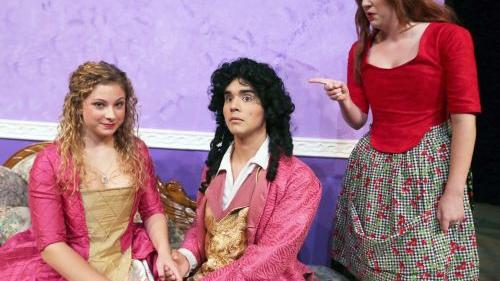
The last of the set of four consecutive plays at this part of the list, and a bookend with its fellow early 18th century English play (The Beaux' Stratagem) around the two Hauptmann dramas. The Beggar's Opera is one of the all time biggest hits in the long and illustrious history of the English stage, veritably the Cats of its century. The Modern Library collection of Twelve Famous Plays of the Restoration and Eighteenth Centuries in which I read it includes 20 pages of musical scores covering 68 "airs". I was not quite organized enough to seek out and have the songs to hand ready to play when they came up in the reading, which I assume can be done via the internet, but as literature alone it is quite funny, moreso than I remember from the time I read it many years ago, and much moreso than The Threepenny Opera, which of course is the Weimar era update of the story. The appeal of this was much clearer to me on this occasion. Evidently I was less distracted and I did read it at a leisurely, even languid pace (it is very short) and was somehow more open to the cleverness and wit that is in it.

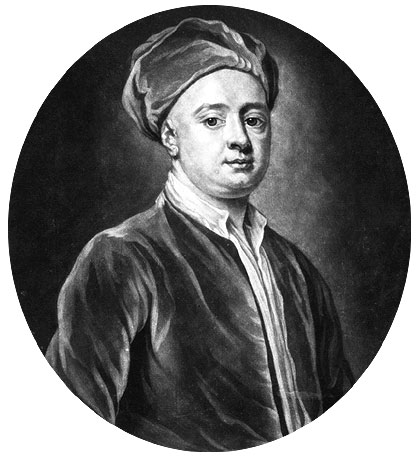
Gay is an unusual figure in English literature, which does not have a lot of similar one-hit wonders where the one hit is as big and central to the character of its era as his is. Since I first came across it I've always been more amused than I should be by the joke concerning Gay and his producer Mr. Rich, that the success of the play "made Gay rich and Rich gay." Gay only lived to enjoy this wealth for four years, dying at age 47. I cannot find the cause of his death in a quick internet search, though one article claims that he lost most of his money in bad South Sea investments which hastened the decline in his health. If I were at home I would check my copy of the Lives of the Poets, in which I think he has an entry, to see if Johnson says anything about it. Internet explanations of this play note that the depredations exhibited by the lower ranks of the society in it were intended to serve as a mirror for the more upscale audience of the day, which being fairly well-read in the literature of this time I am sure I took as assumed. Other explanations connect the various characters with famous, or once-famous, real life criminals or prominent British politicians of the period, which is not something I would have picked up on.
Some favorite quotations. A brief selection:
Act I, Scene IX: "A Fox may steal your Hens, Sir/A Whore your Health and Pence, Sir/Your Daughters rob your Chest, Sir/Your Wife may steal your Rest, Sir/A Thief your Goods and Plate.
But this is all but picking/With Rest, Pence, Chest and Chicken/It ever was decreed, Sir/If Lawyer's Hand is fee'd, Sir/He steals your whole Estate."
"The Lawyers are bitter enemies to those in our Way. They don't care that any Body should get a Clandestine Livelihood but themselves."
I, X: "And how do you propose to live, Child?" "Like other Women, Sir, upon the Industry of my Husband." "What, is the Wench turn'd fool? A Highwayman's Wife, like a Soldier's, hath as little of his Pay, as of his Company."
I, XIII MacHeath: "Is there any Power, any Force that could tear me from thee? You might sooner tear a Pension out of the Hands of a Courtier, a Fee from a Lawyer, a pretty Woman from a Looking-glass, or any Woman from Quadrille.--But to tear me from thee is impossible!"
III, III Filch: "One had need have the Constitution of a Horse to go through the Business.--Since the favourite Child-getter was disabled by a Mis-hap, I have pick'd up a little Money by helping the Ladies to Pregnancy against their being call'd down to Sentence.--But if a Man cannot get an honest Livelyhood any easier way, I am sure, 'tis what I can't undertake for another Session."
I, VI "Fill it up.--I take as large Draughts of Liquor, as I did of Love.--I hate a Flincher in either."
MacHeath is one of the sexiest characters in terms of raw animal appeal and vigor in the history of English literature. In the course of this brief play alone he is revealed to have impregnated 5 women, and lain with 2 others. One of his lovers, the hormonally overwhelmed Lucy Lockit, attempts to poison her identified rival Polly Peachum. Her reminiscence of their love is titillating for such as will never be thought of in such terms: "But his Kiss was so sweet, and so closely he prest/That I languish'd and pin'd till I granted the rest."
Only nine years until the 300th anniversary. If I were more organized and more in control of my time and finances I might think it worthwhile to make the trip to England to catch a commemorative performance--doubtless there will be one somewhere, I would think. But it is unlikely I will be set up well enough to do this even by 2028.
Challenge
1. Richard Powers--The Overstory...................................................455
2. Dear Zachary: A Letter to a Son About His Father (movie).......402
3. Kate Atkinson--Transcription......................................................305
4. Robert Heinlein--Podkayne of Mars............................................216
5. Mat Johnson--Loving Day............................................................158
6. Sally Rooney--Conversations With Friends.................................127
7. Terese Marie Mailhot--Heart Berries...........................................106
8. Lisa Miller--The Spiritual Child.....................................................80
9. Nana Kwame Adjei-Brenyah--Friday Black..................................57
10. Etaf Rum--A Woman is No Man...................................................28
11. Elizabeth McCracken--Bowlaway.................................................26
12. Walter Scott--Heart of Midlothian................................................19
13. Wilkie Collins--Hide and Seek.......................................................9
14. Judith Thurman--Cleopatra's Nose.................................................8
15. George Meredith--Celt & Saxon.....................................................6
16. Eric Puchner--Last Day on Earth....................................................5
This looks to be one of our better tournaments. Enough entries were produced that qualification was necessary, albeit at a fairly low level. Some big names mixing it up with modern novels.
Round of 16.
#16 Puchner over #1 Powers
I remember 15 or 20 years ago Richard Powers being promoted as a genius, or at least a budding genius, in the Pynchon-David Foster Wallace vein. His star seems to have faded a little in the intervening years, or else I just don't follow the literary reviews, or whatever has taken the place of them, as closely these days. His #1 seeded book is over 500 pages, and the Puchner book is just 226 and is not clearly bad, so applying my usual metrics he has to get the victory.
#15 Meredith over #2 Dear Zachary
#3 Atkinson over #14 Thurman
I don't know anything about either of these writers. Since they are similar in length I will award Atkinson the win as the higher seed.
#4 Heinlein over #13 Collins
Collins' Moonstone is on the IWE list and as one of that select group of authors generally would have priority when one of his other books made the contest. But Heinlein, the postwar sci-fi writer beloved by high IQ internet commentators (whose Moon is a Harsh Mistress is a former Challenge winner that I found myself unable to get through) has an upset to play.
#12 Scott over #5 Johnson
Johnson has no such talisman against IWE certification, and goes down to Sir Walter Scott.
#6 Rooney over #11 McCracken
Similar to the 3-14 contest a battle of women authors with books of similar length goes to the higher seed.
#7 Mailhot over #10 Rum
A battle of multicultural writers, apparently. Mailhot would appear to be an American Indian while Rum is identified as a Palestinian-American. At 142 thin pages, Mailhot is going to be tough to beat on length.
#9 Adjei-Brenyah over #8 Miller
Quite a contrast in names in this contest between the emergent and exciting and the stale and fading. Adjei-Brenyah's collection of stories clocks in at under 200 pages, shorter enough than its opponent to guarantee the win. The library catalogue lists it under the category of "Fiction--Racism" so I'm going to guess that the author is black.

Elite 8
#16 Puchner over #3 Atkinson
Puchner prevails again by virtue of his brevity.
#4 Heinlein over #15 Meredith
Heinlein pulls out another upset to get by Meredith, who has no less than three novels on the IWE list. I am rather terrified of his eventual approach on the list, since from what I can make out of his work, he is something like a mid-Victorian proto-Henry James kind of writer, only worse. We'll have plenty of occasion to deal with him without delving into his lesser works.
#12 Scott over #6 Rooney
Scott's immunity carries him through.
#7 Mailhot over #9 Adjei-Brenyah
Adjei-Brenyah's book was short enough to have a chance, but in these cases where what I know of the books and authors is about identical, the higher seed wins.
Final 4
#4 Heinlein over #16 Puchner
Heinlein, whose book is pretty short, is able to prevail here on his own.
#12 Scott over #7 Mailhot
The honored Scott, with no upsets to bar him, can cruise unopposed into the final.
Championship
#12 Scott over #4 Heinlein
Midlothian is about 566 pages long, and I was tempted to give Heinlein the victory in the final, but I decided to give it to Scott, whom I have never read, in a thrilling championship between two distinguished figures.