Showing posts with label Romantic tales. Show all posts

Saturday, February 6, 2021

Sir Walter Scott--The Bride of Lammermoor (1819)

One Sunday a few weeks back, one of those gray, cold, muddy, flurrying sorts of afternoons that are common in January, a group of us took a drive over to Vermont, stopping en route at an antique market near Keene that is a collection of what look like disused long dairy barns crammed full of stalls. The primary object of this stop was for my wife to hunt for various of her current obsessions, among them doorknobs, lamps and light fixtures, and blue willow china (she did find an old doorknob to her taste). I mostly looked through the books and postcards and old sports and college memorabilia, though as is usually the case I didn't buy anything. I did remark, as I went around the various stalls, five or six copies, all in different editions, several of them rather handsomely bound or parts of smart looking collectible sets, of Ivanhoe by today's author, Sir Walter Scott, a book that no one I have ever met, that I am aware of, has ever read through to the end, or at least has ever found the experience worth mentioning or making reference to; yet at one time it was clearly believed to be a book to push on people aspiring to be well read, especially boys in whom one wanted to cultivate that enthusiasm. I remember, due in part to copies of it being ubiquitous even in the environment in which I moved, trying to read it myself once as a teenager. But I didn't get very far in it at that time, as I am pretty sure whatever was going on in the plot was unintelligible, and the manner of writing was one in which I did not have as yet enough practice in reading to appreciate, nor did the early chapters of the book generate enough immediate interest in me to begin trying to cultivate such an appreciation. So like pretty much everyone else has done for the past hundred years, I put it aside and thought little of Scott's works, apart from the occasional references to them that I would come across in other 19th century writers, for more than three decades.
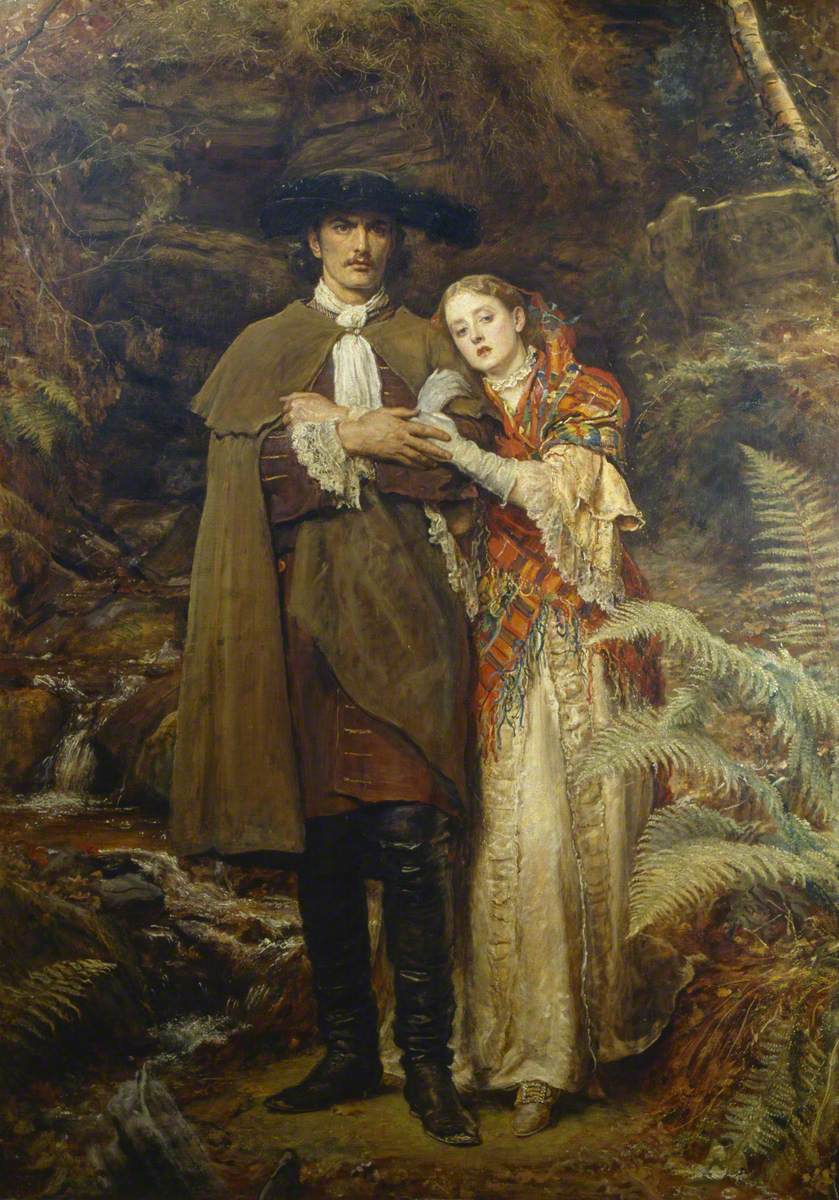
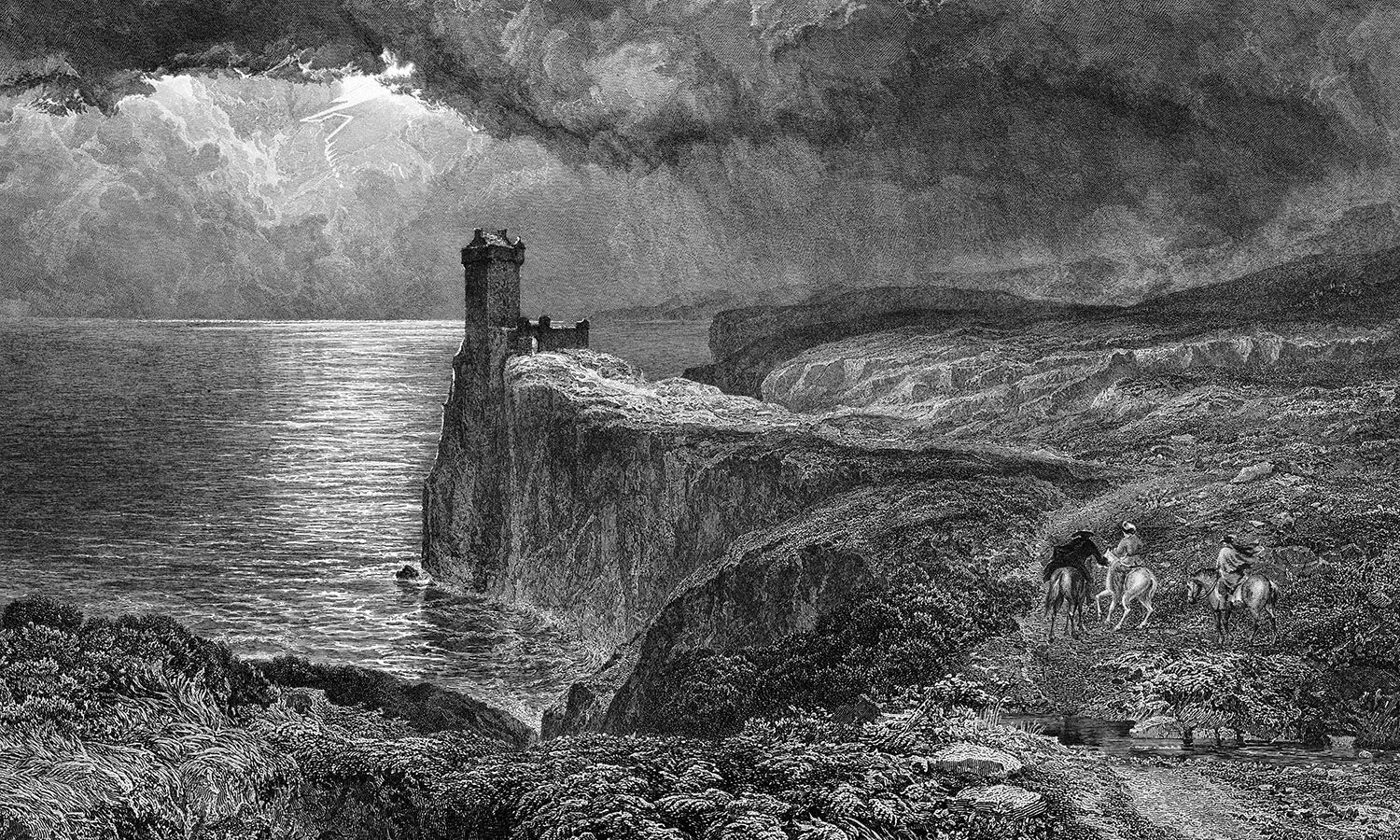
Last year, when I was fifty, one of my lists that I pretty slavishly follow--I do keep three of them in an attempt to disperse the totality of the slavishness at any given moment by allowing for some possibility of variety to creep into my routine--finally brought me face to face with a Scott book, The Heart of Midlothian. While this book was somewhat overlong, the discovery that Walter Scott was a real writer with real big league talent was a revelation to me in my middle age. The Bride of Lammermoor, a shorter, tighter, broodier, more fantastical novel, is even better. The Romantic gothic novel has been done to death, but to read these books is really to drink from the original source. The clouds enshrouding the castle tower, the ancient servant with his candle opening the enormous heavy door on a stormy night, the melancholy of the impoverished Master of Ravenswood gazing on the fox hunt from afar, everything about the mood, the details, the emotions evoked, is just right. Though the descriptions and dialogue are in some degree purposely affected and exaggerated, compared with Scott's many later imitators, they seem unaffected and natural-sounding; as can be said of Flannery O'Connor, who may not seem at first blush to be an obvious comparison, our experience of life would be elevated greatly if people really did always act and talk, and the world always appeared to us, as they do in these books.

The Bride of Lammermoor is somewhat celebrated for its plot construction, which is good without for the most part ever forcing itself on your attention. It builds up leisurely, with the aforementioned hunts, dinners, visits, a few capers, some brooding, some backstory, and then when we get to the last 50-75 pages everything is set up and we are off to the perhaps inevitable but still dramatic and heavy conclusion. 

From the preface: "When the finished (i.e printed) novel was first put into Scott's hands, he assured (John Ballantyne) that he did not remember one incident, character, or conversation in it." It took Scott around eight months to write the book, from September 1818 until May 1819, during most of which period he was evidently wracked by violent pain. In other words, he was not your stereotypical tortured soul type of writer agonizing over every sentence. One wonders how that model of an artist ever gained such influence with us. Most of these really famous guys were prolific, highly focused professional writing and art-making machines. Yes occasionally an interesting and witty debauched poet will make fun of them, and make a few fair points as well, but in the end the prolific producers of copy seem to hold up generation after generation, and are certainly more widely read by every demographic outside of the Cool/Artsy and Wannabe Cool/Artsy 18-35 cohorts. Scott's output it seems to me was especially worthy of note. He started relatively slowly, writing poems at first, publishing his first volume at age 25, and adding eight more before the first of his novels appeared when he was 43. Between this date and the end of his life a mere eighteen years later, 31 more would follow, most of them full length novels (min. 300 pages) or even longer, around half of which are titles immediately recognizable today to anyone with a passing familiarity with 19th century English language literature. This was in addition to 8 more books of poems and 28 volumes worth of miscellaneous prose works, including a nine volume Life of Napoleon and a Lives of the Novelists, which used to be included in the Everyman's Library, from which series I got my reading copy of The Bride of Lammermoor as well. 

The story, which is set in the late 1600s, is introduced by way of some old manuscripts and bits of doggerel poetry from that former age, I assume fictional, though I am not absolutely certain, which Scott claims to have come across in his researches. I had written some lines down which I found humorous at the time, but they don't have the same impact out of context. He followed this up by telling a story of a painter who had been a youthful friend who failed to achieve success and died the premature lonely impoverished death of such characters. "So ended Dick Tinto! a lamentable proof of the great truth, that in the fine arts mediocrity is not permitted, and that he who cannot ascend to the very top of the ladder, will do well not to put his foot upon it at all." Tinto has been introduced into this story because he once executed a sketch of the fatal climactic scene which inspired the novel, though the painting was never completed. This is all done much more amusingly and skillfully in the book than I am conveying here, Scott does not actually get to Ravenswood Castle and Edgar and Lucy Ashton and all of their friends and antagonists themselves until page 27, but I at least did not mind the delay, I rather enjoyed the roundabout means of getting there, which we did do in time. 

p. 42 The ferocious Lady Ashton, married to a wealthy lawyer and government official, but not a man of feudal warrior lineage such as Lord Ravenswood, contemplating the family's position and her daughter's meeker spirit: "Before ancient authorities, men bend, from customary and hereditary deference; in our presence, they will stand erect, unless they are compelled to prostrate themselves. A daughter fit for sheep-fold or cloister, is ill-qualified to exact respect where it is yielded with reluctance."         

There is a jolly ale story contained in a footnote that, in the mood one enters into while reading the book, seemed full of a conviviality and bonhomie of the sort that is so elusive in actual life, and which indeed does not exactly carry over in the same spirit to my copying it here. But I am going to do it anyway.

"It is a current story in Teviotdale, that in the house of an ancient family of distinction, much addicted to the Presbyterian cause, a Bible was always put into the sleeping apartment of the guests, along with a bottle of strong ale. On some occasion there was a meeting of clergymen in the vicinity of the castle, all of whom were invited to dinner by the worthy Baronet, and several abode all night. According to the fashion of the times, seven of the reverend guests were allotted to one large barrack-room, which was used on such occasions of extended hospitality. The butler took care that the divines were presented, according to custom, each with a Bible and a bottle of ale. But after a little consultation among themselves, they are said to have recalled the domestic as he was leaving the apartment. 'My friend,' said one of the venerable guests, 'you must know, when we meet together as brethren, the youngest minister reads aloud a portion of Scripture to the rest;--only one Bible, therefore, is necessary; take away the other six, and in their place bring six more bottles of ale.'  

This synod would have suited the 'hermit sage' of Johnson, who answered a pupil who enquired for the real road to happiness, with the celebrated line, 'Come, my lad, and drink some beer!'"

Prophecies operate as truths in books like this. I can never disbelieve in them though they have no part in real life.

p. 278 "He flourished much on generosity and forgiveness of mutual injuries, and hinted at the mutability of human affairs, always favourite topics with the weaker party in politics."

I should see what the overwhelmingly great white male hopes at the IWE have to say about it. "When Scott wrote this novel he was still using the pseudonym Waverley; and his creation 'Waverley' had become the world's most popular novelist. The Bride of Lammermoor is typical of the Waverley novels, neither better nor worse than the others. Its more lasting fame is due to the Donizetti opera Lucia di Lammermoor, based on it." Not the most ringing endorsement for a book on their own handpicked reading list, but that is one of the charms of the list. It is not always clear why any particular book has made it rather than some other one. Scott was evidently still considered important enough in 1960 that they felt they had to put three of his books on the list, the other two being the aforementioned Ivanhoe, and Kenilworth, which I think also reaches back to the middle ages and the era of knights, and was thought for that reason to be of interest to boys. This one (Lammermoor) is good though. It has real feeling, one feels a connection to the material, and to the author as a kind of clever and entertaining host at a dinner one attends, and wonders why he does not frequent such company more regularly. 

The Bourgeois Surrender Challenge

The notes on this generated an enormous field of which the qualifying group is pretty strong. Contenders with 600+ points have to go on the road in the first round.

1. Jamie Glowacki--Oh, Crap! Potty Training............................................................6,715

2. Pay It Forward (movie--2000)................................................................................3,203

3. Ann Patchett--Bel Canto..........................................................................................3,113

4. Lynn Toler--Dear Sonali: Letters to the Daughter I Never Had.............................1,603

5. J. Edgar (movie--2011)............................................................................................1,559

6. Thomas Hardy--The Mayor of Casterbridge..............................................................876

7. The Duellists (movie--1977).......................................................................................659

8. The Office, Season 3, Episode 1 (TV).........................................................................620

9. Talia Hibbert--A Girl Like Her....................................................................................609

10. Lyndsey Faye--The Gods of Gotham........................................................................609

11. Edward Fitzgerald--The Rubaiyait of Omar Khayyim..............................................499

12. Gabriel Garcia Marquez--Of Love and Other Demons.............................................415

13. My Life is Murder, Season 1 (TV).............................................................................325

14. John Webster--The Duchess of Malfi........................................................................240

15. Nella Larsen--Quicksand..........................................................................................218

16. Arthur Conan Doyle--The Return of Sherlock Holmes.............................................190

1st Round

Mostly clearing out the movies.

#16 Conan Doyle over #1 Glowacki

Sorry Jamie Glowacki.

#15 Larsen over #2 Pay It Forward

#14 Webster over #3 Patchett

Bel Canto is a former winner of this competition that I thought was only so-so at best. Such books are eligible to enter the tournament and try to win again, though none have. Webster's classic Elizabethan era revenge tragedy probably just missed being on the actual IWE list itself, which would have made it ineligible. But it did not make it.

#4 Toler over #13 My Life is Murder

#12 Garcia Marquez over #12 J. Edgar

#6 Hardy over #11 Fitzgerald

This matchup between a pair of late Victorian heavyweights was the marquee attraction of the 1st round. I long thought that The Mayor of Casterbridge was an IWE selection as well and that that listed included 4 Hardy novels, but my memory deceived me, there are only three on it, and this one was the phantom.

#10 Fayes over #7 The Duellists

#9 Hibbert over #8 The Office

Elite 8

#16 Conan Doyle over #4 Toler

#6 Hardy over #15 Larsen

Quicksand is a 1928 novel by a black, or half-black (her mother was Danish) American woman who was part of the Harlem Renaissance. Naturally, not having much contact, even online, with the most attuned literary people, I had never heard of it, but it is available in a Penguin Classics edition, and it's probably decent. I went to Barnes and Noble last Sunday when it was too cold to do anything outside and while they did not have this book, they did have a copy of Nella Larsen's other novel, Passing, which I leafed through, and while you cannot tell whether a novel especially is any good or not by that means, the writing was not obviously weak in any way. That said, given that it is so new to me and I have not come across any reference to it in any other writing at all, let alone in such a manner as to pique my interest in reading it, it would not be quite consistent with my game for it to beat Thomas Hardy in the second round. So it was a hard fought game with some questionable refereeing and perhaps some bitter feelings as the combatants and their fan bases departed the arena. Nella Larsen has entered my consciousness at least, however.

#14 Webster over #9 Hibbert

#12 Garcia Marquez over #10 Faye

Final Four

#6 Hardy over #16 Conan Doyle

A pretty even matchup for these almost exact contemporaries (Hardy was about 20 years older but their careers overlapped). The books are even about the same length. Hardy gets the nod on seeding.

#14 Webster over #12 Garcia Marquez

Even though he tends to be read and gushed over by a lot of people I find annoying, I acknowledge that Garcia Marquez is a great modern writer and I enjoy all of his books. He would gotten the nod over Webster in a straight up game here, especially as I have not read this particular book. But Webster has an upset to knock out the only interloper from a non-British conference (Conan Doyle was from Edinburgh, and had Irish Catholic parents).

Championship

#14 Webster over #6 Hardy

Hardy had a brutal road to the final, Webster had upsets to spring, I need some shorter things on that c-list, so the stars were aligned for The Duchess of Malfi to prevail here.  


Friday, September 20, 2019

Alessandro Manzoni--The Betrothed (1825-27)


So it took me two months, because of all the projects and distractions of the summer, but I finally finished The Betrothed, the traditional great novel of 19th-century Italy, though I am sure the more advanced modern readers have found numerous greater ones. It is considered to be a landmark in the development of Italian literary prose, a quality which obviously was lost on me, but aside from this it has many other characteristics associated with national or other widely loved types of books. It is set 200 years prior (around 1630) to the time when it was written, during the time of the Thirty Years' War, so that not merely the protagonists but the entire society are put through an exhausting series of ordeals, including famine, war and the plague. Some parts of it are much better than others, and while the book is interlarded throughout with sentimental descriptions of nature and the rituals of village life this is often done, admirably I think, as background amongst the more realistic conflicts and unpleasantnesses which give the story its thrust. As it approached its end, especially during the description of the overgrown orchard after the years neglect due to the war, plague, etc, I got that wistful, mildly sad feeling at the thought of passing away once and for all out of another grand, noble, old kind of story, not that there aren't more to look forward to, of course. If I could have gotten away this fall I might seriously have considered taking a trip to Milan, Lake Como and that area for a week or so, which seems particularly appealing to me at this time.    

I took my first note for this pretty early on, regarding the episode at pages 59-61 where Don Cristoforo recounts the fight to the death he had had as a young man with an imperious nobleman over who would walk closest to the wall, which was the prerogative of the higher ranking individual. I remarked that it was a powerful scene.

p. 95 "...(he will) flee like the devil from holy water." An oft-repeated phrase, but for good reason, as it is funny.

p. 95 again "It is said that trouble sharpens the wit; and Renzo, who...had never had occasion to sharpen his in any great degree, planned a design that would have done honour to a lawyer."

p. 150 "Dolls dressed like nuns were the first playthings put into her hands" The strange, sad case of the Signora who was designated from birth by her father to go into the nunnery, very much against her will, though she could never bring herself to say as much publicly, and who became in her bitterness a rather cruel and soul-dead person. She was the most alluring female character in the book, however.  

pp. 202-5 The emoting of the mob with regard to solving the bread shortage is eerily akin to a certain, not insubstantial, portion of our current electorate:

"And besides, not being a man superior to his age, he entertained the common opinion, or prejudice, that the scarcity of bread was produced by monopolists and bakers; and readily did he esteem every method justifiable of rescuing from their grasp the food, which they, according to this opinion, so cruelly denied to the hunger of a whole people...But when the price of food reaches a certain point, there always arises (at least, hitherto it has always arisen; and if it is so still, after all that has been written by so many learned men, what must it have been in those days!)--there always arises an opinion among the many that it is not the effect of scarcity...The multitude attributed such an effect to the scarcity and feebleness of the remedies, and loudly solicited some more spirited and decisive measures."

p. 245 "...the reader must know that, amongst the lower orders in Milan, and still more in the country, the term poet did not signify, as among all educated people, a sacred genius..."

pp. 323-4 "...if it does not come to this, and quickly too, I foresee a mountain of disorders--an Iliad of woes."


p. 434 My favorite character, the cowardly village priest Don Abbondio, trying to explain his behavior to the unflappable, saintlike Cardinal:

"Perhaps I have not sufficiently myself...I was prohibited, under pain of death, to perform this marriage."

"And does this appear to you a sufficient reason for omitting a positive duty?"

p. 435 "Don Abbondio hung his head. His mind during these arguments was like a chicken in the talons of a hawk, which holds its prey elevated to an unknown region, to an atmosphere it has never before breathed."

The whole discourse between the Cardinal and Don Abbondio is very good, I have rarely seen the tenets of Christianity laid out so clearly and forcefully.

p. 540 "...for anger burns to execute its revenge, and...would rather attribute evils to human wickedness, upon which it might vent its tormenting energies, than acknowledge them from a source which leaves no other remedy than resignation." 

This is just like all the current politics, the global warming argument. There is so clearly an element of the latter that slavers to place the blame squarely on their personal enemies and inflict lifestyle punishments on them. But of course no one will own that this is the case.  

p. 641 "It was still early when he arrived there; for he was no less willing and in a hurry to bring matters to an end, than the reader probably is." This was near the end, though there were still 27 pages before the story could finally wind down, though in this particular book I liked the long denouement.

p. 647 Poor Don Ferrante's dilettantism, and absurd cogitations about the nature of the plague. This aspect of life is sad, a minor sadness compared to famines, wars, and plagues, but very sad in its way.

pp. 661-2 "I have said that he was humble, but not that he was a prodigy of humility."

p. 662 "To have seen the different projects that passed through that mind,--the fancies--the debates...it was as if two academies of the last century had there met together." Manzoni carried through with some humor all the way to the final pages of the book, at which point most authors--Dickens comes to mind--falter in that regard.
If I took that trip to Milan I could see this painting in one of the Pinotecas there.

p. 664 The gossip of the villagers in the new town where Renzo and Lucia settle at the end about how Lucia is not so great looking as they were expecting based on Renzo's long years of pining after her when he first came there alone was an unexpected and twist on the romantic tradition: "Is this she?After such a time, after so much talk, one expected something better! What is she, after all? A peasant, like hundreds more..." But on the other hand, this doesn't seem quite fair, the powerful Don Rodrigo after all wanted her badly enough to go to the trouble of preventing her marriage, having her kidnapped, etc, so she clearly must have had some greater than ordinary appeal.    

The role of the church in this book is quite profound. It is a flawed institution populated by regular people with the expected human qualities, but even with all its faults it holds this entire world together and provides all of the nobler characters in the story with a basis from which to become their best selves at the very least, and in some cases to perform near-heroic work. One comes away with a respect for it.

There haven't been a lot of editions of this book published in English. The only older hardcover one I could find in any quantity was from the Harvard Classics set. This copy is from the 20s(?) maybe, and has a kind of flimsy cover that is good for carrying around and reading. Here it is, in fact.


Like many older copies of foreign classics, this edition doesn't indicate anywhere who the translator is, which is too bad, because I think whoever it was did a good job, the book reads very smoothly and pleasantly in English.


This is the view from the front porch that I talk about so much where I sit and read during the few warm months of the year. I've got about a month left before I'll have to bring it inside for the winter. This day here was somewhat overcast. 


And here it is, the big finish, with my trusty bookmark. 


The Bourgeois Surrender Challenge

As so often happens, only fifteen of the thirty aspirants to the tournament could manage to score a review, so we have a 30-team field for this one.

1. Solomon Northrup--Thirty Years a Slave.........................................................6.694
2. Shayne Parkinson--Sentence of Marriage................................................……2,423
3. Chimamanda Ngozi Adichie--Half of a Yellow Sun...………………………..1,068
4. Anne Bronte--The Tenant of Wildfell Hall...…………………………………...151
5. Karl Marlantes--Deep River...…………………………………………………...61
6. Arthur Conan Doyle--The Return of Sherlock Holmes...………………………..59
7. Kevin Lucia--Devourer of Souls...………………………………………………42
8. Garet Garrett--The Driver...…….………………………………………………..16
9. Charles Leland--Gypsy Sorcery and Story Telling...…………………………….14
10. Laurens Van der Post--Jung and the Story of Our Time...………………………9
11. The Cambridge Illustrated History of Medicine...……………………………….6
12. Eric Hill--Time for Bed, Spot...…………………………………………………..1
13. The Poems of Heine (Bowring, ed)………………………………………………1
14. Bayard Taylor--Joseph and His Friend: A Story of Pennsylvania...……………..1
15. Agnes Strickland--Queens of England, vol. 2...………………………………….1
16. Promissory Notes on the Treasury of Merits (ed. Swanson)………………………..0
17. T. W. J. Connolly--History of the Royal Sappers and Miners, vol 1...…………...0
18. Jane Campbell Hutchinson--Albrecht Durer...…………………………………...0
19. Work in the Colonies (Church of England 1865)…………………………………0
20. Louis Baudin--A Socialist Empire: The Incas of Peru...…………………………0
21. Meredith Gaston--Your Bed Loves You...………………………………………...0
22. Malatesta & Monte..?--A Journey Through the Hills of Rimini...………………..0
23. Charles Killinger--Culture and Customs of Italy...……………………………….0
24. D. Medina Lasansky--Hidden Mysteries: The Alternative Guide to Florence...….0
25. A. F. Holmes--Dictionary of Neutral Language...………………………………..0
26. Deslandes--Treatise on Diseases Produced by Onanism, et al...…………………0
27. The Works of William Robertson, Vol. VII...………………………………………0
28. Greek Romances of Heliodorus, Longus and Achilles Tatius……………………..0
29. Leonardo dopo Milano--La Madonna dei Fusi……………………………………0
30. Rome Italy Renaissance: Essays in Art History (ed. Lavin)………………………0

1st Round

#3 Adichie over #30 Rome Italy Renaissance
#29 Milano over #4 Bronte

Upset time

#5 Marlantes over #28 Greek Romances
#6 Doyle over #27 Robertson
#7 Lucia over #26 Deslandes
#8 Garrett over #25 Holmes
#24 Lasansky over #9 Leland
#10 Van der Post over #23 Killinger

This was a close call though.

#11 Cambridge over #22 Malatesta
#12 Hill over #21 Gaston

Time For Bed, Spot has a stronger library presence.

#20 Baudin over #13 Heine

This isn't much Heine available at all, and this edition nowhere.

#14 Taylor over #19 Work

This Taylor book is referred to in one place on the internet as "America's first gay novel", which would seem to make it more noteworthy than it is.

#15 Strickland over #18 Hutchinson
#17 Connolly over #16 Promissory Notes

Not much to choose from here

Round of 16

#29 Milano over #1 Northrup

The upset factor is strong here.

#2 Parkinson over #24 Lasansky
#3 Adichie over #20 Baudin

This one was really close too.

#5 Marlantes over #17 Connolly
#6 Doyle over #15 Strickland
#7 Lucia over #14 Taylor

One library carries the Lucia book.

#12 Hill over #8 Garrett
#10 Van der Post over #11 Cambridge

Considerably shorter. I need to get some short books on the list.

Elite 8

#2 Parkinson over #29 Milano
#12 Hill over #3 Adichie

After scooting through 2 rounds on his library prowess, Hill also has an upset to play

#10 Van der Post over #5 Marlantes

Van der Post clocks in at over 400 fewer pages.

#6 Doyle over #7 Lucia

Final Four

#12 Hill over #2 Parkinson

Libraries do not carry the Parkinson book. Any of them.

#10 Van der Post over #6 Doyle

This was a very tough game. I went back and forth on this one. I decided I needed a (slightly) more modern, non-fiction title in the queue.

Championship

#10 Van der Post over #12 Hill


Thursday, August 17, 2017

Aucassin and Nicolette (c.1200)


One of the most popular and presumably accessible, as well as one of the greatest of the medieval Provencal romances, this is sometimes referred to as the French "Romeo and Juliet". It is also one of the shortest works on the entire list, so I wonder if I should not try reading it in (old) French sometime. Of course it is on the internet. Here are the first four lines:


"Qui vauroit bons vers oir
del deport du viel antif
de deus biax enfans petis,
Nicholete et Aucassins..."


I can probably make out enough of it to follow the story. Whether I would get it enough to get a much better sense of it as a work of literature, I don't know.


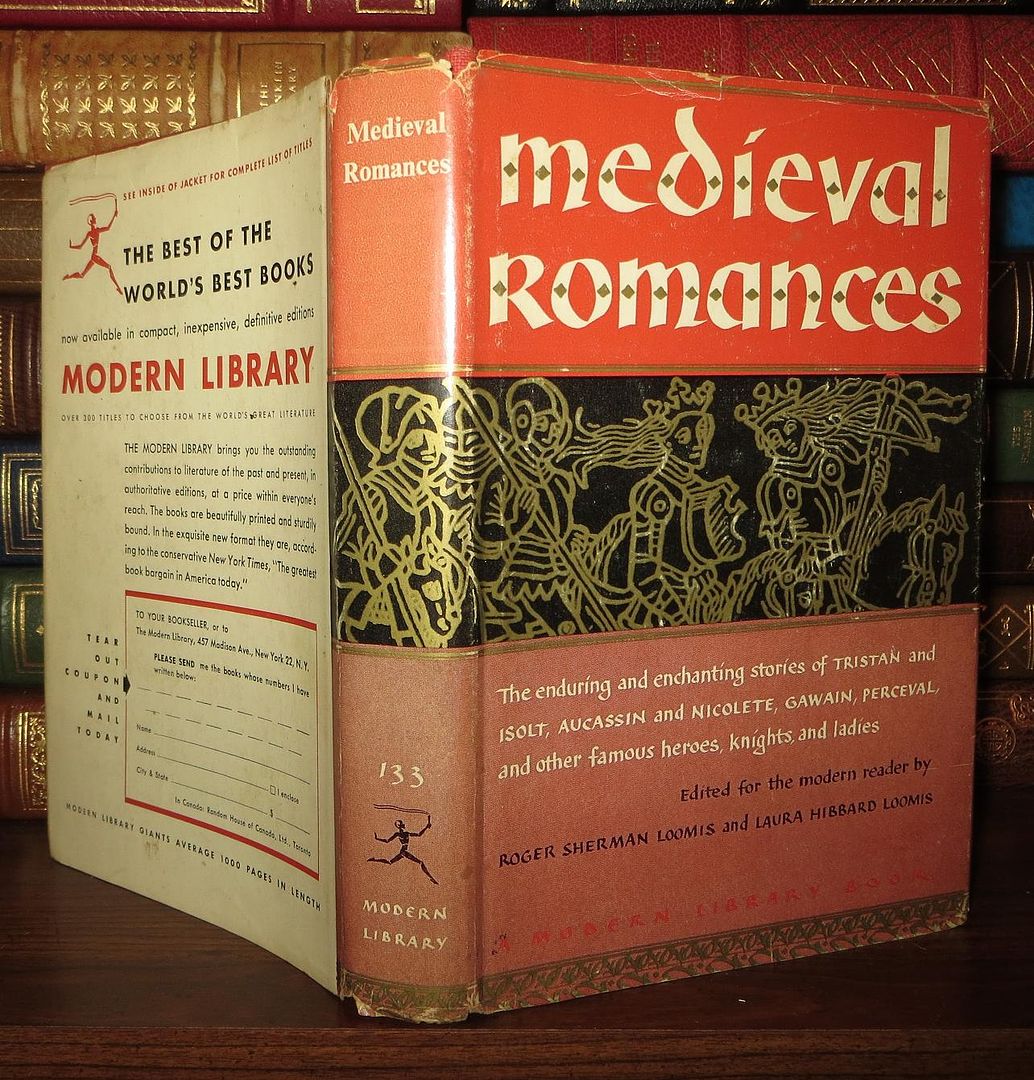
I read the relatively celebrated Andrew Lang translation in the 1957 Modern Library edition of Medieval Romances, which surprisingly does not include anything else that made the IWE list, though it does contain classics like Tristan and Iseult and Sir Gawain and the Green Night. Medieval Romances are evidently underrepresented on the program. I like romances and the ideals of the Middle Ages and old French literature enough that I enjoyed the tale and the nicely translated poetic parts well enough, though I was still more distracted than I would like to be and could not achieve the level of absorption in the book that I like to. Aucassin and Nicolette are, to my perception, a strange pair of lovers. Aucassin comes off as rather whiny and petulant, as opposed to say, angry and fierce, during the parts where his love is denied, refusing even to defend his father's castle from attack, though at other times he demonstrates bravery and martial skill more appropriate to his station. Nicolette, a Saracen who was captured as an infant and sold to a viscount is plucky and keeps her eye on the prize of marrying Aucassin, though I did not get a sense of her having a great romantic passion in the Shakepearean or Villonian sense. Apparently some experts have considered that Aucassin and Nicolette might be a parody of the romantic genre, and there are some decidedly odd episodes in it such as the king being in childbed and the battle fought with hunks of cheese for weapons.


I wish that perhaps I had read this when I was younger and more passionate and more innocent of the world of literature. It probably would have made a stronger impression on me.


I noted on the threadbare Wikipedia page for this book that Walter Pater in the Renaissance and Mortimer Adler somewhere in his writings took up this story. Since I have both of these at home I meant to take them up today and see what they had to say, but of course it slipped my mind because there were multiple things going on at my house today, and now I am not there. I am so scatterbrained nowadays it is comical. I need to try to finish this tonight or who knows how long it will take me.


It is now the next day, as I did not finish the report last night. And I forgot to look at the books again! My excuse is that I am I in the 2-week dog days period where my wife, who is a teacher, has gone back to work but the children haven't gone back to school yet so I have all of them all day. Also there were carpenters in the house today framing walls, so there were a lot of impingements on my intellectual life.


This is the (a?) week where everyone has been riled up politically and morally over Nazis, or wannabe Nazis and the "alt-right", which terms some have declared interchangeable. Of course I have a lot of thoughts about this, which seem to be more coherent when I am not trying to write them down, or maybe I am less tired earlier in the day. These kinds of topics are endlessly fascinating, I suspect because most people, apart from Donald Trump and a small number of others like him, are very attuned to the appearance in the world of people who may hate them, and there has been a considerable amount of hatred expressed in one form or another over our wonderful internet during the past week. Much commentary and denunciation have been passed on the Nazis/alt-righters themselves which I don't have much to add to. I don't deny that they are an embarrassment. I am not convinced how much of a threat they are. Supposedly they constitute a main leg of Trump's support, though there is some dispute about how much of a force they really are. From such footage as I saw there looked to me to be two distinct groups: the tattooed musclebound biker crowd who at least in my lifetime have always been pretty openly racist and offensive and don't really care if everybody knows it. I don't think there is much danger of these guys overthrowing the establishment; and then there were the second, even weaker-looking group, the uncertain, even dorky-looking guys in the torch parade, who it is pretty evident are the products of a socialization and education gone badly wrong and are grasping at any kind of identity that feels vaguely masculine. My guess is that to some extent they perceive that their minority enemies are considered adequately masculine, and that they derive some portion of this strength from it being more socially acceptable, if not encouraged, for them to be aggressively antagonistic towards whites. Whether there are more people turning out like this than people realize, or previously cared about, I don't know, but I suspect that the answer is yes. I also have to wonder if the people who hate them with the most vehemence are subconsciously delighted that the cretins have come out in the open so that they can stomp on them and destroy them in the epic good vs evil confrontation that they have long craved. But now I am going off on a tangent. I had jotted down a few short thoughts this afternoon when I wasn't tired that I thought were reasonable and pertinent. I am going to write those here, hopefully without embellishment:


There are a lot of people of the internet eager to direct my thinking on this issue. Evidently there is only one way to think about it, and perhaps there is, but unfortunately my school training such as it was placed a very heavy emphasis on the idea that it is unlikely there is only one way to think about anything, so these uniform exhortations are not as effective with me as I might like them to be for my own sake.


I saw dozens of reminders that being silent in the face of such evil is basically akin to being complicit in it, that if we ever wondered what we would have done during the Nazi occupation, etc, that what we are doing now corresponds, and so on. Even if we do nothing else about it, I suppose we must at least have it on the record that we have denounced it though since in this instance about 50-100 million people are shouting denunciations in full-throated fury, if Nazis do somehow manage to take over the country, I am assured it will not be because too many people were silent. Also while it may be necessary to suggest that we are currently reliving the Nazi era in real time in order to prevent it from actually happening (though I am skeptical), we in fact are not, not yet. If anything, there are as many calls from the left for stripping people of rights, employment, money that are actually coming from seats of actual power as there are from the right.


Kim Jong Un. Worse or better person than Thomas Jefferson? Robert E Lee? Trump? He certainly doesn't elicit as much passionate fury from the left as any of these guys. I get that he is foreign and not white and most people agree that he is generally bad, while the wickedness of these other guys needs to be taught, perhaps forcefully, to half the U.S. population. Still, if we are to have no tolerance for slavery, murder, homophobia, etc...


I have to admit I increasingly find the left to be unbearably sanctimonious on their pet issues. As much of a debacle as Trump is, I really dread the left getting back into power anytime soon after this, since now there is undoubtedly going to be extra pressure and motivation to "punish" people perceived as being likely Trump supporters, which would be ugly. I don't see a Franklin Roosevelt or Harry Truman type figure on the horizon.


So far the places that have notably taken down confederate statues or have had mobs take them down that I have seen are two big cities with mostly black populations (Baltimore and New Orleans), three cities that are the home of major (i.e. wealthy, largely upper middle class, global-minded) universities (Gainesville, Charlottesville, and Durham, and in the two latter of these the statues did not come down without conflict). In my old haunt of Annapolis they are apparently finally going to remove the statue of Roger B Taney from the state house grounds--there were people talking about doing this when I lived there 25 years ago--but this is in the capital of what is now one of the most reliable Democrat states in the country and one that was not actually part of the Confederacy. In short, places whose spiritual connection to the Old South has grown more tenuous with the passage of time than other old southern towns.


I am planning to do a post on Robert E Lee on the other blog one of these days. I am going to get a computer when school starts so I can write at home. I'm going to put it on a credit card, which I hate doing, but what has it been, two or three years. I still think of myself as a writer in my approach to everything, and I feel left out of everything when I am not trying to do something in that line.


Challenge


1 Fantastic Beasts and Where to Find Them (movie)...............................................9,740
2. Harry Potter and the Prisoner of Azkhaban (movie)............................................2,636
3. Imitation of Life (movie-1959).................................................................................664
4. The Train (movie-1965)...........................................................................................485
5. Chip & Dan Heath--Decisive: How to Make Better Choices in Life and Work.......422
6. Charles Frazier--Nightwoods....................................................................................340
7. Marjorie Bowen--Mary Queen of Scots....................................................................139
8. Theodor Fontane--Effi Briest......................................................................................43
9. Threepenny Opera (movie-1931)...............................................................................32
10. Wilderness (movie--2008)........................................................................................27
11. Andrew Lang--Tales of Troy......................................................................................9
12. Lynne Tillman--Someday This Will be Funny............................................................6
13. Bloom's Critical Modern Views: Tennessee Williams................................................1
14. David Ruffin--"I'm So Glad I Fell For You/I Pray Everyday You Won't Regret Loving Me (record)..............................................................................................................................0
15. E. Jane Burns--Courtly Love Undressed.....................................................................0
16. Jay Ruud--Encyclopedia of Medieval Literature.........................................................0
17. The Violin: A Research and Information Guide..........................................................0
18. Storytelling: An Encyclopedia of Mythology and Folklore (ed. Sherman)..................0


Qualifying Round


#18 Storytelling over #15 Burns
#17 The Violin over #16 Ruud


Incredibly, all of these books except for Courtly Love Undressed have made it into a library somewhere in my state.


Round of 16


#18 Storytelling over #1 Fantastic Beasts


This is at least the 2nd appearance of Fantastic Beasts in the tournament.


#17 The Violin over #2 Harry Potter
#3 Imitation of Life over #14 Ruffin


#13 Bloom over #4 The Train
#12 Tillman over #5 Heath
#11 Lang over #6 Frazier


Lang's book is rarer, and I am intrigued by Frazier a little, but another effort by the once-appreciated translator of Aucassin and Nicolette gets the nod here.


#7 Bowen over #10 Wilderness
#8 Fontane over #9 Threepenny Opera


Theodor Fontane, apparently a quite celebrated author of whom I had never heard, wins the battle of the German productions.


Final 8


#18 Storytelling over #3 Imitation of Life


What a draw for Storytelling.


#17 The Violin over #7 Bowen


The same for The Violin, which beats Bowen because no libraries saw fit to pick up her book.


#8 Fontane over #13 Bloom


Effi Briest is not found outside of academic libraries, though it has been published in English as part of the Penguin classic series.

#12 Tillman over #11 Lang


Final 4


#8 Fontane over #18 Storytelling
#12 Tillman over #17 The Violin


Championship


#8 Fontane over #12 Tillman


"Theodor Fontane (1819-1898)...regarded by many as the most important 19th century German-language realist writer." Given the comparatively paltry extent of my reading in, and even basic knowledge of, German literature, this was a pretty easy choice, though I'll have to scare up a copy of the book.


Friday, October 10, 2014

Washington Irving--The Alhambra (1832)


Of all of the classes of books that at one time or another have been considered to belong to the realm of Literature, those volumes constituted primarily of tales of a fantastic nature would appear to have suffered the steepest decline in esteem by contemporary readers. This seems almost counterintuitive, given the current immense popularity of modern stories featuring fantasy and magic among all ages and classes of readers; it is evident however that the writing ,and the mindsets of the protagonists and the problems to be overcome in the new stories, despite their superficial resemblances to the older stories featuring knights and ladies and enchantments, have been updated to appeal to modern sensibilities such that they possess a vividness to the present generation of readers that the romantic stories of Scott and Boccaccio and their ilk do not.

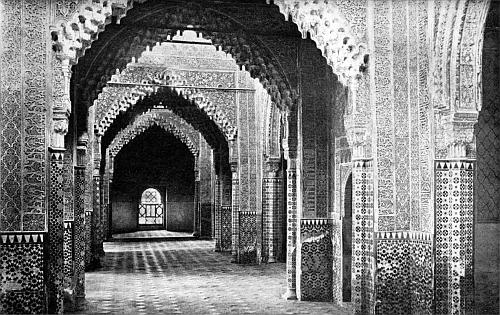
Washington Irving's Alhambra is primarily a book of legends and tales of this romantic sort--that is what it is remembered for, to the extent that it is remembered--though it also partakes of the genres of travelogue and I suppose some light history. I found it a wonderful book, at this particular time of my life anyway, found Washington Irving, whom I had never read before, to be a much more interesting writer than his current stature suggested to me he would be, and found my already fervent (for me) desire to go wandering around Spain re-confirmed and further whetted by the perhaps unrealistically romantic but unabashedly good-natured affection with which the author (infects) his account. The IWE introduction states, with characteristic candor, that the book is a "typical work of North America's first man of letters--good writing but seldom superlative." I suppose this is accurate, but I do want to note that I was struck, more than I usually am, perhaps because the writing was 'seldom superlative' by what a good command Irving had of the language. It is a vigorous kind of writing, always clear and precise in spite of some 19th century tendencies towards effusiveness and hyperbole, and also frequently humorous. I will give a couple of examples from "The Legend of the Moor's Legacy":

""Honest Peregil thus saw himself unexpectedly saddled with an infidel guest, but he was too humane to refuse a night's shelter to a fellow-being in so forlorn a plight."

"Now it so happened that this Alcalde was one of the most overbearing, and at the same time one of the most griping and corrupt curmudgeons in all Granada. It could not be denied, however, that he set a high value upon justice, for he sold it at its weight in gold."

"As ill-luck would have it, there lived opposite to the water-carrier a barber named Pedrillo Pedrugo, one of the most prying, tattling, and mischief-making of his gossip tribe. He was a weasel-faced, spider-legged varlet, supple and insinuating; the famous barber of Seville could not surpass him for universal knowledge of the affairs of others."


My edition is from 1926. It belongs to the 'Academy Classics for Junior High Schools' series, pocket-sized little volumes with nice thick paper, a large number of photographs of the Alhambra and various sites associated with Washington Irving, and about fifty of footnotes, biography, study questions and other supplemental information. The footnotes and appendices of course are unabashedly Eurocentric. (Some favorite footnotes: Allah: God; plains of Tours: Near Tours, in France, in 732, Charles Martel defeated the Mohammedans and thereby saved Europe; Henry III: King of Castile, 1390-1406. He was called "The Weak," because he was by no means inclined to wage war against the Moors.") The editors in their comments about the Moors betray attitudes and thought processes that will properly draw frowns from unignorant moderns, though they are trying, after their paternalistic fashion, to be complimentary:

"(The) Moors, he (Irving) learned, were Caucasians like himself, with the fine strong features of the white race, and of a handsome, dignified, noble appearance. Since they had descended from generations of people who had lived in the hot sun of the desert regions, they had dark-brown complexion, dark eyes, and intensely black hair...They established colleges; encouraged literature, art, and science; the development of mathematics and of medicine, of astronomy and physics, as well as the study of history and geography; and they did wonderful work in the making of silken cloth and of steel. In many ways these dark-faced people benefited Spain, setting slaves free; relieving the oppressed; reducing taxation, and giving wide freedom. They did so much that was remarkable that they thought of themselves as leaders of men, and made all people respect their culture and their intellectual ability."

Irving's own comments on the Moors, it should be noted, had somewhat less of this overt racial condescension. As even the editors of this edition discerned, "Irving wrote about the Moors with enthusiasm because he thought them a great people.":

"As conquerors, their heroism was only equalled by their moderation; and in both, for a time, they excelled the nations with whom they contended."

"The Arab invasion and conquest brought a higher civilization, and a nobler style of thinking, into Gothic Spain. The Arabs were a quick-witted, sagacious, proud-spirited, and poetic people, and were imbued with oriental science and literature."


Washington Irving seems to have led all in all a pretty swell life. Certainly that is the impression given in the biographical sketch of him in my 1926 schoolboy edition, which would have left out all references to the sorts of petty unpleasantnesses with which any life is filled and which tend I think to be overemphasized in modern biography. It did mention that Irving was engaged to be married when he was twenty-six, and that his fiancee died before the wedding. It does not seem that he ever married anyone else, and of course there were no allusions to any kind of illicit romances in the schoolboy book (Wikipedia says that when he was forty, and already long a successful author, he proposed to an eighteen year old who turned him down; it also asserts that Mary Shelley, who was 14 years younger than Irving herself, expressed, through a third party, romantic interest in him, but Irving did not pursue the relationship). He was born in New York in 1783, a great time and place to have done so, certainly by the standards of history up to that point, and acknowledging the favorable circumstances of race, gender, social position, etc that he possessed. For the free Americans my impression, which seems to be corroborated by statistics with regard to things like average height, birth and death rates, etc, those first decades of nationhood after the revolution were a pretty heady time to grow up, full of confidence and purpose, again by comparison to almost any other time and place in history. By his 20s Irving had become the first person in the history of his nation to be recognized primarily as a litterateur in the European tradition. He lived in and traveled all over Europe for seventeen years, including his three month sojourn inside the Alhambra. After the success of that book, he was awarded the post of United States Ambassador to Spain by president Tyler, though he seems to have accepted the post reluctantly. He lived out his middle and old age in his beautiful mansion (which can still be visited, by the way) along the Hudson, reading, writing more books, meandering around the Catskills and heading down to the City when the mood struck him. He died in 1859, just in time to miss the next great national cataclysm, fittingly it seems to me, as he belongs so thoroughly to the epoch of our history that was exploded when the Civil War happened, though perhaps he would have been interested to see it. Really, his life was kind of my ideal, apart from his never having married or any children (which I have to assume he could have afforded and paid/directed someone else to take care of while he wrote and traveled.)

The making of books had attained a very high level by the 1920s. This copy I have is in excellent condition, sturdy, has great paper, no typos or other printing errors, easily readable print, is attractively designed. It's great.

The Bourgeois Surrender Challenge

I read the winner from the last challenge, Bel Canto by Ann Patchett, which came out in 2001, and seems to have been pretty well acclaimed. I suppose it has some qualities of professional literary authorship about it, but overall it doesn't quite achieve anything that that status would suggest. First of all, the book is only 318 pages, but it seems like it goes on forever, which is not a great sign. Secondly, while she does not affect it, the author seeps with a kind of bourgeois snobbery that is not yet wholly earned enough to be tolerable in artistic pursuits. Her characters are too much what she imagines people of their distinction and achievement must be like, and not enough what she knows of the same. I assume Roxane Cox, the opera singing diva from Chicago who possesses an understanding of and intimacy with the higher things of life that are beyond that of almost everyone who has ever lived, is supposed, even if subconsciously, to be a stand-in for our author, which is a identification that the author has not earned, and does not earn by way of a convincing demonstration of the character. The book is most interesting perhaps as a window into the ego of the modern American woman. Roxane Cox, whom I take to be the author's alter ego, is an American from a middle class midwestern Catholic school who somehow has developed into the world's greatest opera singer. She is flown in at exorbitant expense to an unidentified godforsaken country in South America to sing for the CEO of one of the most important corporations in Japan because he loves opera, she is his favorite singer, and the government of the godforsaken country is desperate for him to build a factory or otherwise invest some dough there. During the concert terrorists, expecting the president of the country to be there, burst into the palace and take the assembled international crowd of extremely rich, cultured and important guests hostage. After a couple of days all of the women and unimportant men are allowed to leave, except somehow Roxane is not set free. She is thus the lone woman imprisoned in the among forty or so mostly alpha men, none of whom it should be noted, are Americans--they wouldn't be interesting enough. All of the men fall in love with her, especially after she begins to sing for them all every day. She picks the one she wants out of the bunch, the great Japanese CEO as it turns out, to be her lover during the captivity under the terrorists (don't ask), and the other men--even the Russians!--tamely accept this decision. Of course we are all entitled to our personal fantasy worlds, but at least recognize them when they are delineated so blatantly.

Anyway, onto this week's challenge. I thought with all of the Spanish and Alhambra material producing the magic words that we would have an interesting and high octane contest, but it turned out to be nothing of the sort.

1. Civilization: The West and the Rest--Niall Ferguson.....................................................226
2. Sister Queens--Julia Fox.................................................................................................135
3. Le Freak: An Upside Down History of Family, Disco & Destiny-- Nile Rodgers.........113
4. Enchantments--Kathryn Harrison.....................................................................................99
5. Codex Magica--Texe Marrs..............................................................................................83
6. At Hidden Falls--Barbara Freethy.....................................................................................40
7. The Damascus Cover--Howard Kaplan............................................................................26
8. The Economist Style Guide.................................................................................................7
9. Advanced Language Practice With Key--Michael Vince...................................................2

Lot of zero-scorers this time, mainly among older books: The Dementia of Iyan Igma; A.J. Calvert, Southern Spain (This was actually listed among the recommended supplemental reading in my copy of the Alhambra); Mary F. Nixon-Roulet, Our Little Spanish Cousin; Eyewitness Travel: New York City 2011; Joan Ouellet, The Captive Dove; Happy Days For Boys & Girls; and W.A. Leahy, The Incendiary.

I am glad that the Niall Ferguson book was the winner, because that is the sort of popular non-fiction book that I like to read and have not always taken the time to fit in. Ferguson is, or was a few years ago at least, on the way becoming the new Christopher Hitchens/Andrew Sullivan British expat political and economic commentator for that portion of the educated set that is especially blown away by Oxbridge polish and erudition. I have started his book, and it is entertaining and has some interesting information in it, particularly about medieval era China, though Ferguson is the type of writer who is very emphatic that he is giving us the truth and the assertions of previous authors and sometimes even positions that were widely held among the most prominent scholars in a field for decades were completely off the mark. This kind of thing leads me to suspect that he is oversimplifying the ideas and thought processes that prevailed formerly. However, as I said, I am still enjoying the book.

The Alhambra words produced a very weird movie challenge:

1. Silver Streak......................196
2. Body by Bethenny..............177
3. God's Pocket........................20

Yes, the winner is the 1976 Gene Wilder/Richard Pryor collaboration, and the close runner up is the exercise tape of a divorced reality television personality who is about my age, and unfortunately seems to be a pretty typical specimen of the kinds of women I had to spend my adolescence unsuccessfully trying to figure out how to gain the approval of because they seemed to be the predominant type that was around.