In the course of going through any long-term reading list such as this one I have embarked on, especially one that consists almost entirely of older books, with many of those being what are today considered extremely long novels, coming to a book such as Anna Karenina marks an emotional high point in the course of the journey. This has not only to do with how enjoyable the experience of reading the book is, or appreciation of its numerous superiorities when compared even with other books on the list, but because of its very wide status throughout the reading world as a kind of lodestone, or highly treasured masterpiece. The very best and smartest people have not been able to possess it entirely, while still acknowledging for the most part that it still possesses the highest worth. So it has been exciting, in a low-level kind of way, for me to read this, especially as it my second time with the book, and I did not have the same response to it the first time I read it that I did on this occasion.
My history with Tolstoy goes back to the summer before the old senior year of college; War and Peace is the traditional summer reading before that last year there, and I suppose probably still is. Everyone comes back for the final fall having read it and in most cases willing to engage in conversation about myriad of his aspects, often over drinks, spirits being as infused with the reading as they are, the 1812 Overture will be put on the stereo. It is a hopeful and fun time, as beginnings always are, though one that, in my usual lunkheaded way, I largely missed out on because I had let the approach of the new school year sneak up on me and did not begin the book until the day before the first class. I did manage to get through about 400 pages, which is enough to get a sense for its special qualities, but not enough to be a member of the War and Peace club. I did read through the whole thing some time in the late 90s, and it is on this list too, of course, though as I am doing this alphabetically I am not on schedule to get to it until I am about 80. I read The Death of Ivan Ilych somewhere in the early 2000s as well as my previous reading of Anna Karenina. I have not read any other Tolstoy, though I have often had the desire to throw off all of these other books and go through his whole opus. Boyhood, Childhood and Youth look, based on glancing over a few pages, like they would be considered classics in their own right if anyone else had written them, the short stories, The Sketches of Sebastopol, The Kreutzer Sonata, even A Confession, though one of my friends, back when I used to have friends, told me it wasn't very good. But I haven't done this yet.

I read the Constance Garnett translation this time. On the previous occasion I had used the Maude translation. I love the Maude
War and Peace and in a comparison of passages I prefer it to Constance Garnett, but with
Anna Karenina I found I preferred the Garnett. I can't say what was lacking in the Maude, or my first reading of the book. It is not that I didn't like it, but it had not stayed with me, and even at the time I remember thinking it was like
Madame Bovary, which I had read around the same time,
and maybe not as good. Perhaps Garnett's translation style fit the spirit of the book better. I certainly think I was more drawn into it as an experience, or inhabited world, which is much of what sets Tolstoy apart from other novel-writers.
While I was reading this there was an article published by a respectable outlet about how lousy various of the recent English translations of the Russian classics are. I felt somewhat vindicated in my own decision to stick with the old translations, my reasoning being that these were the versions of these authors that all of the old guys, Joyce and Hemingway and George Orwell and whoever else you want to throw in there, read, and I have not been persuaded yet that the people reading the new translations, wonderful and advanced as some of them probably are, are as yet getting any more literary-wise out of the books than the best readers of past ages did. Still, I must always bear in mind that it is perhaps my primary (curable) flaw to be skeptical of all progress and innovation even when it has been proven beyond all doubt to be superior to whatever preceded it.
Even on this reading I found the earlier parts to be somewhat as I felt the first time, not inadequate by any means, but not extraordinary or as spectacular as I had been led to expect. But this time I really felt, as is often the case with long old books, how it got better and better as it went along. I actually neglected to take any notes for my report until I was on page 658, when I thought I had better start noting a few things to remember about this time, or I would lose them.
On that page 658 there was a description of a scene in the country which reminded me of our camp in Vermont and my own happy life, or at least one of the parts of my life that is happy:
"...he left the edge of the forest where they were walking on low silky grass between old birch-trees standing far apart, and went more into the heart of the wood, where between the white birch-trunks there were gray trunks of aspen and dark bushes of hazel...It was perfectly still all round him. Only overhead in the birches under which he stood, the flies, like a swarm of bees, buzzed unceasingly, and from time to time the children's voices were floated across to him."
The period in which I was reading this--roughly April 26 to June 24--were unusually emotion months for me, as it began with spring vacation and went through the end of the school year, which included my two older sons going a trip to England and Iceland, my daughter finishing pre-school, which means she'll be going to all day kindergarten next year, and last of all, my oldest son's completing 8th grade, at the school he had been going to for eight years, getting him through all eight years of which was a big deal to me. I had a couple of odd recurring visions throughout my time with
Anna Karenina, which I assume something in the book called up to remind me of pleasant associations, one being the old elevated running track at St John's, the other being a rather tired Friendly's restaurant located on U.S. 7 in Bennington, Vermont that we went to for ice cream at the end of an otherwise not very productive day during April vacation right when I was beginning the book--we had driven out that way to do a hike, only to find the park closed; then we went to some other places, minor sites and used book stores mostly, that were either closed, nothing ever being open in this part of the world before Memorial Day, or had gone out of business. I liked the location of it, right near the old part of town, and the atmosphere inside called up the less coldly efficient era of my youth in the late 80s or early 90s. After my son's graduation we went to the Friendly's in Concord on Main Street, which is similarly plunked down in the middle of an older neighborhood, and I had to take baby, who was rambunctious, out to walk around the block numerous times while trying to contemplate the meaning (to me) of this end of the first of the children in this school, thinking about which I now realized had occupied so much space in my mind over the previous eight years. All of this is a propos of nothing with regard to the book, but I wanted to record something of my mental state during this time when I was reading it.

I have to admit that I often felt nostalgia in reading
Anna Karenina, not only that evoked by the writing about nature, which was a considerable amount, but also for the (dying?) western literature tradition that has been so important to me, so much of what is superlative and most admirable about which is contained within its pages. I was about two thirds of the way through when an article entitled "
The Canon is Sexist, Racist, Colonialist, and Totally Gross. Yes, You Have to Read it Anyway" was making the rounds of the internet, in which younger scholars are advised that, unfortunate though it is, "If you want to become well-versed in English literature, you're going to have to hold your nose and read a lot of white male poets." Eventually, one assumes, this odious necessity will be mitigated somewhat by the appearance of greater, or at least equally great, poets, whose backgrounds and outlooks are less personally offensive. I won't say that I do not understand emotionally the idea that one might love or care deeply about English literature without caring much for, to list the authors featured in the course under protest in the above article, "Chaucer, Spenser, Shakespeare, Donne, Milton, Pope, Wordsworth, and Eliot", though I think it is probably unlikely to do so in any kind of deep or thorough way. It is true that I come out of a background that insisted very strongly that, especially at the Chaucer-Shakespeare-Milton level, the work under consideration is of such a high and rare quality and importance as to be really beyond taste or transitory political or social orientation. An extremely intelligent and learned person, practiced in thinking at levels serious enough to be productive of interesting insights, might be able to offer some meaningful criticism or question various aspects of the civilizational significance of the authors under consideration; but even such people as this are rare. Obviously this viewpoint continues to hold a lot of weight with me.
p. 701: "And again the light died away in his eyes. Again, as before, all of a sudden, without the slightest transition, he felt cast down from a pinnacle of happiness, peace, and dignity, into an abyss of despair, rage, and humiliation. Again everything and everyone had become hateful to him."
I noted that this passage described my current state.
p. 709. "At home, looking after her children, she had no time to think. So now, after this journey of four hours, all the thoughts she had suppressed before rushed swarming into her brain..."
I noted that the description of Anna on horseback on page 715 was "great, characteristic stuff." It obviously made a strong impression on me at the time.
pp. 742-3: "During the game Darya Alexandrovna was not enjoying herself. She did not like the light tone of raillery that was kept up all the time between Vassenka Veslovsky and Anna, and the unnaturalness altogether of grown-up people, all alone without children, playing at a child's game."
I noted that I often felt this way myself. Like on Facebook.
p. 790 On debt: "Even the consideration that with such an expenditure he could not go on living for a year without debt, that even had no force." This is pretty much the condition I have been driven into psychologically. I have given up resisting.
p. 794 The meeting at the university, especially the cloth-covered table, reminded me happily of old Europe type associations. Prague perhaps?
p. 823-4 Levin, the night before his wife has her baby. This relates to the debt question also. "There are no conditions to which a man cannot become used, especially if he sees that all around him are living in the same way. Levin could not have believed three months before that he could have gone quietly to sleep in the condition in which he was that day, that leading an aimless irrational life, living too beyond his means, after drinking excess (he could not call what happened at the club anything else), forming inappropriately friendly relations with a man with whom his wife had once been in love, and a still more inappropriate call upon a woman who could only be called a lost woman, after being fascinated by that woman and causing his wife distress--he could still go quietly to sleep."
There is a great deal of what constitutes life in this paragraph, and yet it is so straightforward and unremarkably stated. This is what I admire most in this author.
p. 839 "This position, like all such appointments, called for such immense energy and such varied qualifications, that it was difficult for them to be found united in any one man." This one I just thought was funny.
For the most part I found the best realized characters to be relatively minor ones. Oblonsky perhaps is not minor, but his personal story is not one of the central dramas. Both of Levin's brothers, the consumptive, acerbic, pitiful, rather Dostoevskyan Nikolai, and the intellectual Sergei Ivanovitch, both seemed to me more realized than Levin himself. While they only appeared in one brief scene, I was also taken with Levin's exquisitely educated and serenely wealthy and stable in-laws, Lviv and the mysterious and beautiful third Shtcherbatsky sister, Natalia. I had vividly remembered Natalia's "beautiful arms" being, as I thought, noted at least a couple of times in the Maude translation, though she only appeared briefly in this, and I don't think her beautiful arms were mentioned.
p. 876. Anna's glimpse out the window at the carriage, an observed moment of fleeting and lost life:
"As she passed through the drawing-room she heard a carriage stop at the entrance and looking out of the window she saw the carriage., from which a young girl in a lilac hat was leaning out giving some direction to the footman ringing the bell. After a parley in the hall, some one came up-stairs, and Vronsky's steps could be heard passing the drawing-room. He went rapidly down-stairs. Anna went again to the window. She saw him come out onto the steps without his hat and go up to the carriage. The young girl in the lilac hat handed him a parcel. Vronsky, smiling, said something to her. The carriage drove away, he ran rapidly up-stairs again."

I had a congenial, if brief, talk with my wife about the book, which she read quite a few years ago, when we were in school actually, but she has a better organized memory than I have, and was able to pull up numerous thoughts that she had had at the time. I mentioned that Anna's neuroticism, in combination with the generally chilling nature of the superiority of most of her other qualities, i.e. beauty, carriage, taste, manners, and so on, was so pronounced as to make it difficult for me to like her very much. My wife said that the conditions of her life (or something like that; she would not have said "society") made her that way, because it was too limited, there was nothing for her to do. I agreed that the society depicted in the book was an unhealthy one, though this was a meaningless statement, as all societies everywhere seem to be eternally unhealthy in their relations between male and female as far as anyone is ever satisfied with them. She said that it appears that way to us, now, but that the views of women that it expresses would have been accepted as true, by men at least, up to thirty years ago, such as the old saw that there are two types of women, one represented by Anna, and one by the childish Kitty. She mentioned that at the time she had read it, when she was around twenty, that a man had said something to her to the effect that one of the hard truths underlying the story was that women become unattractive after childbirth, which she said had always bothered her. I would not say such a thing as this, in part because I don't actually believe it, and given that Tolstoy makes a point of depicting Anna as a ravishing beauty even after she has had children, I doubt he wholly believed it either, though the idea that this is so obviously has a power that plays on women's minds, that men who are attuned to this psychology are able to use with effect.
This is last of the three "Anna"-titled books we have to read on the list.
The Bourgeois Surrender Challenge
1. Helen Bryan--
War Brides....................................................................9,070
2.
Skyfall (movie)....................................................................................9,058
3. J. K. Rowling--
The Casual Vacancy...................................................5,672
4.
Les Miserables (movie-2012).............................................................3,978
5. Malala Yousafzai--
I am Malala..........................................................3,122
6.
The Duchess (movie)..........................................................................2,172
7. Tom Rob Smith--
Child 44..................................................................1,143
8.
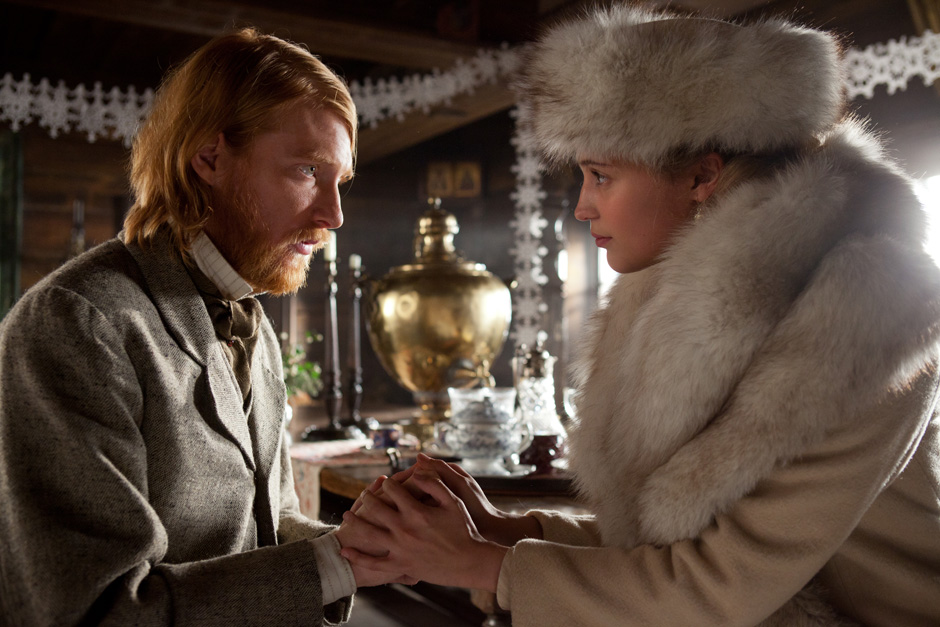
Anna Karenina (movie--2012)..............................................................976
9.
Ghost and Mrs Muir (movie)................................................................774
10. Louise Renneson--
Angus, Thongs and Full-Frontal Snogging...........686
11.
Ricki and the Flash (movie)................................................................644
12. Robert Heinlein--
The Moon is a Harsh Mistress................................521
13. Jill Alexander Essbaum--
Hausfrau.....................................................467
14. Amy Belding Brown--
Flight of the Sparrow......................................417
15. Shirley Jackson--
We Have Always Lived in the Castle.......................385
16. Lois Liveen--
Secrets of Mary Bowser.................................................376
1st Round
#16 Liveen over #1 Bryan
Because my library has the Liveen book. Otherwise they look pretty similar in terms of length, age, etc.
#15 Jackson over #2
Skyfall
#14 Brown over #3 Rowling
Shorter, plus the library has it.
#13 Essbaum over #4
Les Miserables
#12 Heinlein over #5 Yousafzai
Malala did get shot while standing up to the Taliban in the cause of women's rights, but I have been interested in reading Heinlein for some time.
#6
The Duchess over #11
Ricki and the Flash
Neither of these particularly excites me, but the loser looks more painful.
#10 Renneson over #7 Smith
The Smith book looks like some kind of thriller, with which genre I have not had satisfying experiences.
#8
Anna Karenina over #9
Ghost and Mrs Muir
Normally I would choose the oldie (
Ghost and Mrs Muir dates from 1947), but the modern
Anna Karenina presented itself so many times in the qualifying stages that I have to weight it some. There were no less than 5
Anna Karenina adaptations that offered themselves as competitors for the tournament--the 1967 Soviet version, the 1935 version starring Greta Garbo, the 1947 version starring Vivien Leigh, and a 1997 version starring Sophie Marceau--but the 2012 version, which does not look very interesting to me, was the only one with enough reviews to make the field in what was one of the more competitive of our challenges, with a score of 376 points required to be in the tournament. There were a number of interesting old movies (and books) that did not qualify, the most notable looking to me among these being a 1964 film called
On the Streets of Moscow.
Elite 8
#16 Liveen over #6
The Duchess
#8
Anna Karenina over #15 Jackson
A painful upset, but the weighted system requires it.
#10 Renneson over #14 Brown
A close contest, but the Renneson has some slight advantages in the metrics.
#12 Heinlein over #13 Essbaum
Final Four
#8
Anna Karenina over #16 Liveen
#12 Heinlein over #10 Renneson
Championship
#12 Heinlein over #8
Anna Karenina
I had to add a new rule ensuring that a movie could not defeat a book in the championship round to overcome my upset rule. I am always adapting to steer the results somewhat in the direction I want them to go.