Showing posts with label biblical figures. Show all posts

Thursday, June 13, 2019

Lew Wallace--Ben-Hur (1880)

So we come to Ben-Hur, a book that I bought a copy of (part of the green and gold spined 20 volume 1930s era "World's Greatest Literature" Series) at a barn sale in 1986 and, especially after I went to college, did not think for a long time that I would ever actually read. But having come to the point a few year's back where I had lost much of my enthusiasm for developing any further in a higher or more future-oriented direction, I came back to some of the unfinished business of childhood years which set me on the road, five and a half years later, to today's post.

As I mentioned in one of my monthly reports, even though I had owned this book for thirty years I had not really noticed how long it was, and if I ever had, I probably wondered if my edition was not abridged, because I always imagined it to be a doorstop type of book. But my edition was only 488 pages, and contained the whole book. The IWE introduction avows that "It is not great literature", but also asserts that "it would be hard to imagine anyone's packing more action into a single volume" The first statement is certainly true, the second is misleading, as if the book were fighting and other forms of physical exertion and struggle from one end to the other, when in fact there are long stretches of wandering and searching and decidedly non-violent episodes from the Bible. It does have a manly energy and thrust to it that compensates for some of its deficiencies, its author having been a general in the Civil War and President Arthur's ambassador to Turkey (joining Hawthorne and Irving, at least, as American authors who served as foreign ambassadors). The IWE, in its upbeat postwar way, refers to Wallace as "a successful Union general", which seems to be putting an extremely positive spin on the matter as he was accused of committing a major blunder at Shiloh, the most significant battle in which he took part, which resulted in a high number of casualties, the castigation of Ulysses S. Grant himself, and the removal from command for almost two years. And even when he returned to active command in 1864, his troops were defeated in the main battle (Monocacy) in which he took part, though he was credited with delaying the rebel force enough to prevent it from attacking Washington.

The book is written in a heavy 19th century style that is difficult to read if one's body has any inclination to go to sleep. Nonetheless I am so far gone in my nostalgic fantasies about the blue skies and epic vistas alike about the ancient world and pre-1960 literature and my own youthful ideas that when I can stay awake and concentrate for any amount of time I really do enjoy it. Manly contention as well as camaraderie among equals, or near enough equals, in strength and spirit, especially against the backdrop of great historical scenes, cities, empires, etc, is always inspiring or is at least a reminder of that feeling when one could believe in it.

As is often the case, I did not take any notes until page 377, then took quite a few over the last 100 or so pages. Sometimes it takes going through almost the whole book to figure out what the questions raised are.

1st note, p.337 "To the purely Christian nature the presentation would have brought the weakness of remorse. Not so with Ben-Hur; his spirit had its emotions from the teachings of the first law-giver, not the last and greatest one. He had dealt punishment, not wrong, to Messala."

p. 351 "As the mind is made intelligent, the capacity of the soul for pure enjoyment is proportionally increased...Wherefore repentance must be something more than mere remorse for sins; it comprehends a change of nature befitting heaven."

If a living priest or some other person in real life were to say these things to me in 90% or more of any such instances I would despise them, I have no doubt. Yet coming across them in the dead pages of a book they, and the belief system that they evidently represent, are soothing.

p. 361 "A country of hills changes but little; where the hills are of rock, it changes not at all."

p. 418 "The Egyptian has him in her net...She has the cunning of her race, with beauty to help her--much beauty, great cunning; but, like her race again, no heart. The daughter who despises her father will bring her husband to grief."

The despised father to boot is Balthasar, of the famous group The Magi. Wallace is an extremely pro-Jewish writer, especially in the religious sense, vis-à-vis almost all of the other nationalities that appear in this book.   

p. 419 "A man drowning may be saved; not so a man in love."

p. 424 "In his eyes there were tears which he would not have them see, because he was a man."
 
Maybe my favorite sentence in the book. Upon Ben-Hur's accepting that his mother and sister are dead, though actually they aren't.

p. 442 "He persisted as men do yet every day in measuring the Christ by himself. How much better if we measured ourselves by the Christ!"
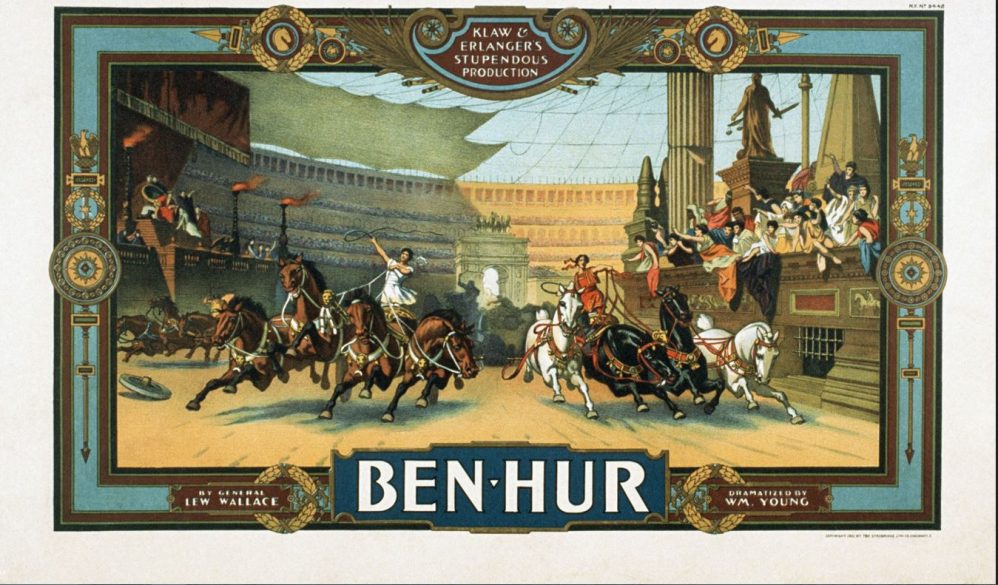
The chariot race is the big action scene in the book as well.

I am about to speak heresy (it is a wicked and godless age), but why do we so easily excuse God/Christ for not immediately overthrowing the Roman power? Modern analytics/efficient practices would suggest that, in the absence of any proof of heaven that would be accepted on Twitter, that would have been a more optimal outcome for humans, though I suppose a worse story. Despite all of the forceful arguments asserting that Jesus Christ, if he ever existed, was the biggest phony in the annals of human history, that belief in supernatural religion is a joke, that spirituality is an invention of the human imagination and has no basis in science and so on, and that this is essentially what almost all genuinely intelligent people in today's world understand to be true, I have never been able to come around to ridiculing the pointless and misguided march of religious, and especially Christian history, which seems to me too important and powerful an--often for good--influence in human culture and psychological makeup to treat so callously. In fact I am admiring and often envious of the truly seriously religious, who seem to me to have a surer sense of who they are than all but the most intellectually invulnerable materialists, whose conception of the nature of the world within which they have found satisfaction is as yet too intricate for me to follow.

According to Wallace's autobiography, he was raised in the Christian tradition but wasn't a devout follower, and he does not appear to have been a member of any church. There are claims on the internet that he was an atheist who wrote Ben-Hur to disprove Christianity, which does not appear to be true, and which I do not believe anyway. Ben-Hur did almost to the last hour cling to the belief that Christ would either lead or inspire in the Jewish people a successful earthly rebellion against the Roman Empire, and he expressed more disappointment about this even after he realized to some extent what Jesus was doing than I would have expected, but the point was not to illustrate that Christianity was wrong so much as that it was difficult to comprehend and to live by.

p. 447 "The idea, old as the oldest of peoples, that beauty is the reward of the hero had never such  realism as she contrived for his pleasure..." The evil, tempting, exotic "other" Egyptian again.

To further comment on my thought above, I wrote "the humbling of Ben-Hur's worldly ambitions something of a surprise ending to me. It is more emphasized than in the film.

p. 477 "The sun was rising rapidly to noon; the hills bared their brown breasts lovingly to it..." At the crucifixion, which I thought was effectively described as a physical ordeal. Perhaps the soldier's sense at work?

The final paragraph of the book is a brief personal note from the author which I found warming. Most of these writers never address the reader so directly.

"If any of my readers visiting Rome, will make the short journey to the Catacomb of San Calixto, which is more ancient than that of San Sebastiano, he will see what became of the fortune of Ben-Hur, and give him thanks. Out of that vast tomb Christianity issued to supersede the Caesars."   



The Challenge

1. David Mitchell--Cloud Atlas..................................................................…..2,317
2. Edward Gibbon--Decline and Fall of the Roman Empire........................…..746
3. Simon Sebag Montefiore--Jerusalem: The Biography...……..................…..422
4. John Julius Norwich--Sicily: An Island at the Crossroads of History...…….111
5. David Graeber--Bullshit Jobs........................................................................…71
6. Margot Lee Shetterly--Hidden Figures (children's book edition)......….……..66
7. Bodie & Brock Thoene--Eighth Shepherd........................................................64
8. Robert Audi--Cambridge Dictionary of Philosophy....................................….36
9. Bill Myers--Devoted Heart...........................................................................….20
10. Teyla Branton--Insight.................................................................................…17
11. G. J. Whyte-Melville--The Gladiators............................................................10
12. Monica Selveira Cyreno--Big Screen Rome...………………………………...7
13. Matthew S. Hedstrom--The Rise of Liberal Religions.................................….5
14. Alexa Person--The Zero Point.....................................................................….5
15. Georg Ebers--Serapis...……………………………………………………….2
16. Works of Lucian of Samosata...……………………………………………….2

Round of 16

#1 Mitchell over #16 Lucian

Lucian is worthy of some respect, his works being part of the Loeb classical series in eight volumes. Eight volumes is lot to overcome against any literary competition in this game, however.

#2 Gibbon over #15 Ebers

Gibbon is one of the last of the inner circle pre-1900 English language classics that I have never read. Its massive length is going to work against it in this format also. I know that I am going to get to it on my "A"-list at some point in the next 10-20 years, so I don't feel the pressure to read it sooner rather than later tightening around me yet.

#3 Montefiore over #14 Person
#4 Norwich over #13 Hedstrom

Hedstrom has no library presence, cannot compete.

#5 Graeber over #12 Cyreno

Big Screen Rome sounds like it might be an interesting book, but no one has it, and the Graeber book, despite its ungenteel and mildly abrasive title, is not one I can eliminate immediately on the basis of near certain dislike.

#6 Shetterly over #11 Whyte-Melville

The Shetterly is a children's picture book edition of the recent adult best-seller and mild sensation--perhaps that would have been a better entry in the tournament, but it was not the one that made it. Whyte-Melville's book, not available in any libraries, looks like another densely written, highly moralized triple decker Victorian novel with a Roman setting, just like Ben-Hur. While I don't mind one of these kinds of books on occasion, there are enough of them sitting on the IWE list that I don't need to add any additional ones for my "free reading".

#7 Thoene over #10 Branton
#8 Audi over #9 Myers

There is not much use for dictionaries on this kind of list, but the Myers book is, for the purposes of this list, a meatball, not being in libraries, being a genre book that does not appear to be published by an outlet with any stature, and thus cannot realistically defeat anything with the Cambridge imprimatur.

All the higher seeds win in the 1st round. The field was lopsided.

Elite 8

#1 Mitchell over #8 Audi
#2 Gibbon over #7 Thoene

If Gibbon keeps drawing red state American Christian novelists, he may triumph in this contest after all.

#3 Montefiore over #6 Shetterly
#4 Norwich over #5 Graeber

Norwich's Sicily book is reasonable in length, and its 29 extra pages over Graeber's are not enough to make us consider the upset.

Final Four

#1 Mitchell over #4 Norwich

Norwich would actually have won this based on shorter length, but Mitchell has the only upset to play in this entire tournament.

#3 Montefiore over #2 Gibbon

Even the Montefiore book is 650 pages. Gibbon proves a tough out in his 1st Challenge appearance.

Championship

#1 Mitchell over #3 Montefiore

Another pretty long book (509 pages) added to the wait list, but the shorter entries need to come through quality-wise. Also Mitchell is about my age and enjoyed the kind of literary success and critical adulation, at that time anyway--maybe he still does, or does any novelist really have that kind of status for life anymore?-- that I used to imagine must be my eventual lot, so looking into his book will be a kind of reckoning for me.



Wednesday, May 8, 2019

May 2019

A List: Rousseau--Confessions...……………………….628/683
B List: Lew Wallace--Ben-Hur………………………....137/488
C List: Rick Perlstein--The Invisible Bridge...……….....378/810

I am a few days late with this month's post. I tried to rush it through last night but it was such a mess even compared to this that I decided to hold it back another day.

This is the fourth update where I am reading Rousseau. Of course I did go on vacation twice. The Confessions is on the B-list too, though not until Vol. XVII (I'm on Vol. III now, so at my current pace I will be getting to it again in about 28 years). In the later parts of the book I am starting to have trouble keeping all of Rousseau's aristocratic friends, and former friends, straight. Having had some of these issues myself, I felt his pain in the parts where he related his kidney stone and bladder problems, and was especially attentive to his account of having a probe inserted into him in 1760, which I had not realized was already being done at that time, and could not have been pleasant.

Doubtless because of the famously gargantuan film adaptation, I anticipated Ben-Hur being one of those enormous 1,000+ page books, so I was surprised to realize that it is not in fact exceptionally long, though the expository parts of it really are written for an audience whose ideas of entertainment and stimulation would be listening to a two hour sermon in the Midwest in 1880. Ben-Hur does not actually appear in the story as a character until about 90 pages in, and Jesus Christ, who I take to be the other main character, is finally born around page 70 after a long introductory section featuring the wise men trekking across the desert, the journey of Joseph and Mary, a discursion on the shepherd(ic?) life in ancient times, etc. Reading the descriptive passages requires a lot of concentration that even I find hard to summon up in the present year, and needless to say it is impossible for me to read more than a paragraph or two at night without falling asleep straightaway. That said I do still like it. When I have the time and level of alertness to immerse myself in it for thirty minutes or an hour it truly puts me in a state of consciousness reminiscent of my pre-online life, which I miss badly much of the time.

The Perlstein book I took back to the library over my vacation and got it out again when I came home. Nixon is gone now and currently I am in the midst of a long recap of Ronald Reagan's Hollywood career and the beginnings of his shift to politics during the post-war Hollywood blacklist era, which I am not finding all that interesting. I like the parts where I am either reminded or learn something new about either how insane the 70s were or how smart people thought about things like the economy or education or how society should be organized, which in many instances is very different from how smart people think about those things now. The author's weak point is that he is an utterly conventional modern liberal, and therefore invariably takes a condescending attitude whenever the subject involves the white working class or Ronald Reagan's mental capacity, and a respectful one when the subject is minorities or immigrants or feminism. These are doubtless on the whole correct, and certainly they are safe, perspectives to adopt, but only liking/being enthusiastic for the approved parts of American history and culture and uniformly, without any apparent inner conflict, disliking the unapproved parts, do not make for very interesting reading.  I'll still be on this book in June so maybe I will try to go into my thoughts on this more.

This is the time of year when I finally am able to get back out and read on the porch again, but so far I have only managed to do this once. April 14th could have been the first day out, as it was in the 70s, but that was a Sunday and my wife loaded us all up with so many spring cleaning-like tasks that I was not able to slip out with my book on that day. Then from the 23rd to the 27th I was down in Pennsylvania and Maryland, but the 28th after I got home was still warm in New Hampshire and that is the day I sat out. Since then the weather has not been very warm, at least in the mornings when I am home it's still in the 40s and 50s, and most of the days it has rained as well. So I still haven't really gotten into porch-reading mode yet.

When I was in Philadelphia I met a new woman. It had been a few years since I had encountered anyone who stirred these kind of unforced love-like feelings in me, and I thought that maybe that part of my life had finally passed. But I guess it hasn't. Her name is Kate, and she is from Phoenixville, which I guess counts as a suburb of Philadelphia, though it's about 30 miles out of town. I've come across a number of people from this town over the years. I don't remember ever having actually been there, though it isn't far from where I used to live. So far it is true I only know her through television, though thanks to the power of the internet there are years of archival footage of her as well as a new upload nearly every day to keep my passion strong.

By the way, she is like 37 or 38, so she is pretty mature, especially for me, but she retains some girlish qualities while being an overall serious person, which is what I really like. This black outfit is my favorite item from her wardrobe that I have seen so far.


Les Charmettes, home of Jean-Jacques Rousseau


Is Rick Perlstein a soyboy?


Tony Orlando and Betty Ford doing the bump

Warning: I may be closing all my posts for the foreseeable future with a Kate Bilo picture, until my love cools. That might take a while.


Monday, May 28, 2018

Par Lagerkvist--Barabbas (1950)


We return to one of my favorite genres within the IWE program, the (usually earnest) Biblical-inspired novel. Unlike most books in this class, this one is quite short as well, coming in at 180 slight pages. It is also, I am pretty sure, the first Swedish book that has turned up thus far, of which there are surprisingly many (well. maybe 12 or so), on the program. It would not the first Scandinavian book overall though, Hans Christian Anderson and his works having turned up a couple of years back. Par Lagerkvist does not seem to be particularly celebrated today, though he was awarded the Nobel Prize in 1951, the year after Barabbas, which in the English-speaking world at least seems to be his best known work, was published. While I did like this lean, understated volume, which undoubtedly possesses a substantial amount of literary skill, it did not stand out to me on an initial reading at least as fitting my idea of a Nobel-quality work. However, I haven't read any of his other works (and he had been nominated three times for the prize before Barabbas came out) and I generally don't get too worked up about Prizes--though obviously I don't mind their existence either--unless I really dislike the winner, which rarely seems to be the case with me. The reason given by the Nobel committee for Lagerkvist's prize was that it was "for the artistic vigour and true independence of mind with which he endeavors in his poetry to find answers to the eternal questions confronting mankind" which does seem however like something that could apply to most winners (besides its assumption of some fixed set of 'eternal questions confronting mankind' whose answers, or attempts at answers, at the very least one suspects would invariably reveal themselves to be hopelessly Euro- and phallocentric). Interestingly Hemingway would be awarded the Nobel Prize just a handful of years after this right after the publication of The Old Man in the Sea, a similarly stripped down, elemental kind of work, and Camus, whose most famous novels also seem to me to partake of these kinds of qualities, won it a few years after that. So even apart from the Swedish Academy, there was clearly something in the atmosphere of the reading portions of the postwar West, and especially Europe, that needed and responded strongly to this type of literature.


From the IWE introduction, after giving the background of the Barabbas Story:


"This is all the Gospels tell. The challenge to novelists is apparent and dozens of them have drawn on their imaginations to give the fuller story of Barabbas--where he had come from, what he had done, what became of him. This is the most distinguished of the many efforts. It has, of course, a Swedish and Protestant outlook...The English translation by Alan Blair is superb (ed--This is true)."


As is my habit I did not read this introduction closely before reading the book, and I did not pick up on the book's having a notably Swedish and Protestant outlook as opposed to anything else. Though I do not come out of that tradition specifically, I suppose its worldview meshes somewhat with my own temperament enough that it does not stand out as strange to me. In the book the character of Barabbas, even with witnessing several episodes of Christ's life, miraculous and otherwise, at first hand or very near to it, and being strongly affected by the experience, is never really able to believe wholeheartedly in the man's divinity, and as such life is a lonely, existential struggle for him devoid of peace or joy. I am guessing this is what is referred to by the Swedish and Protestant outlook.


I did not make any notes on this book as there were no individual sentences or passages that would be very striking taken apart from the rest of the novel. It is small and easy to read and I found it to be thought-provoking in a manageable, comprehendible way.


Here is my book. Unfortunately I was not entirely successful in effacing the sticker that comes on every book I have to order online. This Vintage paperback from the 50s, along with a 90s reprint, is the only English language edition of this book I could find.


The Challenge
1. C. S. Lewis--Mere Christianity.....................................................3,322
2. Barabbas (movie-1961)....................................................................164
3. Gregory A. Boyd--Crucifixion of the Warrior God............................45
4. Bruxey Cavey--(Re)Union..................................................................32
5. Gregory A. Boyd--Cross Vision..........................................................25
6. Colin Wilson--A Criminal History of Mankind...................................21
7. Robert J. Hutchinson--The Dawn of Christianity................................21
8. Rahim & Thomson--Jesus Prophet of Islam.......................................12
9. Marie Corelli--Barabbas: A Dream of the World's Tragedy.................3
10. Benjamin Constant--On Religion.........................................................0
11. Trench H. Johnson--Phrases & Names: Their Origin & Meanings....0
12. Now Barabbas (movie-1949)...............................................................0
13. Did Jesus Die? (movie--2003).............................................................0
14. The Jesus Tomb (Secrets of the Cross) (movie--2009)........................0
15. Lois Windon--My Walk With God........................................................0


This Challenge is inevitably heavy on Christian themes.


1st Round


#2 Barabbas over #15 Windon


I am being discriminatory against the Windon book because it does not seem to be published by a respected house nor does it have any other signs of success going for it.


#3 Boyd over #14 The Jesus Tomb
#13 Did Jesus Die? over #4 Cavey


Upset special


#5 Boyd over #12 Now Barabbas
#6 Wilson over #11 Johnson
#7 Hutchinson over #10 Constant
#9 Corelli over #8 Rahim & Thomson


The Johnson and Constant books have been out of print for over 100 years. Corelli is a writer of some fame whose book interests me slightly more than her opponents'.


Final 8


#13 Did Jesus Die? over #1 Lewis


Brutal for the quality of the competition, but the documentary was entitled to a rare two upset tournament


#3 Boyd over #7 Hutchinson


I thought this would be a real game, but there isn't a single library in my state that has a copy of either of these books.


#9 Corelli over #2 Barabbas
#5 Boyd over #6 Wilson


This Boyd isn't available in any libraries either, while Wilson made it into two, but this Boyd has an upset to play.


Final 4


#3 Boyd over #13 Did Jesus Die?
#5 Boyd over #9 Corelli


No libraries have the Corelli book.


Championship


#5 Boyd over #3 Boyd


Saturday, December 17, 2016

Sholem Asch--The Apostle (1943)


The Jewish authors who made the pre-1960 IWE reading list are in many instances not those who would seem obvious today. There is no Bellow, no Mailer, no Malamud, no Singer (Roth was obviously too young to have his early works considered), no Kafka, no Dorothy Parker, no Salinger even. Marx and Freud did make it, as did Proust. Kafka's Prague contemporary Franz Werfel, like Asch famous for novels about Biblical and Christian themes (a genre that is itself well-represented on this list) made it, as did Herman Wouk and some of the American playwrights of the 30s such as Kaufman and Hart. Anne Frank is on as well. I suspect that a few of the other late 19th and early 20th century French, German, Austrian or Russian authors on the list who are not as well known today might turn out to be Jewish, but I have not done the research on all of these yet. What immediately strikes one about those included on the list is that they tend more towards the sober and scholarly end of the distribution, whereas the more comic and bombastic/fantastical authors are held in higher regard today. It is a very old WASPy, and more specifically old Yankee list for sure, which however, despite its shortcomings and oddities, such as its fondness for doorstop historical fiction about early American history, I think is a good one. Old Yankees, though they continue to loom somewhat sinisterly in the national imagination, are getting ever harder to find in actual life even on their native ground, and their presence in and influence on American literary culture withers more and more every year. When I was younger I used to frequent numerous antiquated libraries in New England which partook of this old time atmosphere, even the books on the shelves in many instances not having been replenished in decades. These reminiscences date back 30 years now however, and even most of these places have been remodeled and brightened up and made more accommodating to technology, many of the books which formerly furnished the rooms on shelves reaching from floor to ceiling having evidently been discarded or relegated to the off-limits storage area in the basement. But I am getting far off of the subject of The Apostle now.

Sholem Asch was born in 1880 in Kutno, Poland, which was at that time part of the Russian Empire. He lived in Warsaw for a few years as a young man and got married there, then went abroad, eventually making his way in 1910 to the United States, where he remained for the duration of the first World War and beyond, becoming a citizen in 1920. He went back to the newly independent Poland after the war, and then lived in France for a while. returning to the United States in 1938. He seems to have stayed in the U.S. until some time in the 50s, after which he spent two years in Israel, where his house is preserved as a museum, towards the end of his life. He died in London in 1957. I note all of this because the biographies of people impacted by tumultuous historical upheavals are of interest to me. He wrote in Yiddish and was a prolific author no matter where he happened to be living, writing in the neighborhood of thirty books, the majority of which look to be weighty in length, tone, and subject matter. The Apostle, which depicts the life of St Paul, is actually the middle volume of a trilogy of novels about the lives of major early Christian figures, the other two being The Nazarene, about Christ himself, and Mary. The Apostle however is the only one of these, or any other of Asch's books to make the IWE list.


I liked this quite a bit, even if it is perhaps a little overlong. It is distinguished by an earnest seriousness that seems strange to us ("us" referring to that imaginary segment of the contemporary intellectual world that is super smart and well-informed whose sensibilities are remarkably in "sync" with mine) because earnest has become to my thinking something of a derogatory word that implies futility and a certain limitiation of ability when applied to intellectual pursuits. He was thoroughly Jewish, and led a thoroughly Jewish life, socially, culturally, and so on, so I doubt it would have been possible for him to adopt any of the more drastic Christian beliefs under any circumstances, but he was able to grasp the possibility of others' doing so. To be sure there is much more emphasis on Paul's Jewishness, and the Jewish origins of the entire Christian movement, than is usually found in Christian origin literature. There is always a fashion, maybe more prominent nowadays than ever, to be skeptical that the stories and major figures of the New Testament, including Peter, Paul, and Christ himself, have any basis in reality whatever, in some instances to the point of arguing that every aspect of them is entirely fictitious. What Asch believed as far as this goes I suppose I don't know, but he treated the stories and ideas of the gospels and epistles, whoever wrote them and who and whatever they are supposed to be referring to, very seriously, which is an approach most modern Christian debunkers don't see themselves as having to do. He knows that the power of the story is important in any case.


As with other long books I have had for this list recently, I neglected to take any notes until I was about 300 pages in, when I thought I had better jot some things down for the report. And as usual, once I began I ended up with quite a lot.

What prompted me to begin writing notes was a debate between Paul and his faction of Messianists and an opposing one led by some older school Jews regarding the necessity or not of circumcision for initiation into the new covenant ("circumcision a big deal" reads my note).

"He who cannot summon up enough courage to submit to circumcision for the sake of the God of Israel, is not worthy of admission into the congregation of the Messiah. He is a coward who cannot fight the battle of the Lord. For the Messiah is the battle of the Lord. And only those shall be admitted to the ranks who have the strength to give their blood to the covenant: even as it is written: `And in thy blood shalt thou live!'"--p.336

I took a moment to note the general awesomeness of the Jews across history, though perhaps there is some playing up in this author of their centrality and dynamism in the life of the Roman Empire.


The more the book went on and Paul began his travels throughout the Empire, Asch began to emphasize the myriad abusing and tormenting of human beings that underlay its entire operation. The first instance that pushed me to feel the necessity of making some record of my impression was the section on the bronze-working slaves of Corinth who passed away their entire lives in caverns feeding the smelting ovens and never seeing the light of day. I can't quote the whole section, but I will lift some especially pertinent sentences: "The life of these cave-workers was a short one." Regarding the mixers, whose work required a higher degree of skill which afforded them somewhat better treatment than the oven slaves: "Their beds were comfortable, but they were chained to them. For them as for the others, the cavern was a living tomb." "Most of the children taken into this work were such as had some physical defect, or some sickness, for which reason they could not be sold as house servants or prostitutes. These unfortunate discards of humanity were the dregs of the slave markets...When night came their bodies collapsed about the blocks and stalls at which they had worked all day. In the morning the overseers woke them with the lash..." (pps. 429-431) And on and on. I remarked at the time that this part was good, but Asch was just getting started with the depiction of atrocities. They seemingly kept getting worse with each change of scene.

After that I didn't make any more notes until page 654, at which time Asch dropped Sabina Poppea, the ultra-cultured wife of the manchild emperor Nero and diva superbabe of her generation, on my head. "Sabina had dreams of becoming the `Helen of Rome', with a temple of her own, in which worshipers would offer sacrifice after her death." She kept five hundred asses which accompanied her on all of her travels, as she maintained her glorious complexion by bathing regularly in their milk. On being introduced to the concept of resurrection, "Poppea was deeply interested; the possibility that she could arrange to be resurrected in all the beauty and charm which she alone possessed was something to be looked into."--p.656. However, "Any hint that worship of the Jewish God was bound up with duties, penalties, obligations, self-denials, discipline of any sort, she rejected. This was not in her style."--p.657. She capriciously punishes one of her attendants by pinching her breast with a pair of tweezers as hard as she can until the slave collapses.

     
The catalog of atrocities indulged in by the Romans never fails to fascinate. There is a section devoted to the epidemic of dumping bastards and other unwanted babies alive into the Cloaca Maxima, which is depicted here as a stream into which all of the sewage and other refuse of the capital was dumped and sent on its way out to see, Then there was one of Nero's parties, which took place on barges in a lake full of alligators:

"...in any case he (Nero) would enjoy the spectacle of the terrified slaves who, from their small boats, had to bring the dishes to the barges. The reptiles, their appetites awakened by the odor of food, swam after the boats and set them rocking. The girl dancers who had to perform on narrow ledges running round the barges were pale with terror; and the guests, reclining on couches at their tables, laughed drunkenly at the antics of slaves and dancers. The laughter rose into a shout of excited merriment when an unhappy youth or girl, unable to endure the test, fell with a scream into the water. A huge pair of reptilian jaws closed on the white body, and the water was stained red."--p.680

There is no reason not to believe I guess that the Romans really enjoyed watching people get eaten by alligators. Middle American types have always hard time understanding this as a major strain in the human character that their society has largely been able to suppress, at least in this kind of raw form. 

PP 700-701 brings the graphic torture of the character Antonius. It occurred to me rather belatedly, that he must have been supposed to be St Anthony, though I cannot find a St Anthony whose dates and mode of life corresponds with this guy's. Nonetheless, several of the minor characters sneaked up on me as being major biblical personages, Lukas, Marcus, etc, which I did not pick up on until they began to do fairly obvious things that signified who they were. Oh yes, about that torture:


"The bones of his hands and arms and legs had been cracked one by one between the claws of iron pincers. The skin had been torn, strip by strip, from his quivering flesh. One by one the nails of his fingers had been pulled out by the roots. His flayed feet had been held over a slow fire. He lost his human aspect and was reduced to a bundle of raw, blistered flesh."

It is remarkable what these early Christians had (and were willing) to suffer to be near God while Jimmy Swaggert and his ilk (or me, though officially I claim not to really believe in any kind of divinity or afterlife) don't have to suffer anything. It is true, Paul and his early followers were often buoyed by visions of and meetings with Jesus himself. Of course Jimmy Swaggert probably claims that he has talked to Jesus too, so it's really a puzzle why American Christians get to have the easiest of earthly passages.

After Nero had most of Rome burnt down, he famously (assuming the story has not been debunked) and absurdly pinned the blame on the Jews and their Christian adjuncts and held a giant entertainment in which members of these unfortunate groups were to be killed en masse for the delight of the Roman crowds. The show was boring, however: "...the Christians did not fight (in the gladiatorial arena); they only prayed and let themselves be eaten...here and there even the dulled, brutish heart of the Romans were touched by the spectacle of so many women and children fed to the wild beasts." 

Last note, on the conditions at the Tullianum prison, the last destination of saints Peter and Paul prior to their respective executions: 

"They were not starved to death so much as eaten to death. Food of some kind was given them, but they in turn, while still alive, were eaten by monstrous rats and crawling things which bred in countless numbers in the foulness of the cells and corridors. The prisoners were chained, either to rings in the walls or to great, immovable blocks of wood. The floors of the prison were littered with human offal, with moldering bodies and bones gnawed clean, and the poisonous air ate into the lungs and skin. A thick ooze dripped from the walls..." I think you get the picture. At the time I guess I thought this was the worst of all the executions and tortures, but probably the endless parade of them over the last half of the book had softened me up, and when they brought the rats in, I was finished, you know.


The Bourgeois Surrender Challenge

The major words used to produce this Challenge were obviously heavily Rome or Jewish-specific, which could have produced great results, but in this case produced a list of contestants I have no interest in reading. However, I have to try one of them, so I am going to go straight with the shortest of these that I can check out of the library  

1. Acharya S--The Christ Conspiracy: The Greatest Story Ever Sold......................373
2. Peter Heather--The Fall of the Roman Empire......................................................167
3. Elaine Pagels--The Origin of Satan.......................................................................166
4. John MacArthur--One Perfect Life........................................................................148
5. John L Allen, Jr--The Global War on Christians..................................................101
6. Dietrich Bonhoffer--Letters and Papers From Prison............................................85
7. Simon Schama--Landscape and Memory................................................................42
8. Saul: The Journey to Damascus (movie).................................................................33
9. Mark A Gabriel--Journey Into the Mind of an Islamic Terrorist............................19
10. James Wasserman--The Temple of Solomon.........................................................12
11. Copan and Litwak--The Gospel in the Marketplace of Ideas................................12
12. The Real Jesus: A Defense of the Historicity and Divinity of Christ (movie).......11
13. Makers of Ancient Strategy (ed. Hanson)..............................................................11
14. Robert Silverberg--Needle in a Timestack.............................................................10
15. Stuart Munro-Hay--The Quest for the Ark of the Covenant....................................5
16. Mark Gibbs--The Virgin and the Priest...................................................................4

Round of 16

#1 S over #16 Gibbs
#15 Munro-Hay over #2 Heather
#3 Pagels over #14 Silverberg
#4 MacArthur over #13 Makers, etc
#5 Allen over #12 The Real Jesus
#6 Bonhoffer over #11 Copan and Litwak
#10 Wasserman over #7 Schama
#9 Gabriel over #8 Saul....

Elite 8

#15 Munro-Hay over #1 S
#3 Pagels over #10 Wasserman
#4 MacArthur over #9 Gabriel
#5 Allen over #6 Bonhoffer

Final Four

#3 Pagels over #15 Munro-Hay
#4 MacArthur over #5 Allen

Championship

#3 Pagels over #4 MacArthur


Nothing much to be said about these. Pagel's book is 214 pages. She is a professor at Princeton, so the odds that she is a total crackpot are reduced somewhat, I suppose.

Sunday, March 10, 2013

Author List, Volume I

I have gone on a bit of a hiatus. I am still interested in the twee little essays, but I don't have time to do them for the foreseeable future, and as the main purpose of this blog is supposed to be to store my various lists, which is not being done, I am going to devote the next 60 or so posts to doing that. Trust me, it will be fun, and I hope sometime we can have a meet-up of all the devotees and groupies of the site in one of our dominant literary cities.

Authors, Subjects, Pertinent Sites, Volume I:

Robert Sherwood (1896-1955): Abe Lincoln in Illinois (1938). BP: New Rochelle, Westchester, New York (address unknown). Buried: Unknown (d. New York, New York). College: Harvard.

Abraham Lincoln (1809-1865) BP: Abraham Lincoln Birthplace National Historic Site, Hodgenville, Kentucky. Buried: Oak Ridge Cemetery, Springfield, Illinois. Other major sites: Abraham Lincoln Presidential Library & Museum, 112 North 6th Street, Springfield Illinois; Library & Museum, Lincoln Memorial University, Harrogate, Tennessee; Lincoln Home National Historic Site, Springfield, Illinois; Ford's Theatre National Historic Site, 511 10th Street NW, Washington, D.C; Lincoln Boyhood National Memorial, Lincoln City, Indiana; The Lincoln Depot, 10th & Monroe Streets, Springfield, Illinois; The Lincoln Family Church, 321 South Seventh Street, Springfield, Illinois; Lincoln-Herndon Law Offices, 6th & Adams Streets, Springfield, Illinois; Old State Capitol State Historic Site, Downtown Mall, Springfield, Illinois: Lincoln Memorial, Washington, D.C.; President Lincoln's Cottage at the Soldier's Home, Upshur Street at Rock Creek Church Road NW, Washington, D.C.; Lincoln Memorial Shrine, 125 West Vine Street, Redlands, San Bernardino, California; Lincoln Museum, 66 Lincoln Square, Hodgenville, Kentucky; Abraham Lincoln's Long Nine Museum, 200 South Main St, Athens, Illinois; Forkland Abraham Lincoln Museum, Forkland, Kentucky; Lincoln's New Salem State Historic Site, Petersburg, Illinois: Lincoln Trail Homestead State Memorial, 705 Spitler Park Drive, Mt Zion, Illinois; Lincoln State Park, Lincoln City, Indiana.

(Yes, there are a lot of Lincoln Sites. Most of these guys are not so fondly memorialized. And even Lincoln is not as popular as he used to be. According to one Wikipedia page, visitors to the house in Springfield fell from 650,000 a year in the late 1960s to 393,000 in the early 2000s, while those to the village in New Salem fell by half over the same period. The same page claims that visits to the Memorial in Washington peaked at 4.3 million in 1987 and have since declined, though it does not give current figures, and estimates given by other web sources varying wildly, from as low as 3.5 million up to 6 million).

Ann Rutledge (1813-1835): BP: near Henderson, Kentucky. Buried: Oakland Cemetery, Petersurg, Illinois.

Raymond Massey (1896-1983): BP: 519 Jarvis Street, Toronto, Ontario, Canada. Buried: Beaverdale Memorial Park, New Haven, Connecticut. College: Balliol (Oxford).


John Drinkwater (1882-1937): Abraham Lincoln (1918). BP: Dorset Villa, 105 Fairlop Road, Leytonstone, London, England. Buried: Churchyard, Piddington, Oxfordshire, England.

John Wilkes Booth (1838-1865): BP: Tudor Hall, Bel Air, Maryland. Buried: Green Mount Cemetery, Baltimore, Maryland.

William Faulkner (1897-1962): The Sound and the Fury (1929), Sanctuary (1931), Absalom, Absalom (1936), Requiem For a Nun (1951). BP: Jefferson & Cleveland Streets, New Albany, Mississippi. Buried: Oxford Memorial Cemetery, Oxford. Rowan Oak, Oxford, Mississippi; Union County Heritage Museum, 114 Cleveland Street, New Albany, Mississippi.

Absalom: BP: Hebron, Israel. Buried: Tomb of Absalom, Kidron Valley, Jerusalem, Israel. (I am aware that this supposed tomb dates from about 1,000 years after Absalom's death, but in matters of such antiquity, especially where no authentic sites associated with the person can be expected to have survived, I allow longstanding tradition to be accepted as if truth). 

Samuel: BP: Ramah (modern Er-Ram), Israel.

George Eliot (1819-1880): Adam Bede (1859), The Mill on the Floss (1860), Silas Marner (1861). BP: South Farm, Arbury Estate, Nuneaton, Warwickshire, England. Buried: Highgate Cemetery, Highgate, London, England (*****9-9-96*****).

James M Barrie (1860-1937): The Admirable Crichton (1902), Peter Pan (1904), Dear Brutus (1917). BP: 9 Brechin Road, Kirriemuir, Angus, Scotland. Buried: Cemetery, Kirriemuir, Angus, Scotland. College: Edinburgh.

Virgil: (70-19 B.C.): The Aeneid (29-19 B.C.). BP: Andes (Mantua), Lombardy, Italy (*****3-2-97*****). Buried (trad.): Salita della Grotta 20, Naples, Campania, Italy.

Aeneas: Troy, Turkey (Trojan Horse).

Anchises: Dardania (Troas) (Mt Ida), Turkey. Buried: Mt Eryx (Monte San Giuliano), Sicily, Italy.

Dido: BP: Tyre, Lebanon. Carthage, Tunisia.

Mezentius: (unknown)

Aesop: Aesop's Fables (6th century B.C.). Samos, North Aegean, Greece.

Phaedrus (15 B.C.-50) BP: Pydna, Central Macedonia, Greece.

Edith Wharton (1862-1937) Ethan Frome (1911), The Age of Innocence (1920). BP: 14 W 23rd Street, New York, New York. Buried: Cimitiere des Gonards, Versailles, Ile-de-France, France. The Mount, 2 Plunkett Street, Lenox, Berkshire, Massachusetts.

Thomas Paine (1737-1809) The Age of Reason (1795). BP: 6 Thomas Paine Avenue, Thetford, Norfolk, England. Original Burial Site: Thomas Paine Cottage Museum, 20 Sicard Avenue, New Rochelle, Westchester, New York.  Thomas Paine's Cottage, 20 New Street, Sandwich, Kent.

King James I (1566-1625) BP: Edinburgh Castle, Edinurgh, Scotland. Buried: Westminster Abbey (Henry VII vault), Westminster, London, England.

Anne Bronte (1820-1849) Agnes Grey (1847). BP: 74 High Street, Thornton, Yorkshire, England. Buried: St Mary's Churchyard, Scarborough, Yorkshire, England. Bronte Parsonage Museum, Haworth, Yorkshire, England.

Eugene O'Neill (1888-1953) Beyond the Horizon (1920), The Emperor Jones (1920), Anna Christie (1921), Desire Under the Elms (1924), Strange Interlude (1928), Mourning Becomes Electra (1931), All God's Chillun Got Wings (1932), Ah, Wilderness! (1933). BP: Broadway & 43rd Street, New York, New York (*****2-  -98*****). Buried: Forest Hills Cemetery, Jamaica Plain, Suffolk, Massachusetts (*****8-3-96*****). Eugene O'Neill National Historic Site (Tao House), Danville, Contra Costa, California. Monte Cristo Cottage, 325 Pequot Avenue, New London, Connecticut.

George M Cohan (1878-1942) BP: 536 Wickenden Street (Corner of Governor), Providence, Rhode Island. Buried: Woodlawn Cemetery, Bronx, New York. Statue, Times Square, New York, New York.

Willa Cather (1876-1947) Alexander's Bridge (1912), The Professor's House (1925), Death Comes for the Archbishop (1926) BP: Route 50, Gore, Virginia. Buried: Old Burial Ground, Jaffrey Center, New Hampshire (*****11-25-11*****). Willa Cather State Historic Site, 413 N Webster, Red Cloud, Nebraska. College: Nebraska.

Washington Irving (1783-1859) The Sketch Book of Geoffrey Crayon (1819-20), The Alhambra (1832). BP: 131 William Street, New York, New York. Buried: Sleepy Hollow Cemetery, Sleepy Hollow, Westchester, New York. Sunnyside, West Sunnyside Lane, Tarrytown, Westchester, New York. Washington Irving Trail Museum, 3918 S Mehan Road, Ripley, Oklahoma.

The Alhambra, Granada, Andalusia, Spain.

Booth Tarkington (1869-1946) Monsieur Beaucaire (1900), Penrod (1914), Alice Adams (1921). BP: Indianapolis, Indiana. Buried: Crown Hill Cemetery, Indianapolis, Indiana. Kennebunkport Maritime Museum, Ocean Avenue, Kennebunkport, Maine. College: Princeton.

Lewis Carroll (1832-1898) Alice's Adventures in Wonderland (1865), Through the Looking Glass (1872). BP: Glebe Farm, Morphany Lane, Daresbury, Chesire, England. Buried: Cemetery, Guildford, Surrey, England. Lewis Carroll Centre, All Saints Church, Daresbury, Cheshire, England. College: Christ Church, Oxford.

Sir John Tenniel (1820-1914) BP: Bayswater, London, England. Buried: London, England (ashes in wife's grave, location unknown?).


Susan Glaspell (1882-1948) Alison's House (1930). BP: Davenport, Iowa. Buried: Snow Cemetery, Truro, Barnstaple, Massachusetts. College: Drake.

Eva Le Galliene (1899-1991) BP: 42 Doughty St, Holborn, London, England. Buried: Rock Outcropping (?), Weston, Connecticut.

Emily Dickinson (1830-1886) BP: Emily Dickinson Museum, 280 Main Street, Amherst, Hampshire, Massachusetts.*****(7-31-13)***** Buried: West Cemetery, Amherst, Hampshire, Massachusetts.*****(7-31-13)*****

John Dryden (1631-1700) The Conquest of Granada (1670), All For Love, or The World Well Lost (1678). BP: Opposite All Saint's Church, Aldwinkle, Northamptonshire, England. Buried: Westminster Abbey, Westminster, London, England. College: Trinity, Cambridge.

Antony (83-30 B.C.) BP: Rome, Italy. Buried: near Alexandria, Egypt.

Cleopatra (69-30 B.C.) BP: Alexandria, Egypt. Buried: near Alexandria, Egypt. Cleopatra Needles (3): Victoria Embankment, Westminster, London, England. Central Park, New York, New York. Place de la Concorde, 8me Arr, Paris, France.

Augustus Caesar (69 B.C.-14 A.D.) BP: Rome, Italy. Buried: Mausoleum of Augustus, Campus Martius, Rome, Italy. Domus Augusti, Palatine Hill, Rome, Italy.

Actium (Battle Site): Actium, Epirus, Greece.


Erich Maria Remarque (1898-1970) All Quiet on the Western Front (1929). BP: Osnabruck, Lower Saxony, Germany. Buried: Ronco Cemetery, Ronco sopra Ascona, Switzerland. Erich Maria Remarque Friedenszentrum, Markt 6, Osnabruck, Lower Saxony, Germany.

William Shakespeare (1564-1616) Henry VI, Parts 1,2 and 3 (1591-2), A Comedy of Errors (1592), Richard III (1593), The Taming of the Shrew (1593),  A Midsummer Night's Dream (1595), Richard II (1595), Romeo and Juliet (1595), The Merchant of Venice (1596), Henry IV, Parts 1 and 2 (1596-7), The Merry Wives of Windsor (1597), Henry V (1599), As You Like It (1599), Julius Caesar (1599), Twelfth Night (1600), Hamlet (1602), All's Well That Ends Well (1602/3), Othello (1604), Macbeth (1605), Antony and Cleopatra (1606), King Lear (1607),  Coriolanus (1608), Cymbeline (1610), The Tempest (1611) BP: Henley Street, Stratford-upon-Avon, Warwickshire, England*****(6-30-01)***** Buried: Parish Church, Stratford-Upon-Avon, Warwickshire, England*****(6-30-01)*****

Seat of Count of Rousillon: Perignan, Langudoc-Rousillon, France

Robert Penn Warren (1905-1989) All the King's Men (1946) BP: Third & Cherry Streets, Guthrie, Kentucky. Buried: Willis Cemetery, Stratton, Vermont*****(7-30-13)***** College: Vanderbilt.

Huey Long (1893-1935) BP: Winnfield, Louisiana. Buried: Grounds of New State Capitol, Baton Rouge Louisiana. Huey Long Museum, Old State Capital Building, Baton Rouge, Louisiana.

Henry Fielding (1707-1754) Tom Jones (1749), Amelia (1752) BP: Sharpham Park (house), Sharpham, Somersetshire, England. Buried: British Cemetery, Lisbon, Portugal.

Henry James (1843-1916) The American (1877), The Bostonians (1886), The Awkward Age (1899) BP: 21 (Plaque at 29) Washington Place, New York, New York (*****2-25?-98*****) Buried: Cambridge Cemetery, Cambridge, Massachusetts (*****8-3-96*****) Lamb House, West Street, Rye, Sussex, England.

Edward Bok (1863-1930) The Americanization of Edward Bok (1920) BP: Den Helder, Netherlands. Buried: Bok Tower Gardens, Lake Wales, Florida.

Theodore Dreiser (1871-1945) Sister Carrie (1900), An American Tragedy (1925) BP: 318 South 2nd Street, Terre Haute, Indiana (House now located in Fairbanks Park). Buried: Forest Lawn Memorial Park, Glendale, Los Angeles, California.