Showing posts with label 1900s. Show all posts

Wednesday, June 24, 2020

Maurice Maeterlinck--The Blue Bird (1907-8)

When I was a young child and my parents would go to some other adults' house (which they did far more than I ever do), especially if they did not have children around my age (which seemed to be the case most of the time), if there were nothing else to amuse me, they would drop me by the host's bookcases and tell me to find something to my taste. Usually this would mean a sports book or perhaps a history book with a lot of pictures, but I did go through a stretch where I became fond of certain kinds of books of plays and would be excited to come upon one of those. Almost everyone seemed to have at least some volume of Shakespeare, but as an eight or nine year old I didn't care for that, due to the length of the speeches and the difficulty of the language. If there were nothing else I would give it a try but I never got much out of these, other than becoming somewhat familiar with the lists of characters. The real jackpot was to come across an edition of popular midcentury American plays, which were written more like the television programs I was used to, and best of all was to find something like "30 One Act Plays for School Groups" (most of my parents' acquaintance were teachers) which I remember as being invariably wholesome and having satisfying endings. I would imagine all of the roles as being played by the most vivid kids from my school who would fit them, though with myself of course always as the star. This period didn't last more than a year or two at most, but I was reminded of it when reading this, as it the kind of play I would have liked to have come upon that time, though I don't recall ever doing so.
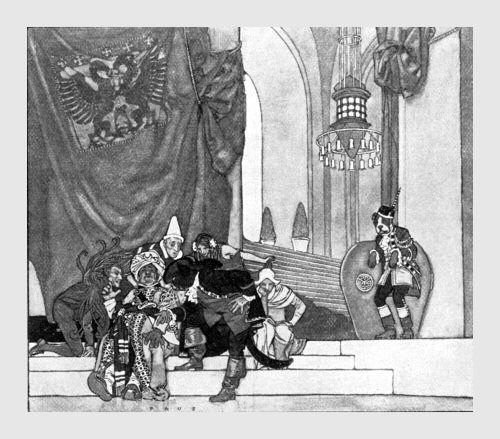

Maurice Maeterlinck was a Belgian author who won the Nobel Prize in 1911 at the age of 48--they used to give it regularly to much younger writers than has been the case recently. The Blue Bird was overall his most celebrated work, but some of his earlier plays from the late 1880s and early 1890s seem to be well regarded. In the words of the IWE, "A fairy-tale play for children is the best-known and most surely immortal work of the Belgian Nobellian. It gave the world a phrase, 'the blue bird of happiness,' and its moral is that the blue bird is to be found at home, be it ever so humble. The play is excellent for performance by schoolchildren in large schools because it offers an almost unlimited number of parts, costume parts at that. It can easily accommodate 200 performers. But it demands elaborate sets and machinery for professional performance. When it is properly produced it is quite a spectacle." Though I had not been attentive to it before, if it had ever come up at all, I have come across two instances of someone using the expression "blue bird of happiness", since I read this, including one who tossed it off in the course of ordinary speech. So I guess it is still somewhat alive.

The style of dialogue was reminiscent to me of Samuel Beckett's writing. Very spare, with a lot of exchanges consisting of each speaker uttering speeches of 1-3 simple words in turn for several pages. Maeterlinck was a proponent of what he called "the static drama", which downplayed emotion in favor of emphasizing the external forces that acted on man. Samuel Beckett certainly strikes me as having some relation to this tradition, though obviously taken to a much more relentless and unsettling extreme. 


p. 72--The Land Of Memory. The children, passing through here on their quest to find the Blue Bird, encounter their dead grandparents. "Why don't you come to see us oftener?...It makes us so happy...It is months and months now that you've forgotten us and that we have seen nobody." 


The idea of the Land of Night--diseases, fears, etc, that have largely been conquered by human knowledge--I thought was worthy of being remarked on. It is an optimistic, pre-World War I nod to progress. Although Maeterlinck lived until 1949, he doesn't appear to have written anything considered to have much literary value after the first World War, though his books still sold well in France through the 1930s.   


p. 130 I thought the catalog of the trees and their various personalities: the poplar, the birch, the chestnut, the beech, the elm, etc, was very good. The eloquence of the stark depiction of the elements of the (sensitive?) child's world, physical, cultural, emotional. I am now sure that literary and artistic minded people in our age are as attuned to this, in their own manner, as any old European writer was, but I do like this particular expression of it. 


p. 186 "Here is the Happiness of Loving One's Parents, who is clad in grey and always a little sad, because no one ever looks at him." In the Palace of Happiness, there are various Happinesses who appear as characters, among them the Happiness of Being Well, the Happiness of Pure Air, the Happiness of Innocent Thoughts, the Happiness of the Winter Fire, and on and on. I noted the characterization of the Happiness of Loving One's Parents, because I am myself guilty of not allowing myself to feel this, even though there is no reason not to other than that I have always been unhappy about my lack of talents and attractive qualities that might have given me some of the social standing and respect I would have liked to have had. But I just can't overcome that.

p. 204-5 Fire's role in death. "I am used to burning them...Time was when I burnt them all; that was much more amusing than nowadays..." "Fire, in particular, would want to burn the dead, as of old; and that is no longer done." Of course it is going back the other way now. I still personally recoil in something (can't read my note) against the idea of cremation and would prefer to be buried, but due to cost, changing mores, concern for the environment, etc, it probably will happen the other way. I don't know why the thought of being burned bothers me, especially it would eliminate any chance of my being buried without actually being fully dead, which is something to avoided for sure.


p. 246-7 This is the part where they encounter all of the babies preparing to be born. There are two of these babies, one boy and one girl, who were lovers and always embracing, and had to be forcibly separated in order to be born, never fated to meet on the earth. This was reminiscent to me of the incels, some number of whom are wont to speculate about the possibility that some potential girlfriend of theirs may have been aborted and things of that nature. Somebody I went to school with called me, or least my younger self, an incel within the last year, which I don't think was really fair, or quite accurate when considering the crowd going by that designation now, but obviously the impression was made.

I have a note here to "comment on worldviews therein ([word I can't read] of fire, bread, etc) in light of current cultural reassessment." I don't remember what I was referring to here. I should note again that during the fairy part of the story, Fire, Bread, Sugar, Water, and so on are live characters who have elaborate costumes and speak, as well as the Dog and the Cat. Apart from the Dog, who is unshakeably loyal to the humans and regards the little boy as his god, the other characters do a fair amount of complaining about their relation to and usage by man and attempt from time to time to abandon him. Overall the story does not promote an idea of struggle, but presents an idea of the world as something to marvel at and full at all times of unseen and unnoticed energies and passions and phenomena that are sources of wonder and strength, while much of what is immediately visible is crude and distracting and were best overcome. I am not sure how this relates to the current cultural reassessment, beyond that people don't seem to have time for this kind of miniaturist approach to thinking about the world and their own lives, but I really do not often have consistent ideas about anything from day to day.


There have been numerous film versions of this play, the most notable being the silent 1918 adaptation directed by Maurice Tourneur, a 1940 version starring Shirley Temple, which turned out to be the first box office flop of her career however, and an animated Soviet movie from 1970. I don't think the story has remained familiar to modern audiences however.


So with the completion of this report I have now reached the end of Volume 3 (out of 20) in the progress of this list. Volume 3 took me about 2 and a half years to complete, which is about 6 months longer than I got through each of the first two volumes. At my current pace I wouldn't be able to get through the whole list until I was 88, which is an age I am not going to make it to. These months of quarantine and having everyone home all the time have not helped this either. Still, if I can make it through a few more years, I should have more time to read these books and write these reports faster. I know there are at least a couple of very long (although very great) books coming up in Volume 4, but the first few that I see include a number of plays and very short novels, so perhaps I will be able to get back on a doable track.


The Bourgeois Surrender Challenge

1. Dale Carnegie--How to Win Friends and Influence People...............…...............16,982
2. The Words (movie-2012)..................…............................................................…...7,724
3. Mary C. Neal--To Heaven and Back...….............................................................…3,264
4. Kate Danley--The Woodcutter...........................................................................…..1,880
5. The Village (movie--2004).................................................................................…..1,327
6. Arnold Lobel--Frog and Toad Are Friends............................................................…496
7. Pamela Aidan--An Assembly Such as This..................................................................356
8. Jack London--"To Build a Fire"...............................................................….........…..128
9. Erin Hunter--Survivors (novel series).....................................................................….114
10. Colleen Coble--The Mercy Falls Collection.........................................................…104
11. Zen Cho--The True Queen..........................................................................................55
12. Patricia Marx--Him Her Him Again the End of Him.............................................…..43
13. Isabella L. Bird--The Hawaiian Archipelago..............................................................33
14. Paul Higgins--No More Bile Reflux........................................................................…28
15. Dawn Brower--One Heart to Give........................................................................…..24
16. Lara Richard--A Chance For Him........................................................................…...24

Round of 16

#1 Carnegie over #16 Richard
#15 Brower over #2 The Words
#3 Neal over #14 Higgins
#13 Bird over #4 Danley
#12 Marx over #5 The Village
#11 Cho over #6 Lobel
I own and have read Frog and Toad Are Friends, which is a children's book. I don't care for it that much, as it is a series of understated, repetitive stories in which virtually nothing happens, but my children seemed to like them well enough when I would read it to them, so I guess there is something to it.
#7 Aidan over #10 Coble
Aidan's book is Jane Austen fan fiction, it is about characters from Pride and Prejudice, etc, which is a genre of story that I am not inclined to like at all, but it has an upset.
#8 London over #9 Hunter
We have this Survivor series as well, though I have never read them. My wife tried to get one of my reluctant sons to read them a few summers ago, but I don't think he made it very far in them.


Round of 8

#1 Carnegie over #15 Brower
#3 Neal over #13 Bird
The Neal book, despite the romance novel title, appears to be a spiritual book about angels and that sort of thing. It is very short.
#12 Marx over #7 Aidan
Marx was a comedy writer for the New Yorker and Saturday Night Live. I doubt I would find her particularly funny, and would probably find her writing smug and sanctimonious--most people in this vein of the culture seem to fall naturally into this character nowadays (though this book is from 2006 at least)--but I am sure it is more endurable than Jane Austen fan fiction.
#8 London over #11 Cho

Final Four

#1 Carnegie over #12 Marx
This was a pretty close match, but the Carnegie is kind of a classic, and I have never read it, and that will carry it to a win here.
#8 London over #3 Neal

Championship
#8 London over #1 Carnegie
In this battle of publishing heavyweights, London's story wins by being even more of a classic, and one which, rather incredibly, I have also never read.  


Friday, January 31, 2014

J M Barrie--The Admirable Crichton (1902)

It didn't take me long to get through this one (it has now officially taken me more days to put up this post than it did to read the book--1/30). That is one of the beauties of generally intelligible plays. The Admirable Crichton was famous in its day, and for many decades afterwards, and the story, which concerns an aristocratic English household that is shipwrecked on a tropical island, during the duration of their confinement on which their butler establishes himself as the master of the party, remains something of a modern archetype, though much less so in the last twenty years, as the perception of the general competence of anyone stuck in the mass of the population has declined. In an earlier post I described this plot as sounding like 'Jeeves and Wooster meet Gilligan's Island', though on reading it, which I had not done before, it reminds me more of the World War II prison camp novel King Rat. It doubtless has other spiritual offspring in 20th century literature and drama.   

I had anticipated was that it would be more of a comedy. It tries to be that some of the time, but only Lady Brocklehurst, who is a less light-hearted cousin of Aunt Agatha in The Importance of Being Earnest, is at all funny to me, and she does not appear until the final act. The character of Ernest, with his foppishness and fondness for insipid anagrams, seems to be something of a spoof of Oscar Wilde himself, though it falls mostly flat because Oscar Wilde actually was funny, and at a level that Ernest does not begin to approach. The character of Crichton himself was the biggest surprise when contrasted with my expectations. There is nothing comic about him at all, and if anything he is almost unsettlingly hard. Perhaps this is necessary to illustrate how nonsensical the family and society are, but it has the effect of making the main character unlikable. The play is on the whole much darker and has a more bitter edge than the references I had seen to it in the past had led me to believe.


Is it worth reading? Well it was easy to get through (by which I really mean I had no difficulty motivating myself to read it), and I do not think it would be a chore to sit through a good production of it in a theater either. These are obviously marks in its favor. Because of the extra 100+ years of cultural conditioning that have formed me since the original appearance of the play, I anticipated it to unfold in a completely different way than it did, and for the particular emphases of the author to be different from what they were. So while I always looked forward to seeing what would happen next, what did happen next usually felt to me to be not the thing that offered the most interest or opportunity for effect. Often it simply was the case that the dialogue or the arc of the story failed to be memorable, to strike the imagination. The play at this point is not very alive for readers, I don't think, and I am guessing this is part of the reason why its fame has declined. Its sensibility is not in sync with ours.

The Challenge

The results of the last challenge (winner: Quiet, by Susan Cain) left me in a bit of a dilemma regarding whether I should really have moved on to the next IWE book or not, since by my own rules I should have tried to read the challenge book. I was able to resolve this by taking out the audiobook version from the library and listening to it in the car. My children don't like it that much, but it won't go on much longer, and I do not see myself making a habit of consuming books in this way. Quiet is exactly like dozens of other non-fiction books that have come out over the last fifteen years or so. First, its author is an extremely well-connected Ivy League graduate active at the highest levels of the Manhattan/D.C./Boston meritocracy. Second, the book centers around a single rather flimsy premise (in this case, that introverts are undervalued in the current ethos that prevails in our society's leading institutions), a greater attentiveness to which will ultimately reveal unsuspected sources of talent and potential economic productivity. Third, the author, in the name of research, makes a number of field trips to places where her thesis can be demonstrated in an extreme form--so far in this book we have been to Harvard Business School, a Tony Robbins event/revival, and Rick Warren's Saddleback Church (all of these places frown on taciturnity and reflection). Fourth, numerous important academics and scientists are interviewed and a waterfall of studies and researches are quoted from to support the author's premise (authors of this class swear by the findings of academic research). On the fourth disc the amygdala and the ways in which it responded (when possessed by an introvert) to various stimuli made its appearance. The amygdala and its activity is another staple of this genre of literature. It is an oracle of Science that people who read and write these kinds of books want to see consulted before they will buy into anything. For me it is an oracle telling me that it's time to abandon the book.

The tone of this is very much of that 'Anyone who doesn't live and work in my particular Manhattan/upper class milieu and did not go to an Ivy League school are not really identifiable to me as sentient beings' camp that has become increasing prevalent in the writing and analysis coming from this quarter of society. I actually don't think Susan Cain herself is mean-spirited, or a snob, or even intentionally condescending--it's just that people of this sort can't help themselves anymore. Any other kind of life is more or less unfathomable to them, and usually in an exaggeratedly horrible way (there was a profile of one woman who had languished too much in high school and missed out on going to an Ivy League college, which was presented as a kind of catastrophe that she had determined never to experience the equivalent of in her adult career).  This includes Tony Robbins and Rick Warren, even though both clear tens of millions a year and have provided life coaching to presidents and Nobel Prize winners. It is as if these things aren't really real, don't mean anything, if you haven't gone to the proper schools...But onto this week's results.

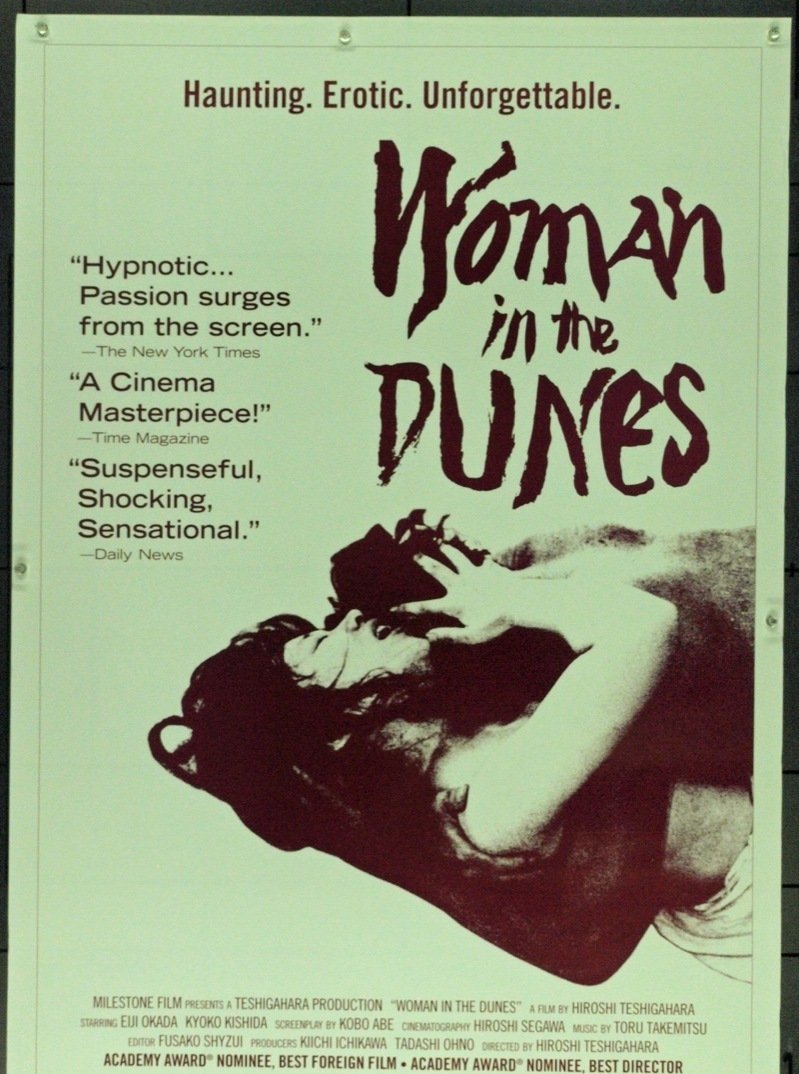
1. The Woman in the Dunes--Kobo Abe....................................83
2. Charles Dickens: A Life--Claire Tomalin................................46
3. The Life and Death of Mary Wollstonecraft--Claire Tomalin...3
4. Building For Life--Stephen R. Kellert.......................................2
5. Cricket Radio--John Himmelman..............................................1

Books in this challenge that received 0 reviews were The Mystery of Mary Stuart by Andrew Lang, The Encyclopedia of Literary Romanticism by Andrew Maunder, and Songs From the Past by He Waiata Onamata.     


A small field this week, and a winner with what I suspect will be an unusually low score in these competitions. Technically I do not have to read this book either, as my library does not have a copy and it is not available online for less than $1.00. However, as this is exactly the kind of book--it is a fairly modern (1962) Japanese novel of some literary value (of which a well-regarded film was made as well two years after it came out)--that the Challenge was designed to lead me to, I am going to bend my old rules and order a copy of it.

Till next time...


Even though I do not think her book was any good, and she is obviously much more market and media-savvy and comfortable in the company of the powerful and the great than she would like me to believe, and even though her worldview, as determined by her background and collegiate and post-collegiate experience, is so extreme that it is impossible she and I would be able to get along or talk about anything even I were to become a talented and successful person of some kind tomorrow, I admit I still have a tiny crush on Susan Cain. I guess as a reminder that I once perceived there to be chance that my life would lead into this segment of society (though only heaven knows why I ever imagined that).

Thursday, August 16, 2012

James Barrie


Will probably be remembered, as long as he is remembered, as the author of Peter Pan, though I do not have the sense that many people, either adults or children, read the original play anymore (I must admit, I have never read it myself). In addition to Pan (1904), two of Barrie's other plays were chosen for the 1958 list: The Admirable Crichton (1902), and Dear Brutus (1917) [ his ages at the publication of these books: 42, 44, & 57]. Much like Lewis Carroll, such reputation of him as survives is as a children's author who in private life had issues with emotional immaturity and dysfunctional sexual problems, though in fact he was a major figure in the adult literary, theatrical and social worlds of his time, achieving a high measure of fame and esteem during his lifetime. As such his biography is well-chronicled. His stature as an important literary figure seems to have been gradually, but steadily fading, since the 1920s. However he does remain a name, to the point that there was even a film (Finding Neverland) within the last decade based loosely on his life in which he was played by Johnny Depp; I have not seen this movie, though the previews do not strike me as particularly capturing the interesting essence either of James Barrie's life and work or of his era. But I am basing this on my own reading from and about this time, which is doubtless itself grotesquely flawed.


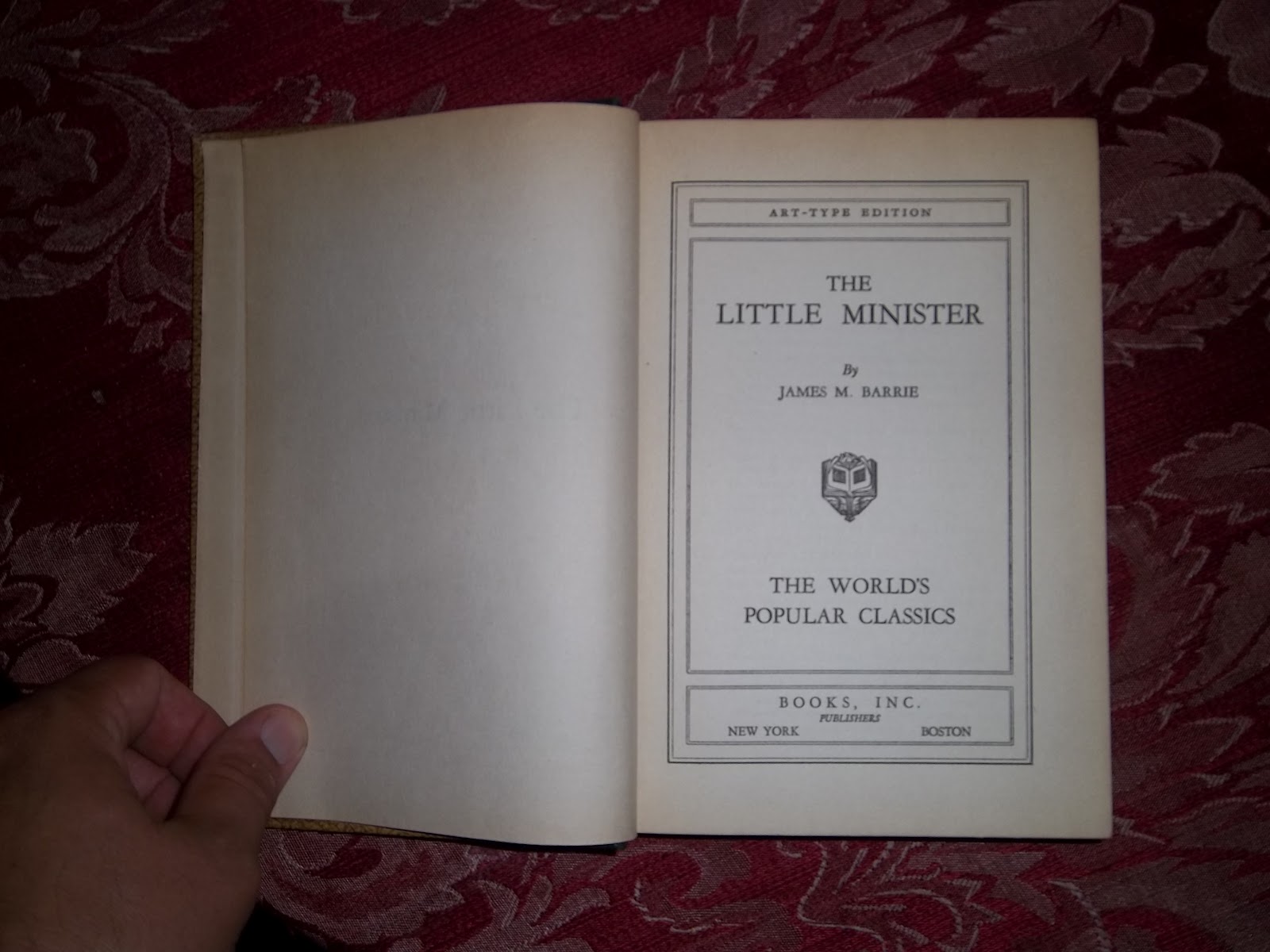
This is the only James Barrie book I own, a copy of his 1891 novel The Little Minister. I have not read it, either. It belongs to a set of "The World's Popular Classics" which my wife found set out in several boxes by the side of one of our country roads a few years and brought home, knowing I have a fondness for such collections. The set sits currently on the whatnot in the living room. The Little Minister is regarded as sentimental Victorian junk by most professional readers, but it was a best seller in its time.

I should pick up a copy of Peter Pan if I ever run across one. It still is a classic, and it is the kind of thing one of my children might pick up and read someday if they find it on the shelf. Modern children are obviously busier, or at least have more things other than books to distract them, than their forbears, so my sense actually was that this would never happen; however my oldest son has taken up and read (at fairly long intervals) Frankenstein, The Prince and the Pauper, and A Christmas Carol in this manner and he is only ten, so maybe some minor good--but here I am still assuming that reading tired old books produces some kind of valuable result, when my entire life had been one long refutation of this once widely-believed tenet..  


I have not read anything of Barrie's, though he does interest me a little, because he did manage to produce a minor classic after a sort, and because his generation of writers represent a curious time in literary as well as British history. This period when Barrie was solidly ensconced in the literary establishment, roughly 1900-1920, is among my least favorite in English literary history, as far as the writing goes; but the earnestness, the assumptions regarding the value and permanence of literature and the arts and religion and much of what might be called the entire English way of life--even if, as I believe, these were frequently unconscious and internalized--and these characteristics proving largely unable to survive World War I and the onset of modernity, nonetheless hold a high amount of fascination for me.

The Admirable Crichton is the story, now become somewhat of a cliche, of some typical English aristocrats who get shipwrecked on a desert island during a disastrous yachting outing, in which circumstances the butler Crichton is revealed to be a naturally superior man to his masters--the effect sounds like Jeeves and Wooster meet Gilligan's Island. Also like Jeeves, Crichton is assiduous in his efforts to maintain the relations proper to everyone's social positions. To believe in the necessity of this so thoroughly even when one is perfectly capable of occupying a higher station than one is born into, and to actively promote its preservation, would not seem to be logically consistent to anyone who did not grow up in a society with such a strictly delineated hierarchy. The supposed contradiction is almost always presented in these British works with the implication of being comedy, and, unlike some of the even more aristocratic cultures on the continent, which do not even seem to allow for the possibility of such a reversal of parts between master and man, it does not seem to be considered matter for concern with regard to the general health of society; at the same time, even while highlighting some of the absurdities of society as currently constituted, the idea that it should be fundamentally reorganized is never very strongly pressed either.

The (original) film version of The Admirable Crichton, made in 1919, was called Male and Female. Among its stars was Gloria Swanson of Sunset Boulevard fame. Here is a clip of it (embedding is not allowed). To those of us who lived in the days when public screenings of silent movies usually meant an ancient, filthy print of actual celluloid being run through a actual film projector, these modern restorations are so good that they barely even look real.

With regard to Peter Pan, the IWE observes that "Many reviewers have read into Peter Pan all kinds of deep symbolic intents and perhaps they are right, but also there is the possibility that its author intended it simply as a clever fairy tale for children". That's my kind of summary. While the 1953 Disney interpretation is probably the iconic one, film versions of the story are legion, and the title role has been a signature part for many legendary actresses, including the original, the great and beautiful Maude Adams, of whose performances there does not seem to be a film record however.

Many people consider the 1924 version the best of them all (Barrie was still living at this time--he died in 1937). This selection from it at nearly five minutes is a little long, but it is worth it for the dog (who comes in around the 2:50 mark), which is hilarious. I am not previously familiar with this Betty Bronson person who played Peter, but she was a babe. The girl who plays Wendy (Mary Brian) is cute too. The smaller of the boys--I can never keep Michael and John straight--has a strong resemblance, in facial expression and texture and wave, if not color, of hair, to my five year old son. Another unbelievable restoration:


Mary Martin is one of the famous actresses identified with the Peter Pan role, which she first played in her 50s. Below is the "We Can Fly" scene from her 1960 television version, which was very popular and well-received at the time.


And of course, I cannot leave out the Disney version of the same part, though even upon its original release, before a critical mass of the public realized how offensive its racist depiction of Indians was, I don't think it was considered one of their best movies. I do like the cartoon depiction of Edwardian London here. It really is the primary London of my imagination; Walt Disney was doubtless reared on all the same books I was. Cartoon Wendy has it going on too. Whoever does her voice has the Teresa Wright/Eva Marie Saint thing going on which was apparently a common way of speaking at the time, and which we can only hope might return in some form someday.


Dear Brutus was a work of Barrie's mature years, and was apparently very successful despite making its appearance in the darkest depths of World War I and being a fantasy set in a country house during Midsummer's Week (life goes on, wherever it is not completely overturned, I guess). Even in 1958 the encyclopedists noted that "it is seldom revived, perhaps because it has no one part that is sufficiently outstanding." I am always intrigued by the idea that writing and art of this sort still exists, is still welcomed, and needed, in times of grave crisis and societal upheaval, when most people's attention is directed upon grimly serious matters. I am curious about this play. The only video clip of it I can find is from a college theater production, and a recent one at that; the actors and direction I found too affected however to make it worthwhile to put up here.

Barrie was a Scot, from the town of Kirriemuir, in Angus (Forfarshire from 1700-1929), which is farther north in Scotland than most of her famous authors hail from. His birthplace, at 9 Brechin Road, is now a National Trust museum. He is buried with his parents in the cemetery here as well, though he lived continuously in London after he was 24. The closest railroad station to the town appears to be Dundee, which is about 20 miles away.

In London the statue of Peter Pan in Kensington Gardens, where Barrie, who lived in the neighborhood, used to walk his dog, is famous. Lancaster Gate and Queensway on the Central Line look to be the closest subway stops.

Here is footage of Barrie, who comes across as genuinely eccentric in this short clip, at the dedication of what appears to be the well-known Thomas Hardy statue in Dorchester in 1931.


Barrie was a degree holder (M.A.) from  the University of Edinburgh